


Today’s Read – est. 15-minute reading time
If you want to know who is draining the Great Salt Lake, farmers are an easy place to look. But that answer gets complicated fast.
Agriculture accounts for roughly two-thirds of human-caused water depletion in the lake’s watershed, much of it tied to alfalfa and grass hay grown for livestock. That makes farmers an obvious target as Utah searches for ways to keep more water flowing downstream. But an obvious target is not necessarily an obvious culprit.
Farmers are operating inside a water system Utah spent generations building — one that incentivized use and made conservation surprisingly difficult. The real question is not whether agriculture has to change. It almost certainly does. But saving the Great Salt Lake will require the rest of Utah to carry some of that burden, too.
Background
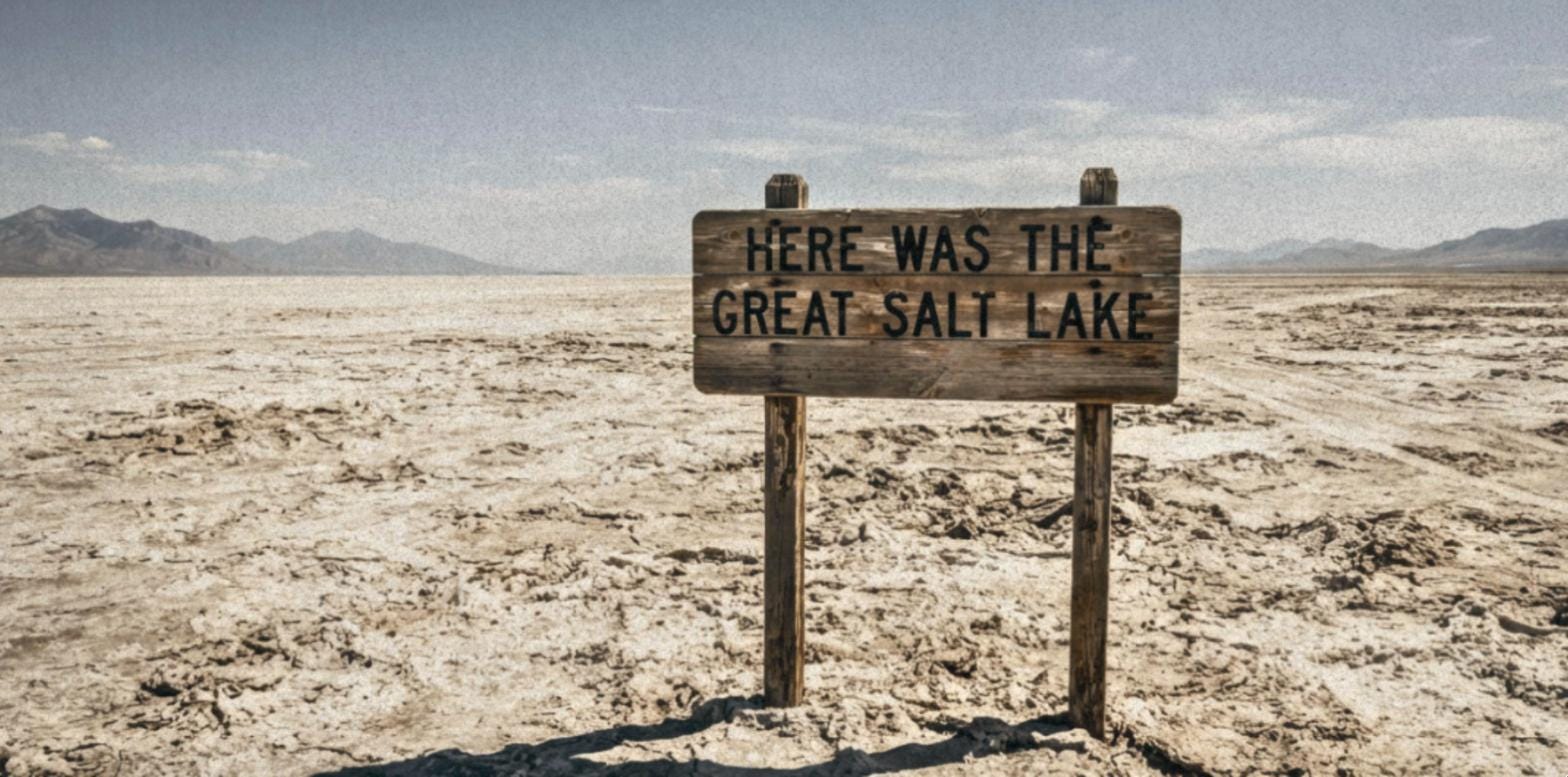
At its 1986 peak, the Great Salt Lake covered a surface area larger than Rhode Island or Delaware. Today it’s smaller than either.
Having lost somewhere between 60-73% of its historic water volume, the lake has lost more than half its surface area since Mormon pioneers first settled Salt Lake Valley. This drastic decline has captured the attention of everyone from scientists to President Trump, who posted “MAKE ‘THE LAKE’ GREAT AGAIN!” earlier this year on Truth Social.
Unfortunately, the lake doesn’t respond to social media posts — even ones from presidential accounts.
As of mid-September, the Great Salt Lake sits barely a foot above its all-time low of 4,188 feet above sea level, a record set in November 2022, and about 10 feet below the 4,200-foot mark scientists believe to be the lake’s historical average. That may not sound like a lot, but this is a very shallow body of water. Every foot drained exposes roughly 70 square miles of lakebed.
We’re not just talking about a diminishing view. The health of Utahns is closely tied to the health of the Great Salt Lake.
Of the more than 800 square miles of Great Salt Lake playa now exposed, roughly 9% — 70 square miles — is actively emitting toxic dust laced with arsenic and other heavy metals into nearby communities. Recent analysis finds this share could soon rise to 187 square miles, or 24%, if protective crusts deteriorate or groundwater levels fall.
Aside from protection from pollutants, the lake provides more than $2.5 billion in economic value, increased snowfall and enhanced snow quality, migratory bird habitats, and a brine shrimp ecosystem.
Given all that’s at stake, how did we get here? And what do we do now? The good news, ironically, is that this is a man-made crisis.
Yes, Utah is the third driest state in the nation, behind only Nevada and Arizona. And four of the past six years have been notably dry. But lack of rainfall is only a small part of the problem.
The real culprit is direct human depletion.
BYU Professor Robert B. Sowby defines depletion as “water that doesn’t return because it evaporates or is transpired by plants and is no longer liquid.” As a saline lake, direct, unreturned withdrawals are limited. Just over 7% of human water depletion is withdrawn directly from the lake itself (for mineral extraction), while roughly 93% occurs upstream or before the water reaches the open lake.
Three primary tributaries feed the Great Salt Lake. The Bear, Jordan, and Weber rivers account for roughly 64%, 21%, and 17% of lake inflows, respectively. But anthropogenic consumption claims 62% of river water before it even reaches the lake.
And one industry is clearly responsible for more depletions than any other: agriculture.
Agricultural use represents 65% of human depletions, whereas municipal and industrial (M&I) usage represents only 26%, with mineral extraction a distant third at 6%. Nowhere is this disparity more pronounced than in the largest tributary, the Bear River, where agriculture claims roughly 95% of total river depletion.
About 80% of agricultural water goes to cattle-feed crops, specifically alfalfa and grass hay. Put in perspective, cattle-feed farming alone consumes 909,000 acre-feet of water each year. That’s more than the additional 800,000 acre-feet of annual inflow per year that experts estimate will give the lake a 47% chance of reaching its minimum healthy elevation of 4,198 feet by the 2034 Olympics.
These data have driven many to the conclusion that blame for the depletion of the lake lies with farmers, and that saving it is agriculture’s responsibility. But is that fair? Or are farmers being asked to play an outsized role in solving a problem Utah’s broader system created?
What critics of agricultural water use say
Farming is clearly responsible for most of the Great Salt Lake’s water depletion
Farmers are choosing to grow uniquely thirsty crops, such as alfalfa and grass hay
Farmers may not always be employing the most efficient irrigation methods
Some researchers indicate that the lake simply cannot be saved without significantly reducing how much water is used by agriculture.
One study, published in the journal Environmental Challenges, is unambiguously titled “Reducing irrigation of livestock feed is essential to saving Great Salt Lake.” One of its authors clarified the import of reducing agricultural depletions.
“You can’t get the volume of water that you need to save the lake in any other way, other than substantially reducing how much water is going towards those cattle-feed crops,” said Brian Richter, president of Sustainable Waters and a lead author of the study.
According to Eric Ewert, chair of the Department of Geography, Environment & Sustainability at Weber State University, alfalfa and grass hay are simply not suited for Utah’s arid climate.
“There is one paradigm-shifting scenario that quickly and easily refills the lake and replenishes all the ecological and economic benefits it bestows upon us: Stop growing alfalfa. We could have all the water many times our current population could ever need by simply transitioning away from a non-native thirsty crop that never belonged in the desert in the first place. . .
“Protected by senior water rights, generous subsidies, loyal politicians, and the cultural iconography of a family farm, hay growers aren’t going to just give up their businesses. Instead of another posturing tax cut . . . let’s spend that money and more to transition hay and alfalfa farmers to some other livelihood. This would be millions cheaper than the costs and lost revenues of the environmental apocalypse a dead Great Salt Lake will bring.”
Matt Yost, a Utah State University irrigation specialist, has highlighted room for irrigation improvements.
“We’re finding that we can reduce consumption of water by probably 10-15% without affecting crop production. And most of that comes from reducing evaporation — that’s the major way we lose water that we can’t get back,” Yost said. “And if we do that across the board, we estimate we could send nearly 180,000 acre-feet of water [a year] to the lake without affecting crop production.”
What farmers and agricultural advocates say
Farmers are actively doing more to reduce their usage than other industries and users
Structural incentives are partially to blame for agricultural share of water usage
There’s no certainty that water saved by farms will reach the lake
Clay Carter, Cache Valley farmer and irrigation-tech company owner, explained how farmers are already doing their part to conserve resources.
“Farmers are maybe some of the best conservationists in the country and they seldom get the credit for it.”
He described cutting his water use in half through automated irrigation tech and framed the lake’s decline as a slow-building, decades-long problem rather than one farmers alone created: “You’re talking twenty years of drought that have created this problem. It may take us twenty years of finding and deploying solutions to get to a viable and working solution.”
Though efforts to reduce water depletion are now well underway, farmers have historically been incentivized to “use it or lose it.”
Devin Stein, then research associate at Strata, a policy research center in Logan, and Randy T. Simmons, who directed the Institute of Political Economy at Utah State University’s Huntsman School of Business, highlighted this in an op-ed long before efforts to improve the system were implemented.
“Irrigation water, for example, makes up the vast majority of water used in the state, but agricultural water users have no incentive to conserve because of ‘use it or lose it’ provisions in the Utah Code that threaten to take their water rights if they do not use every last drop. Many farmers still use inefficient irrigation techniques because more efficient irrigation systems that use less water may force farmers to give up their unused water rights without being compensated.”
Since 2020, Utah has steadily rewritten its water laws so farmers can lease water temporarily without losing their rights, starting with a law that authorized water banks. Most recently, lawmakers created a state-funded program to pay farmers market rates to lease water to the lake.
However, there’s no way to ensure returned water ultimately reaches the lake.
Shawn Regan, senior fellow at the Manhattan Institute, explained why returning water to the lake can be so challenging.
“Much of the water in the Great Salt Lake basin moves through a network of canals maintained by irrigation companies — collective entities that deliver water to individual farmers and depend on sufficient flow to serve all their shareholders. If one user leases water out of the system, canal flows can drop enough to make delivery to downstream users unreliable or even impossible. In practice, that means that many leases require cooperation not just from individual farmers but from entire irrigation networks.”
And even Rep. Casey Snider, who sponsored much of Utah’s water legislation, confirmed there’s presently no way to guarantee water savings benefit the lake.
“There isn’t absolute assurance that the water that’s being saved is going to make it to the absolute end of the ditch, which is the Great Salt Lake.
“I believe that it is, but I can't tell you with perfect certainty that it is.”
My take
Agriculture will need to do the heavy lifting to substantially reduce depletions — but it shouldn’t be solely responsible and can’t do it all
Government is responsible for Utah’s water and will ultimately need to create a system that incentivizes and enables water savings
A multipronged approach is required to save the Great Salt Lake
Farmers and conservation
The data is unambiguous: Two-thirds of human-caused depletion comes from agriculture, primarily to support alfalfa and grass-hay production. No one disputes that, including farmers. And no serious restoration strategy can succeed without doing something about this driver.
However, alfalfa’s reputation as uniquely thirsty lacks nuance. As a crop, alfalfa only requires more water per year than other common crops — such as corn or wheat — because it’s a perennial, giving it an extended growing season. That extended season is also what makes it flexible. According to Utah State University Extension, farmers can stop irrigating alfalfa “at almost any point in the season without causing long-term damage.” This resilience makes it an ideal crop for farmers leasing water — or looking to return water to the lake.
Nor is switching crops a simple swap. Moving from alfalfa to other specialty crops can require entirely new planting and harvesting equipment, storage infrastructure, and specialized labor — a steep cost for any operation.
“Solving” the agricultural depletion driver is more difficult than acknowledging it.
Even if compelled to do so, Utah farmers cannot simply stop irrigating these cattle-feed crops and walk away completely: If protective vegetation disappears, exposed fields can lose soil health, attract invasive weeds, and, ironically, become sources of windblown dust. To avoid this, an intensive and actively managed transition would be required, introducing new and potentially long-term land-management obligations.
And if farmers in Utah’s Great Salt Lake basin walk away from cattle-feed production, which basin does it relocate to? Would the already overallocated Colorado River Basin pick it up? Can Central California, where groundwater pumping has made parts of the land sink by more than 25 feet, ramp up production? Would Idaho, where groundwater pumping along the Snake River has been curtailed due to overuse, eagerly plant more crops? Or perhaps enterprising farmers might want to use water from the rapidly depleting Ogallala Aquifer.
Farmers grow crops because they’re in demand. And there simply aren’t any perfect options.
Of course, not all Utah farmers would need to cease operation or transition to something else. A previously referenced study found “that the most potent solutions would involve a 61% reduction in alfalfa production along with fallowing of 26-55% of grass hay production.” Nevertheless, this is still substantial and would require either significant government intervention or a complete market collapse.
As someone with years of experience working in and around Utah politics, I’d say the odds of the state paying farmers to shut down their cattle-feed operations entirely are roughly in line with the odds of the Jazz winning a championship next season. The more feasible path is to enhance conservation efforts and ensure efficiency gains actually make it to the lake.
Saving the lake is in farmers’ interest, too. Lakebed dust can threaten cropland, while a smaller lake could weaken lake-effect precipitation and snowpack. Mar Chiquita and Lake Urmia offer cautionary examples.
The data indicates Utah’s farmers have already been working to reduce water usage. Since 1989, agricultural water use has decreased in both absolute and relative terms. Meanwhile, alfalfa and hay yields have risen over the past 36 years, with alfalfa rising 16% and “other-hay” rising 47%. Greater yields combined with falling water use implies greater farm-level water efficiency.
Over the same period, water used for M&I purposes has risen. Overall, there has been nearly a 14% increase in total depletions. Agriculture can only do so much on its own.
That certainly doesn’t mean farmers don’t have room to improve. Thirty-two percent of irrigation in the Great Salt Lake watershed is wheel-line irrigation, a system that releases water 5-to-6 feet off the ground, making it vulnerable to evaporation.
Certain modern pivot technologies can improve irrigation application efficiency by 10-30% compared with conventional mid-elevation spray systems. Unfortunately, that doesn’t substantially help the lake. Efficiency gains don’t translate one-for-one into additional water for the lake. Some of that water stays in the watershed.
Utah’s latest analysis estimates that converting to more efficient systems reduces depletion by only 1-4% on affected fields — and even that conserved water must be legally protected and shepherded downstream to reach the lake.
This highlights the problem many farmers have already raised: Even if farmers maximize their conservation efforts, will it actually help?
Systems and government
The Great Salt Lake Strike Team notes three things that must be implemented to ensure farmers’ efforts don’t go to waste.
Officials must actively measure how much water is saved since only provable savings can be rerouted to the lake instead of just being reallocated elsewhere.
Farmers need a way to sell or lease water without losing their rights permanently.
And third, returned water needs to actually make the trip downstream to the lake without being used up elsewhere along the way.
Without all three of these components in place, farmers’ efforts will have limited impact. Ultimately, responsibility for the systems and infrastructure to save the lake rests with the state.
Frankly, it always has.
Water in Utah belongs to the public, but individual water rights do not. The state administers our precious public resource, meaning it regulates, appropriates, and distributes the use of water. Decisions regarding rights, infrastructure, and pricing — made over multiple decades, by our state government — ultimately led us to where we are now.
Farmers — like residents, municipalities, and everyone else — are simply responding to the incentives and resources made available to them. The state historically encouraged farmers and other users to develop and consume water by granting valuable rights based on beneficial use, threatening unused rights with possible forfeiture, and subsidizing dams, canals, and other infrastructure through tax exemptions and low-cost financing.
In other words, the state had built a machine whose product was water usage. Now, according to Emily Lewis, University of Utah’s S.J. Quinney School of Law professor, the Utah Legislature has passed dozens of bills that have “totally modernized its water law.” Agricultural efficiency grants, water meters, tiered municipal rates, turf-removal rebates, and water leasing are all components in the state’s revised suite of tools.
Not only has water law been modernized, the state is now putting meaningful money behind conservation efforts. In 2022, lawmakers put $40 million into the Great Salt Lake Watershed Enhancement Trust to facilitate water leases for the lake. This year, they created the Great Salt Lake Preservation Program and set aside $2.75 million to lease water from farmers. Farmers can now lease for part of the season or, on a rotating basis, a full season, and get paid to leave some fields unwatered while still retaining water rights.
The legislature has also empowered the State Engineer to order leased water past diversion and impoundment structures, legally prohibiting its diversion and requiring managers to treat it “as if the water was naturally flowing.”
It remains to be seen whether the machine has been sufficiently retrofitted, but the revised end product should be a healthier Great Salt Lake.
A team effort
For the average Utahn, it’s tempting to think that Great Salt Lake restoration efforts are someone else’s problem. How much of an impact can one household have?
Individually, not much. But in aggregate, a lot. Although data hasn’t been published since 2015, Utah previously had the second highest residential water-usage rate in the nation, behind only Idaho. Most residential water usage occurs outdoors, keeping lawns and landscaping alive.
Outdoor usage is particularly wasteful because, while indoor water enters sewer systems and returns to watersheds as treated effluent, outdoor deliveries evaporate. Almost 97% of M&I depletions were driven by outdoor watering.
As Utah’s population grows, more parks and beautification efforts are required. New developments, city landscaping, universities, and other large institutional developments all maintain significant areas of urban or suburban turf. That’s likely why these depletions increased a whopping 60% between 2000 and 2024.
Are your sprinklers set to go off in the middle of a summer day? Do you think maintaining your lawn is crucial but wonder why farmers continue producing alfalfa given its relatively small contribution to our state’s GDP? If so, consider you may be part of the reason overall depletions continue to rise even as agricultural depletion falls.
Former Great Salt Lake Commissioner Brian Steed pointed out that every water user has a role to play in watershed conservation. “Humans do have an impact on this lake, and yes, our choices do matter.” The choices you and I make are just as necessary in determining the long-term trajectory of the lake as any farmer.
Conclusion
The debate over the depleting lake can easily become a search for the right person or industry to blame. That tendency is hardly unique to water policy. The digital age we live in is long on debate but short on substantive solutions. It demands individuals “stand on the right side of history,” but taking a side isn’t the same as taking action.
This isn’t a time for name and blame. It’s time for action.
The lake won’t be saved by identifying the proper villain. It will be saved by every Utahn deciding what they can do now, within their sphere of influence, to reduce depletion — and then doing it.
The Great Salt Lake’s levels have been retreating, but Utahns can’t afford to. This problem sits downstream from countless decisions, made by countless people over countless generations. Reversing that trajectory will require the same of us — countless decisions, made by countless people, starting yesterday.
A note from the editor
If you're wondering how you can actually make a difference within your “sphere of influence” when it comes to saving the Great Salt Lake, I was too. So I did some research and found two fairly impactful ways to get involved besides watering your lawn less.
Help pay for water that goes to the lake. The Great Salt Lake Watershed Enhancement Trust leases water from farmers and other water users and sends it downstream to the lake. It takes gifts of any size through the Community Foundation of Utah.
Ask your city to join in. When you water your lawn less, the water you save doesn't automatically end up in the lake. It usually stays with your water provider. This spring, Salt Lake City and Sandy became the first cities to change that. They committed 2,500 acre-feet of conserved water a year to the lake for up to a decade.
If your city hasn't done something like this yet, a friendly note to your city council or water district is a great place to start. Most of them have never been asked.
Think we got this one wrong? We want to hear about it.
The sharpest reader responses may end up in a future article.

I think this is a great article. Appreicate the factual and fair tone on an important issue. I will say, after reading, I was still confused about why water conserved might not reach the lake. I had to ask Chat GPT to explain that to me and make me a graphic. Might be a helpful figure to add for those of us unfamiliar with the water usage of farmers
At the very least, legislators should sponsor a bill that ensures alfalfa grown in Utah is used in Utah. Many farmers grow alfalfa as a cash crop and sell it for use overseas or in other states. There could even be tax incentives to help those farmers switch to more water-efficient cash crops.
https://www.sltrib.com/news/environment/2023/03/16/should-utah-be-exporting-its/