


At the Plum, we seek to be a source of news that Utahns can trust, no matter their political orientation. Last week when we asked your political affiliation, 182 of you answered: 47% unaffiliated or independent, 25% Republican, 24% Democrat, 2% another party, 3% preferred not to say. We’ll keep monitoring those numbers as we grow.
Next week we’ll be sending out a breakdown of Utah’s two ballot measures Amendments A & B.
Today’s Read – est. 16-minute reading time
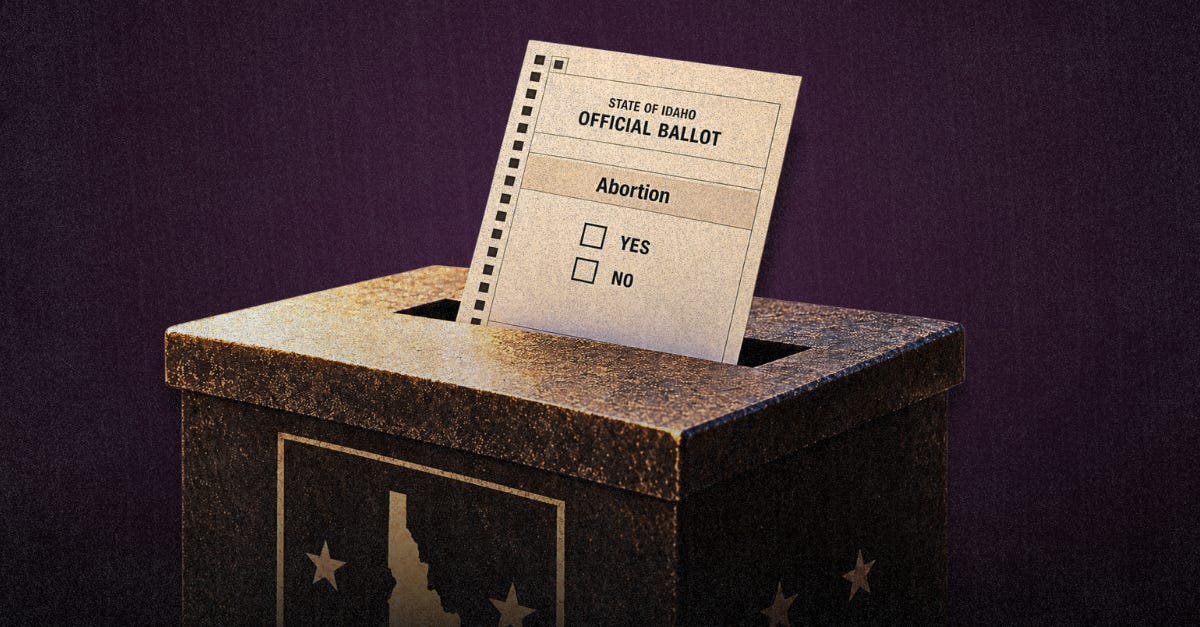
In Idaho, the fight is heating up over Proposition 1, a November ballot measure that would replace the state’s near-total abortion ban with broader protections for abortion up until fetal viability, including elective abortions.
The Church of Jesus Christ of Latter-day Saints has weighed in, sending a letter to be read in congregations throughout Idaho.
What the Church’s letter said
In a letter dated Sept. 16, the Church’s U.S. Central Area Presidency stated the institution’s opposition to Proposition 1:
“An initiative called the Idaho Reproductive Freedom and Privacy Act will be on the November ballot seeking to amend Idaho state laws related to abortion. The Church opposes this initiative,” the letter said. “Our long-held stance on abortion remains clear and unchanged.”
Church leaders then went a step further, encouraging Idaho members to oppose the measure as well.
“We join with other like-minded individuals and organizations working against this initiative and encourage our members to voice their opposition to it in a respectful manner consistent with prophetic direction of always demonstrating Christlike love and civility in political discourse.”
A few days later, the Church sent a similar letter to congregations in Nevada where residents will be voting on a constitutional amendment protecting abortion rights.
The move is particularly significant in Idaho where 14% of Idahoans self-identify as Latter-day Saints, and the Church reports about 483,000 members. Some are predicting the Church’s message could matter at the margins if the vote is close.
The LDS Church has long opposed elective abortion, while recognizing limited exceptions for rape, incest, serious threats to a mother’s life or health, and certain fatal fetal conditions. That position is more progressive than Idaho’s current near-total abortion ban, but more conservative than Prop. 1’s broader abortion protections.
Idaho’s law leaves little room for medical exceptions
Idaho’s abortion ban is among the strictest in the country. The 2020 Defense of Life Act bans abortion in nearly all cases. The law does not punish the pregnant woman for obtaining an abortion. Rather, it places legal responsibility on any doctor who performs one outside the law’s exceptions.
Doctors may intervene when an abortion is necessary to save a mother’s life, and the law includes limited exceptions for rape or incest. However, if a pregnancy threatens severe or permanent damage to a woman’s health, her doctor cannot legally end the pregnancy. The same is true if a fetus has a condition that makes survival outside the womb impossible.
Republican lawmakers, who hold a supermajority in Idaho, have revised the law before. In 2023, they clarified that doctors would not be penalized for treating miscarriages or certain pregnancy complications involving accidental or unintended fetal death. The law also made clear that treating an ectopic or molar pregnancy is not considered an abortion.
Since then, however, further changes have stalled.
Why the Idaho legislature isn’t passing wider abortion exceptions
“I don’t think our law reflects the general consensus of Idahoans, and it’s just because of a small number of people, a very small number.”
— Sen. Jim Woodward, R-Sagle
Idaho is overwhelmingly Republican, but its GOP is divided between more traditional conservatives and a harder-right activist wing that has gained influence over local committees and the state organization. Local party groups regularly censure Republican lawmakers, and the state party has published platform ratings that count some votes as “violations” when they conflict with party positions.
Abortion has become one of the clearest tests of that divide. At the 2022 state GOP convention, delegates rejected a proposal to add a life-of-the-mother exception to the party platform by nearly 4 to 1. More moderate Republicans warned that the position went further than many Idaho voters — including many Republicans — were willing to go, but they lost that fight. The 2026 platform says personhood begins at fertilization, and the party’s priorities call for protecting unborn children “without exception,” including in cases of rape, incest, and serious fetal anomalies.
Republican leaders have repeatedly blocked efforts to broaden the law’s exceptions. In 2023, the Idaho GOP party chair helped derail a bill that would have loosened abortion restrictions by sending a statewide email urging Republicans to oppose it; the committee chair pulled it from the agenda the next morning. Two years later, Senate Republican leaders again limited debate, allowing an exception bill to be introduced but not given a full public hearing.
All these moves sit well to the right of much of the public. Boise State polling found that nearly two-thirds of Idahoans — including 41% of Republicans — supported broader exceptions. But inside Idaho’s GOP, departing from the party line or attempting compromise is politically costly.
The ban has coincided with a sharp contraction in maternity care: The state lost 35% of its practicing obstetricians between August 2022 and December 2024. Of those who remained, many are concentrated in just a handful of counties. The law has also complicated emergency care, with doctors describing treatment delays and out-of-state transfers, all against the backdrop of 14 Idaho counties classified as maternity-care deserts.
The creation of Prop. 1
As frustration over the 2020 ban continued to mount and fixes languished in the Legislature, some Idahoans decided to bypass the Legislature by gathering 110,000 signatures to put the question directly on the ballot. The initiative’s authors went beyond medical exceptions, though. Their stated goal was to restore Idaho abortion policy to something closer to the pre-Dobbs status quo.
In early 2025, before Prop. 1 was on the table, polling suggested that most Idahoans occupied the middle. They wanted abortion restricted, but not as rigidly as current law. By late 2025, about 6 in 10 said they would support Prop. 1.
What supporters of Prop. 1 say
Repeated failures to even hear bills expanding maternal-health exceptions helped drive voters to pursue Prop. 1 themselves as a way to force the Legislature to act.
Idaho’s current ban has caused hardship for women, families, and doctors, while lawmakers have repeatedly failed to advance broader medical exceptions.
Sen. Melissa Wintrow, D-Boise, told The Plum that lawmakers had repeatedly failed to get exception bills even a hearing in the statehouse.
“For years there has been great conflict and fighting about reasonable exceptions for the health of the mother, to the point that bills were drafted but couldn’t get a hearing in a committee. I think it’s because the religious organizations probably have such a hold on some of the legislators that they wouldn’t hear these bills. And therefore, as I indicated, the people took it into their own hands and said, ‘We are going to put it on the ballot, and we’re going to make the decision and guide the legislature.’ I would hope the legislature, if that ballot initiative passes, that they would respect it and not overturn it.”
Melanie Folwell, executive director of Idahoans United for Women & Families, the group behind the Idaho Reproductive Freedom and Privacy Act (Prop. 1), told The Plum that the current ban has already caused “incredible hardship.”
“We would welcome any and all relief for the women and families and healthcare providers in Idaho. Here’s the truth: For four years, four legislative sessions, our lawmakers have heard from those women and their families and doctors. They have heard about circumstances that would break anyone’s heart. They have heard about the harm caused by the ban. They have heard the ways that the ‘exceptions’ that do exist are completely unworkable. They have heard, and no one in the building, in a majority, has had the courage to actually make changes.
“There have been many bills behind the scenes that were drafted to add in health exceptions. Idaho is one of only five states with no exception for health of the mother, one of only 12 with no exceptions for fatal fetal diagnosis or doomed pregnancy, and it has caused incredible hardship. It is why we are seeing so many women leaving Idaho and going to Utah. The laws in Utah are just more compassionate and recognize that in a pregnancy there are hundreds if not thousands of things that can and do go wrong.”
What opponents of Prop. 1 say
The medical exceptions in the current law are already sufficiently clear and should remain narrow.
Idaho’s abortion restrictions are a higher medical standard that requires doctors to treat the unborn child as a second patient.
In a statement to The Plum, Blaine Conzatti, president of Idaho Family Policy Center said the law is sufficiently clear about medical exceptions.
“According to the Idaho Supreme Court, these abortion laws are clear, understandable, and legally sound. In the landmark case Planned Parenthood Great NW v. State (2023), the Idaho Supreme Court found that any physician — and even any ‘person of ordinary intelligence’ — should ‘unquestionably understand’ what care a physician can provide under our state abortion laws. …
“We don’t support abortion exceptions when a pregnant mother is struggling with mental health. Abortion is never a valid form of psychiatric care. Women struggling with mental health need treatment, not the enduring trauma that inevitably accompanies the unnecessary death of her preborn child. Likewise, while we support an exception for medically necessary abortions, we don’t support an exception for abortions in cases where a pregnant mother could receive other medically necessary care that would stabilize her and enable the pregnancy to continue. And even in cases where an abortion is necessary, doctors should still do everything possible to treat the preborn baby as a patient deserving of care and dignity.”
David Ripley, executive director and founder at Idaho Chooses Life, described the medical environment since passing DOLA (Defense of Life Act) as a period of transition to a higher standard of medicine.
“They (doctors) do not want to be held accountable to a higher standard of medicine, which is what DOLA imposes. It requires them to treat the baby as a second patient, regardless of their political agenda or their personal feelings in the matter. … In the OB/GY specialty, we have to always bear in mind that we are still in a cultural shift, a legal shift of huge proportions. Every single one of the people practicing in that specialty were trained under the Roe era. They were trained that abortion is part of the tools in the kit and was at best morally neutral, if not morally good. They were trained to look at the baby as ancillary to their primary mission, which is to take care of that woman. … That’s part of what the fight that we are having right now in Idaho is: We are trying to impose a higher standard of care, and there’s a lot of resistance to that because we have people in the profession who were trained under a different regime, and in fairness to them, that’s a difficult transition.”
What different Latter-day Saints say about the Church’s letter in opposition to Prop. 1
Rep. Sonia Galaviz said the letter failed to acknowledge the circumstances that led to Prop. 1, including the gaps between Idaho law and Church guidance.
Merrilee Boyack said the Church’s opposition provided welcome clarity for members who see Prop. 1 as a threat to the sanctity of life.
Colin Nash said the Church could have opposed Prop. 1 while also pressing Idaho leaders to address the law’s medical gaps and the hardships facing women.
In speaking with The Plum, Rep. Sonia Galaviz, D-Boise, called the letter a heartbreak and said she felt like it omitted the most important part of the conversation.
“It was heartbreak because it felt like it was missing the largest part of the conversation about what brought us to this point. I know I’ve said that multiple times. Why did there have to be an initiative to push the conversation forward? What have the last four years been like for women in Idaho and for doctors? And if we had recognized what brought us to this point, even a mention in the letter that the Church does not support the existing Idaho statute, or even recognizes that Idaho statute needs to do better to accommodate health of a mother, and just bring it into alignment with the Church’s guidelines, or cite the Church’s guidelines as an example of how we can accommodate the health of the mother. Anything to recognize the complexity of what brought this moment forward.”
Merrilee Boyack, development director for Latter-day Saints for Life, a pro-life organization, said she welcomed clarity from Church leaders.
“I think it’s really important that The Church of Jesus Christ of Latter-day Saints issued the letter because I think it’s very clarifying for the saints that live in Idaho,” she said. “We have many members in Idaho who have been talking about it, and we’ve all just been waiting for this.
“The Church has been very clear that the sanctity of life is a fundamental doctrine of the Church, and this is very much threatened by this proposition.”
Boise City Council member and former Idaho legislator Colin Nash, a Latter-day Saint who plans to vote for Prop. 1, said he was disappointed the Church did not go further in addressing the concerns facing Idaho women.
“I don’t fault the Church for restating its long-held position on abortion. But I believe it missed a critical opportunity to do more for Idaho mothers. …
“I don’t expect the Church to support Proposition 1. I do expect it to speak to the painful realities Idaho women face. And I hope it will call on Idaho’s leaders, many of them fellow Latter-day Saints, to fix the broken law that gave rise to this citizen-led ballot measure.”
A quick note from Erica before her take
This issue is charged enough that I need to be up front about where I’m coming from.
I’ve lived in Utah for more than half my life, about 30 minutes from Idaho. I have family in Idaho. I visit often, and I care deeply about the state. Politically, I often vote conservative, but not automatically. I care more about whether someone has integrity than whether they agree with me on every issue. I believe good policy should be both compassionate and grounded in evidence and that elected officials have a duty to represent their constituents even when doing so requires setting aside their own preferences.
I’m also a Latter-day Saint. I believe Church leaders are inspired, but not infallible or immune from political pressure.
I have four children, and pregnancy was hard on me physically and mentally, even though I was never considered high-risk. Those experiences changed how I think about pregnancy, risk, and how much control the government should have over medical decisions.
I have long considered myself pro-life. Before Dobbs, I assumed that position still left room for doctors and families to make difficult decisions when a pregnancy became dangerous. I was wrong about how simple that would be.
So I come to this debate opposed to elective abortion, but far less comfortable with politicians trying to write one rule for every pregnancy, emergency, and family.
As a Utahn trying to make sense of what’s happening in our northern neighbor, here’s where I land.
My take
Prop. 1 is voters’ response to years of GOP leaders choking off debate over abortion exceptions.
This citizen initiative is a way for voters to take some of that power back.
I’m still pro-life, but I now think Prop. 1 may be the pressure Idaho needs to get to a better law.
I thought this story was going to be about the Church’s letter. It isn’t — at least not entirely.
The deeper I looked, the more the letter became just one piece of a larger story about power inside Idaho’s Republican Party. Over and over, I heard that the Legislature had failed Idaho women. But the reality is more troubling. Most lawmakers have never even had the chance to meaningfully engage in the debate. A small number of powerful GOP leaders, some of them unelected party officials, have repeatedly controlled whether proposed changes advance at all. Bills to revise the abortion law have been stopped before reaching a full floor debate, leaving most legislators without the opportunity to argue the merits or cast a vote.
Prop. 1 is voters’ chance to force the issue, and its growing support appears to have rattled lawmakers who are used to operating in one of the country’s most reliably Republican states. Which seems to be why the Church was drawn in.
The disturbing dynamic in Idaho politics
Idaho’s Republican Party has too much power, and too often it is using that power to police elected officials instead of letting voters do the job. The situation is alarming. If I lived in Idaho, I would feel like my vote had been negated by people I never elected. Left unchecked, that concentration of power risks pulling Idaho toward a more authoritarian style of politics, where power increasingly flows downward from party leadership rather than upward from voters.
Representative government is supposed to mean citizens choose lawmakers to represent them. In Idaho, Republican legislators are also being asked to prove loyalty to a party platform that increasingly functions like a creed. Stray from it, and local committees can censure you, withdraw support, or try to strip away your standing as a Republican.
That is not healthy party discipline. It is a system that punishes lawmakers for responding to the people who actually sent them to Boise.
The same pressure hangs over Idaho’s abortion debate. A handful of powerful gatekeepers have frozen the Legislature on this issue.
“We have had four legislative sessions to solve this problem, and we couldn’t,” said Rep. Galaviz, D-Boise. “The bottom line is, we were unable to do the work that was necessary to protect our women, and so, in absence of our ability to be able to thread the needle with all the stakeholders, it became the citizens’ right to bring a ballot initiative forward. So we are now charged with answering that request from Idaho citizens.”
The way this has played out, I think it’s high time Idaho voters raise the stakes.
Prop. 1 creates a counterweight to the extraordinary amount of control party and legislative leaders have exercised over the abortion debate. Gatekeepers can keep a bill off the legislative calendar. They cannot keep a statewide citizen-led initiative from becoming a statewide conversation. Now the debate is happening on doorsteps, in coffee shops, at school pickup and in church parking lots. The issue is proving far less settled than party leadership has treated it.
If the initiative passes, GOP leaders have vowed to repeal it, but the harder-right among them would no longer hold all the cards. They could either live with a much broader abortion law or pull up a chair and negotiate something narrower with the other Republicans and Democrats in the Legislature.
More moderate lawmakers would have new leverage. Now they could block any amendments to Prop. 1 that they deemed too extreme and negotiate for a ban-with-exceptions plan that better reflects their constituents.
GOP leaders may have pressed the Church to weigh in
The Church’s letter seemed to drop into the middle of an already complicated debate. It was devoid of any nuance or understanding for the people of Idaho. Some members have since said they wished the Church had either stayed out of the fight or said more about what a better alternative to Prop. 1 might look like.
Why it chose this particular moment and this particular message is harder to know. The Church did not respond to The Plum’s request for comment, and anything beyond the letter itself requires some speculation.
Sen. Jim Woodward offered one possible explanation in a brief interview. He believes some of his Republican colleagues may have sought an explicit statement from the Church opposing Prop. 1. We have not been able to confirm this, and it is a significant claim. But if he is right, it would help explain the letter’s narrowness: It opposes Prop. 1 and reiterates that the Church’s abortion policy has not changed, without addressing Idaho’s years-long fight.
Even if no one did ask the Church to intervene, I can easily understand why Church leaders might have felt that weighing in was the proper moral choice. From outside Idaho, the request could easily have looked straightforward. The ballot initiative would substantially expand abortion rights, and the Church opposes elective abortion, full stop.
But as Idahoans know all too well, this fight is far more complicated than that.
I nearly made a similar mistake while writing this article. My first draft focused only on the abortion issue. Then, while I was talking it through with my husband, he made a simple observation: “Living in Utah, we tend to think Idaho is just like Utah. It’s not. Some of their Republicans are super extreme.”
That sent me back into the reporting, including a deep dive into Idaho politics. What I found was a far more complicated political story than I expected.
How would I vote on Prop. 1?
This debate has pushed me harder than I expected. It has forced me to confront how far lawmakers are willing to go to micromanage abortion access, even in situations involving serious medical risk. But it has also strengthened something I already believed. Abortion is not only about ending a pregnancy. In my view, it also ends the life of a child.
Supporters of Prop. 1 often argue that pregnancy decisions belong to a woman and her doctor, not the government. I understand the appeal of that argument. But privacy has limits when another life is at stake. We learned something similar in the long fight over domestic violence, when abuse was too often treated as a private family matter and government intervention was seen as an intrusion. That deference did little to protect women and children.
I cannot look at abortion as purely private for the same reason. Before Idaho’s ban took effect, roughly 1,500 abortions were reported each year. I cannot shrug at that number simply because those decisions happened behind closed doors.
At the same time, being pro-life cannot mean being indifferent to what happens to women. If we are going to insist that the unborn child matters, then the mother has to matter just as much. Idaho’s law should make room for serious threats to a woman’s health and for fatal fetal conditions, and then trust doctors to use their medical judgment in good faith.
I have made my peace with Prop. 1, not because I agree with everything in it, but because I now understand why it exists. I see it as a practical way to push back against the top-down control Idaho GOP leaders have exerted over the Legislature.
In particular, I appreciated this insight from Rep. Galaviz: “We need to be careful of creating an artificial dichotomy, that it’s either yes or no, and it’s as simple as that.”
Referring to Prop. 1, she continued, “We know it brings forward a conversation of every nuance, every specific example, every exception that could possibly come forward. So I want to recognize the complexity of the issue and that we live in a very conservative state, but we also care deeply about the health of our mothers. We’ve got to be able to do hard things together. I feel good about the proposition because people want a solution. They want us to be able to figure this out, and that is our charge as legislators and representatives of every district in Idaho.”
So I’ve ended up in a place I did not expect.
I am still fiercely pro-life. I still have real concerns about Prop. 1. But if I were voting in Idaho, I think I would vote yes.
Not because I think Prop. 1 is the law Idaho ultimately needs. I’d want a narrower, better law — one that protects unborn life while giving women and doctors more room to navigate serious medical complications.
I just no longer believe Idaho’s current political system will produce that compromise unless voters force the issue.
Think we got this one wrong? We want to hear about it.
The sharpest reader responses may end up in a future article.

Thanks for this piece Erica! I'm always trying to be less black and white about issues and I appreciate other people doing the same. But I have a few questions for you below.
Besides the fact that you've just shown that the corruption in Washington DC spreads among all other Red States as well. The Church besides controlling your life, also wants to make your choices for you and how to live it. Certainly seems to have cultish similarities to me. Let Idahoans decide for themselves if you dare.