


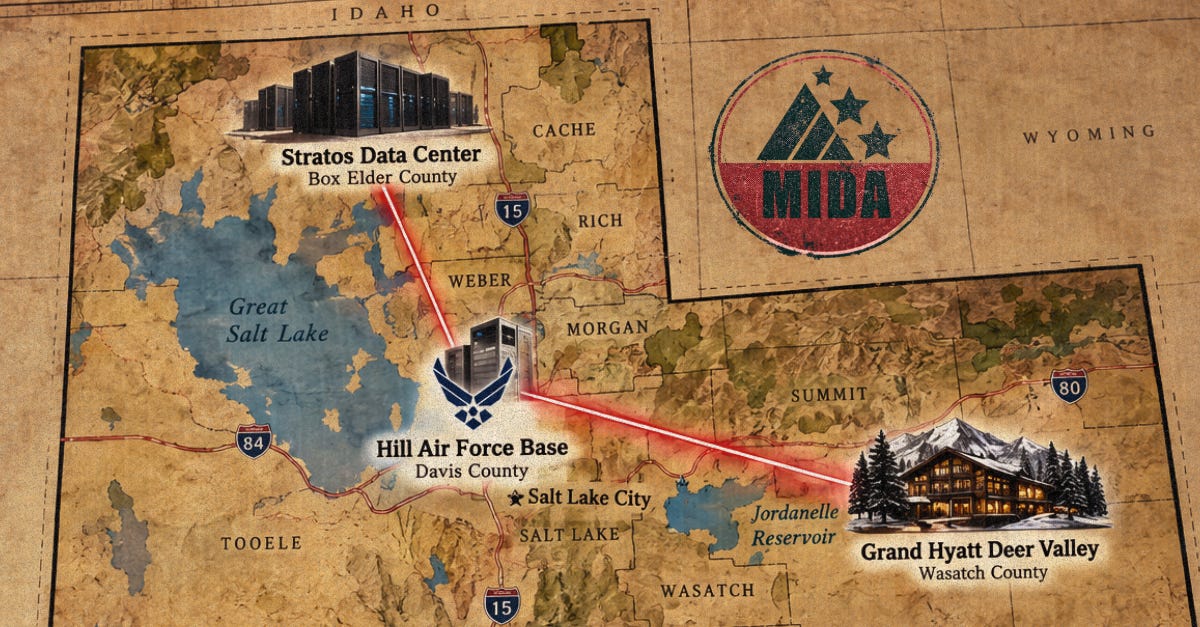
During his monthly PBS Utah news conference on Aug. 20, Cox called the approval process for the Stratos data center “not good and the MIDA process especially.” He said MIDA–the Military Installation Development Authority–had experienced “a little mission creep” and now needed “major reform.”
That same day, at a MIDA board meeting, Sen. Jerry Stevenson warned that data centers were “probably as hot a topic as we have on the Hill right now.” He anticipated “quite a bit of legislation” during the 2027 session and suggested keeping their heads down until the session ended, “if possible.”
MIDA operated in relative quiet until it joined forces with Shark Tank’s Kevin O’Leary to create Project Stratos, a hyperscale data center in Box Elder County. The backlash got so loud that it followed Adams into his Republican primary, where the Utah Senate president (and MIDA board chair) lost his reelection bid. Suddenly, everyone from the state auditor to the governor was paying attention.
What exactly is MIDA?
In 1993, Hill Air Force Base was in danger of being closed. According to Utah economic-development official Rick Mayfield, “Hill Air Force was the largest employer in the state. It was really the economy of Davis and Weber County.” Faced with the possibility of losing Hill, a grassroots lobbying group of local Utahns sprang into action. Their campaign helped keep Hill Air Force Base open and save an estimated 23,000 jobs.
But surviving one round of closures did not necessarily make Hill safe. Officials realized Hill’s best defense against another BRAC round was to increase its military value, since that is the primary factor the Pentagon considers when deciding which bases to close.
One way to increase that value was to put Hill’s underused land to work. Through a federal program, the Air Force could lease the federal land at Hill to private developers in exchange for money or new infrastructure. Hill found about 500 acres to develop, but the land crossed two counties and four cities, each with different rules, making development highly complicated. So, Utah created MIDA in 2007—one authority that could coordinate land use, taxes, and infrastructure on designated land, regardless of local policy. MIDA’s first project, Falcon Hill, helped turn underused land around Hill into a huge aerospace development and generated new infrastructure for the base.
After the first project’s success, lawmakers passed several laws that broadened what MIDA could do. In 2009, the legislature passed a law allowing MIDA to include private land in its project areas. A 2010 law, SB 124, sponsored by Sen. Jerry Stevenson (the same Sen. Stevenson on the MIDA board), gave MIDA the power to impose a resort communities tax. Then, a 2018 law, SB 240, with Sen. Jerry Stevenson as the chief sponsor, gave MIDA the power to impose an accommodations tax of up to 15% on lodging on government- or MIDA-owned property. In 2020, the same Sen. Jerry Stevenson sponsored SB 192, which let MIDA collect tax increment for up to 40 years instead of 25. Meaning as much as 75 cents of every new property-tax dollar can fund the MIDA project instead of going to the county or school district for four decades. In 2024, SB 169, also sponsored by Sen. Stevenson, authorized an additional resort sales tax and expanded where the 2018 accommodations tax of 15% could apply.
MIDA today operates much like its own city authority. MIDA’s board is appointed, and of its eight members, seven can vote: the governor chooses five, while the Senate president and House speaker each choose one. The eighth, nonvoting member comes from the Governor’s Office of Economic Opportunity. For the past eight years, Stuart Adams has served as both MIDA’s board chair and president of the Utah Senate.
MIDA’s first big controversy. Grand Hyatt Deer Valley.
In the late 1990s, Hill Air Force Base ran a seven-room recreation lodge near Snowbasin where military families could ski without paying resort prices. When Snowbasin prepared to host the 2002 Olympics, the Air Force closed the lodge and handed it to the resort. To make up for it, Congress gave the Air Force a 26-acre parcel in Park City in 2001 to build a new lodge or trade for a better site. But Congress never funded construction, and after years of local opposition, the Air Force gave up on Park City and asked MIDA to find somewhere else.
In 2012, MIDA combined two unconnected properties into a single 66.5-acre project area: the Air Force’s Park City parcel and a privately owned 40-acre parcel near Jordanelle. Neither was meant to become the hotel. The Park City land was there to be traded for a replacement site. Development on the Jordanelle land would generate tax revenue to help pay for the future hotel, and, of course, a ski lift.
Then New York developer Extell arrived. It bought the Jordanelle parcel, acquired more land nearby, and agreed to donate a site inside its Mayflower development for the military hotel. According to Wasatch County Manager Mike Davis, Extell wanted MIDA to handle development approvals because it found the county’s process too slow. Once the county had signed off on the initial project, Davis said the state “somewhat forced our hand” into letting MIDA oversee land use west of the highway. By 2019, roughly 5,000 acres west of U.S. 40 were under MIDA’s authority.
Extell and MIDA then planned an entire resort across that area, with $3.2 billion in development expected in the first five years. MIDA supplied the financing: up to $260 million in bonds in 2021, and up to $390 million more in 2024 through its Mountain Village Public Infrastructure District.
The seven-room lodge became Grand Hyatt Deer Valley: 381 rooms, five restaurants and bars, a heated outdoor pool, three hot tubs, and a spa. MIDA set aside 100 rooms at discounted rates for eligible military guests, and the hotel includes a secure room for classified military discussions. As of June 2026, MIDA reported 3,900 discounted room nights booked for the year at an average of $149. After a two-decade wait, military families are getting their ski vacation. And this time, it has a hot tub.
The Stratos Data Center Controversy
The Stratos Data Center also falls under MIDA’s land-use authority. And by now, the story might sound familiar: an outside developer came in with a massive project and partnered with MIDA. Some people weren’t too happy about it. You can read our full breakdown from July here.
Below are the arguments from MIDA’s critics and supporters, followed by my take.
What critics of MIDA are saying
MIDA has overstepped its original military mission.
MIDA’s unelected board is exercising powers the Constitution never gave them.
MIDA has too little oversight from elected officials.
Republican Rep. Jason Thompson, who is drafting legislation that would generally keep MIDA projects within five miles of a military installation and require a direct military purpose, argued that Stratos stretched MIDA’s mission too far:
“When we start using MIDA more as an economic development tool than its original tie to military-specific projects and supporting our military bases, then we have to start to ask some serious questions,” Thompson said. “I believe that MIDA simply said, ‘Hey, listen, data center, military contracts, national defense. OK, it checks the military box. Boom, let’s go with it.’… For MIDA to reach, it’s a stretch.”
David Irvine, the attorney representing Alliance for a Better Utah and five Box Elder County residents in their constitutional challenge to the MIDA Act, argued that powers normally exercised by elected local governments have instead been placed in the hands of an unelected authority:
“Do Utah residents have the right to be governed by elected officials who are accountable to them? MIDA is an unelected body exercising powers the Utah Constitution never authorized. Furthermore, Senators Adams and Stevenson’s presence on the MIDA board as active legislators appears to violate the prohibition on holding more than one office of public trust simultaneously and should render the Stratos approval null and void. Backroom deals and pay-to-play have no place in Utah government, and Box Elder County residents deserve a voice in what happens to their community.”
Gov. Spencer Cox (R) argued that MIDA’s expanding mission requires greater oversight from the elected officials whom voters ultimately hold responsible:
“We have a lot of independent entities in this state, and they’re great. They play a very important role. But we’ve also delegated a lot of authority there, and the people are going to hold us accountable for what those entities do. We need to make sure that we have insight and some say in what it is they’re doing, what projects they’re taking on. And are they the right projects for our state? We, the elected officials of the state, should be able to have a little bit more of a say in what happens there.”
What defenders of MIDA are saying
MIDA cuts through government red tape, and Falcon Hill shows the model can work.
Deer Valley gives military families a real benefit: 100 deeply discounted rooms.
MIDA can’t go where it isn’t invited; local elected officials must consent first.
Rep. Blake Moore, who represents northern Utah in Congress, pointed to Falcon Hill as evidence that MIDA can coordinate complicated development, strengthen the region surrounding Hill Air Force Base, and create economic opportunities:
“Who thinks Falcon Hill has been a bad idea? Falcon Hill has been an exceptional plan, a streamlined way to get good solid growth and job opportunities here. MIDA has a good track record….There’s a strong track record of good, solid growth that’s been responsible with MIDA.”
Gary Barnett, the founder of Extell Development, which is developing Deer Valley’s East Village, rejected the idea that its military hotel is a pretext for private development. He pointed to the portion of the Grand Hyatt reserved for eligible military guests at subsidized rates:
“And what we’re doing in this hotel is we’re giving more than 25% of the rooms to use for the military. And that’s active military, retired military, some family. And they have the ability to come here at a very, very reduced and subsidized rate for what is an absolutely beautiful hotel. I mean, it is a first-rate hotel with great conference facilities, beautiful rooms, beautiful design, and great food and beverage.”
Stuart Adams, outgoing president of the Utah Senate and chair of MIDA’s board, argued that MIDA can only act after receiving approval from the affected local government:
“MIDA has no authority to go to Box Elder County. It’s only if the local authority in the county acts—that’s why we act. Every city has input on everything it [MIDA] does. So [MIDA] is really an extension of that local government, but they’re able to do more.”
My take
MIDA has strayed from its original purpose.
The required military connection to MIDA projects needs to be defined more clearly.
MIDA needs to eliminate the conflicts of interest from its board.
I admit, I felt a swell of Utah pride reading about MIDA’s origins. Utah citizens banding together, fighting to protect Hill and defend Utah’s economic and military future against all odds. How can you not be inspired?
And in some cases, like Falcon Hill, MIDA makes sense! So my real question isn’t really whether I’m mad at MIDA. It’s this: how far can MIDA stretch the word “military” before it stops meaning much of anything? And who gets to say “okay, that’s far enough”?
Deer Valley falls somewhere in the middle. The military benefit at Deer Valley is real. One hundred rooms are set aside at discounted rates for eligible military guests. But the cost is real too. Up to 40 years of new property taxes diverted from the county and schools, enough to back roughly $650 million in MIDA and district bonds, plus land-use authority over 5,000 acres.
And the Grand Hyatt is the only hotel in the development that sets aside rooms for the military. The Deer Valley project now calls for eight hotels, 250,000 square feet of shops, 68,000 square feet of recreation space, 3,700 acres of ski terrain and 16 new lifts. None of that revenue goes to Hill. We are wayyy past “replacement ski lodge” territory. And that’s without even mentioning Stratos.
Stratos is where the word “military” gets even fuzzier for me. At Deer Valley, I can point to 100 discounted rooms. At Stratos, the military benefit is still described in the language of possibility. MIDA’s own project area plan promises “the federal government and related defense industry users as clients,” a project that will “strengthen energy resilience in support of national defense interests,” and “ongoing revenue that will be used by MIDA to support new improvements and missions on the Associated Military Land.” For a project this massive, and with this much public backlash, why are the military benefits still so vague? The plan doesn’t name any committed military clients, say how much revenue would actually go to military projects, or explain what happens if neither ever shows up.
If future customers or hypothetical military revenue is enough, where is the line? By that logic, heck, MIDA could build Disneyland, promise Hill a cut of the ticket sales, and call Space Mountain military infrastructure. Obviously, a data center has more to do with national defense than Space Mountain. But “it might help the military somewhere down the road” can’t be the whole sales pitch.
That brings me to the second half of my question: Who gets to say no?
Does Box Elder County get to say no? After all, MIDA didn’t steal the land for the Stratos. Box Elder’s elected commissioners voted to let MIDA take control. But according to Commissioner Lee Perry, that vote was not much of a choice. He says they were the last to know, the process was rushed, and he believed the data center would be built on that private, unzoned land whether the county partnered with MIDA or not. Voting yes, he said, was the only way to give the county “a seat at the table.”
What about residents? Can they say no? Well, residents tried to put the data center decision on the ballot, but the county attorney rejected their referendum applications and said the county’s consent to MIDA could not be challenged by referendum. 100% of Box Elder residents could have signed, and it wouldn’t have mattered.
Then voters tried to vote Stuart Adams out of office. They succeeded, but Adams still chairs MIDA’s board. Voters could vote him out of the Senate, but they couldn’t vote him off MIDA. Why? Because Adams used his power as Senate president to appoint himself to MIDA’s board. Under state law, only the Senate president can remove him, so that decision will fall to whoever succeeds him.
What about the Legislature? Can they say no? They could. And maybe they even would. If the sitting chair and vice chair weren’t both prominent members of the Utah Senate. In fact, Senator Jerry Stevenson—MIDA’s vice chair—originally sponsored four of the five laws that expanded MIDA’s authority.
Once MIDA decides it wants to do a project, it seems very difficult to stop it, which is probably why private developers are so fond of teaming up.
So, where do we go from here? I have three suggestions.
Better-defined parameters for MIDA projects.
Before MIDA can create a project area, the plan should state exactly what the military receives, in rooms, dollars, or square feet, and it should be written into the agreement. Rep. Jason Thompson’s draft bill starts down this road by requiring a direct military purpose within five miles of a base. Geographical proximity is one option. But it’s not the only one.Make county consent to MIDA a legislative act, not an administrative one.
When Box Elder County residents tried to revoke MIDA’s recently granted land-use authority, they were told they couldn’t, because only legislative acts are subject to referendum. So make MIDA designations a legislative act.Remove conflicts of interest from MIDA’s board.
The Legislature is supposed to oversee MIDA. But when sitting lawmakers like Adams and Stevenson also serve on MIDA’s board, they are on both sides of that relationship. They already have power over MIDA in the Legislature; they don’t need another seat at the table.
MIDA doesn’t need to disappear. But it does need to remember what it was built to do—and what it wasn’t. Utahns banded together once to protect Hill Air Force Base. I hope we do it again, this time by pushing for clearer limits, more local say, and no sitting lawmakers on MIDA’s board. MIDA shouldn’t get to act like a city without any elections.
Think we got this one wrong? We want to hear about it.
The sharpest reader responses may end up in a future article.

I smell a rat in political clothing! This is ridicules and self-serving. When politics became a career, it became corrupted! Vote these people out of all public office, NOW! MIDA may have served a purpose, albeit to counter political influence, it appears that is has become the same, even worse. Thank you for explaining the details and shedding light on this seriously devious organization.