


Happy Friday! It’s Editor-in-Chief Nick Huey.
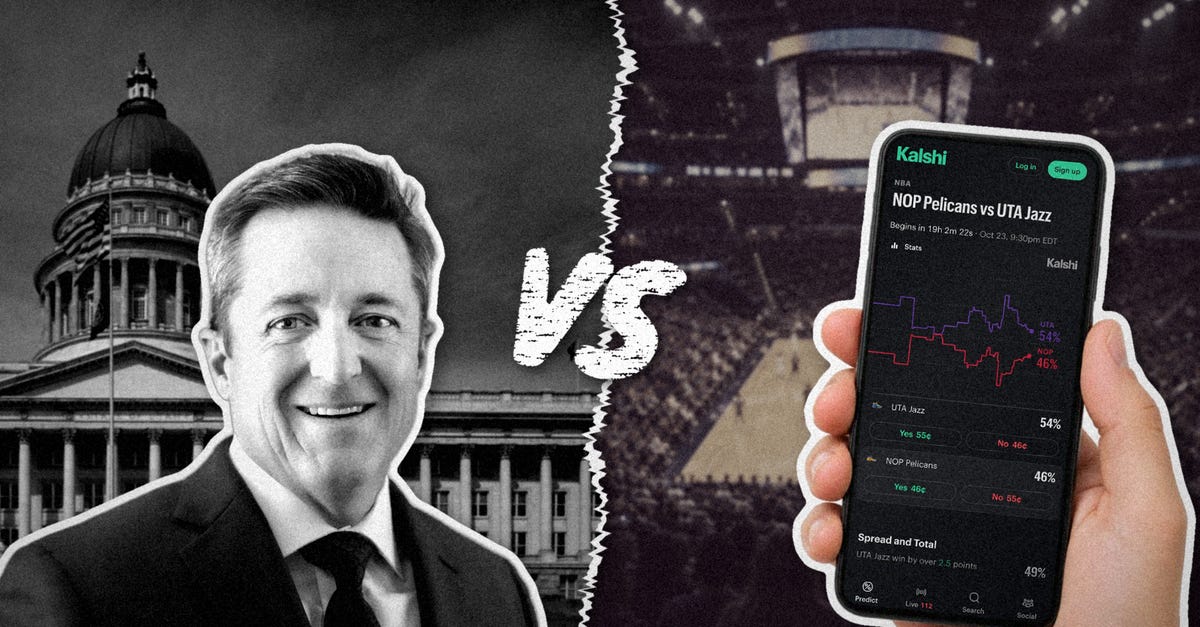
Today we’re covering the lawsuit Utah AG Derek Brown filed Tuesday against Kalshi, the prediction market app where you can buy a contract that pays a dollar if the Jazz win tonight. Kalshi says that’s a trade, not a bet. Utah says “tomato, tomahto.” We’re about to dive into the nuances of bets, swaps, and other financial mumbo jumbo.
But first, let’s look at the results of the Amendment B article from last week.
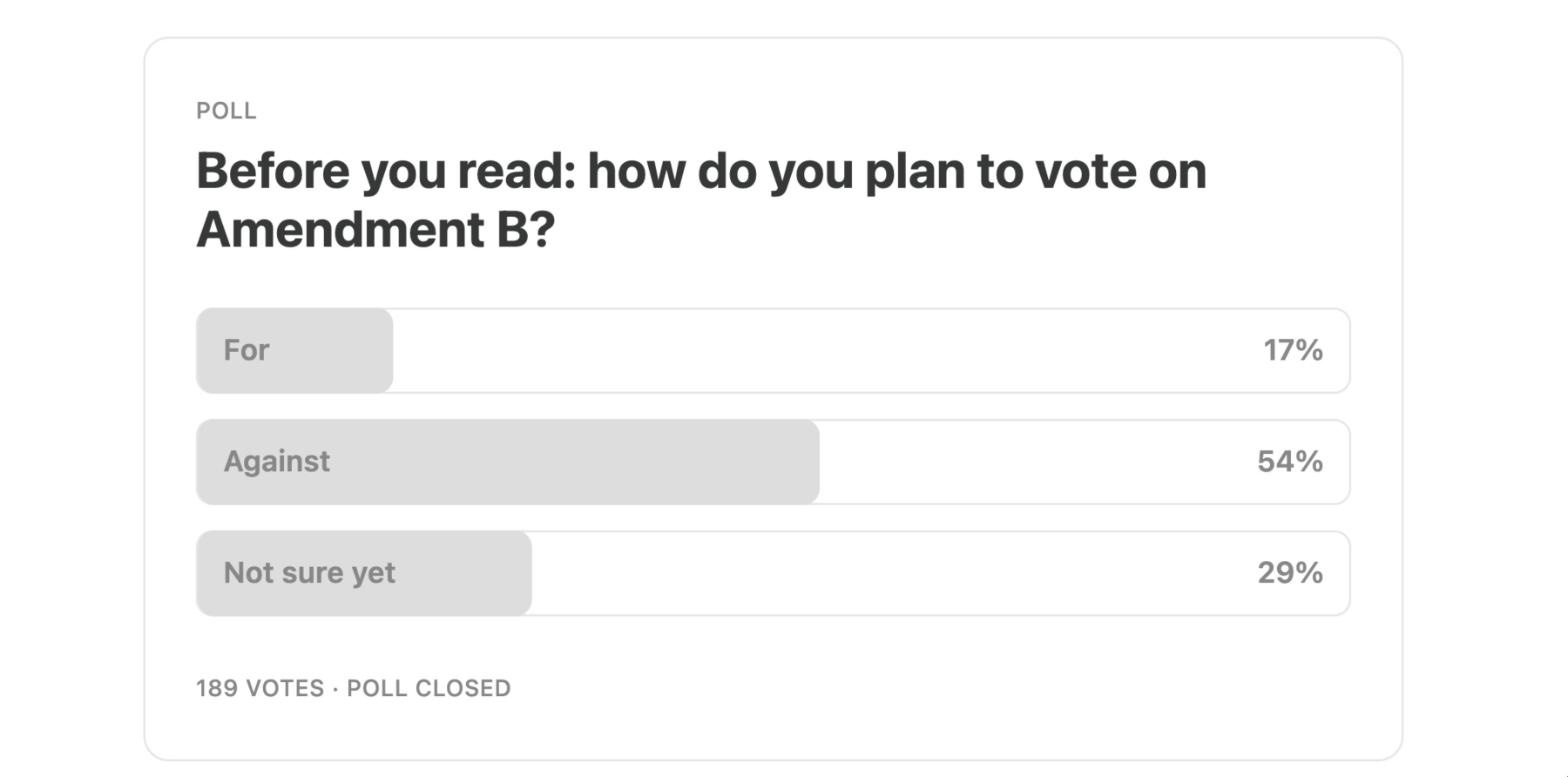
Plum readers started out leaning against Amendment B, 54% to 17%, which is the mirror image of the Noble poll of Utah voters (50% for, 21% against). So don’t read our polls as representing Utah yet. I hope to get more representative of Utah as our audience grows and our articles naturally cut both ways.
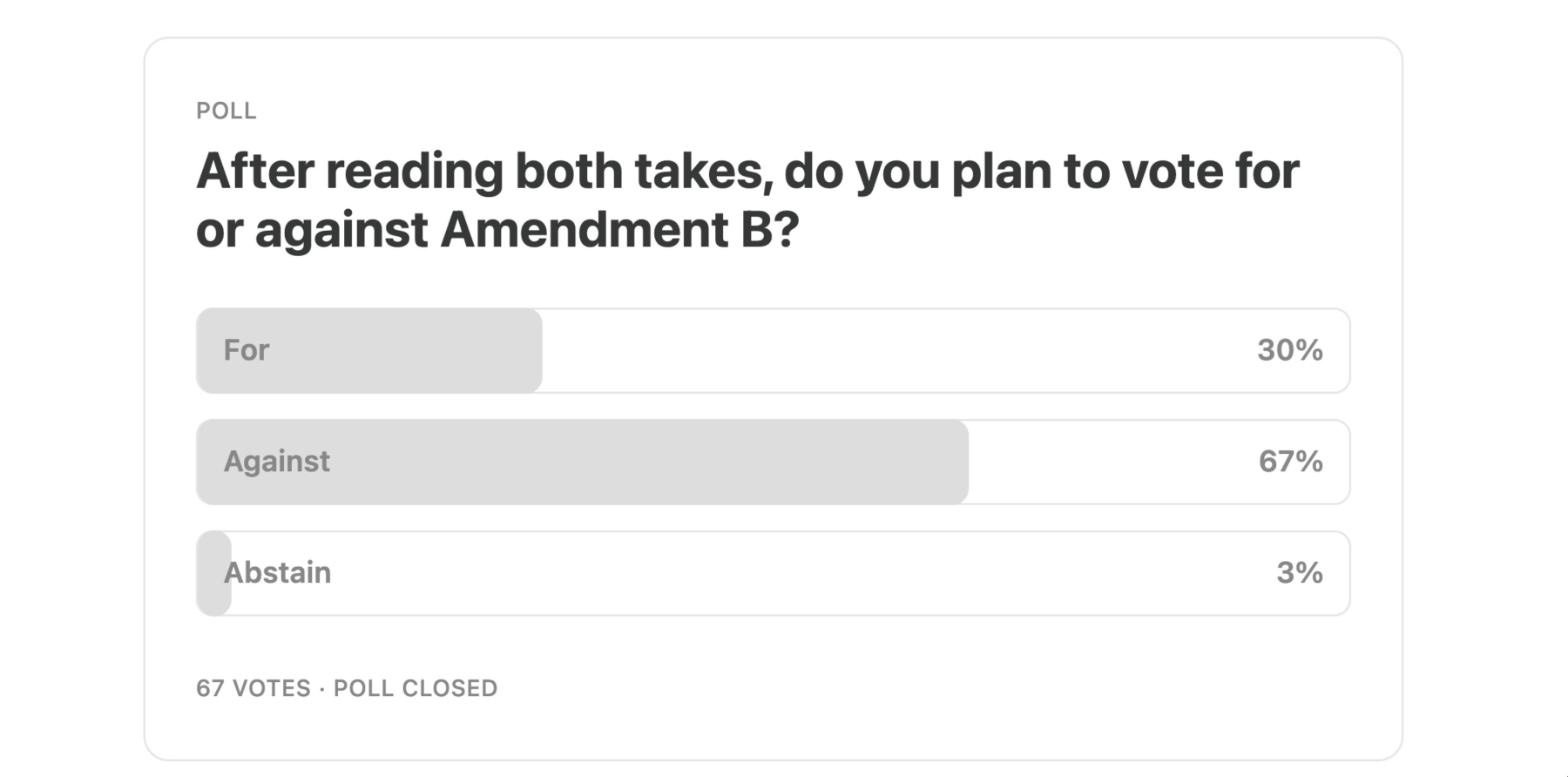
After reading both takes, “For” and “Against” both gained exactly 13 points. Shout-out to Billy Hesterman of the Utah Taxpayers Association for his strong rebuttal.
Now let’s talk about the shares.
The article has been shared 102 times across Facebook, Instagram, and other sources, more than 8X any article we’ve published. I’ve also been told that it showed up in a news aggregator and an HOA GroupMe. And we have no way to measure how many private forwards the email had. Judging by the engagement, there were a fair few.
But what made me happiest is how it was shared.
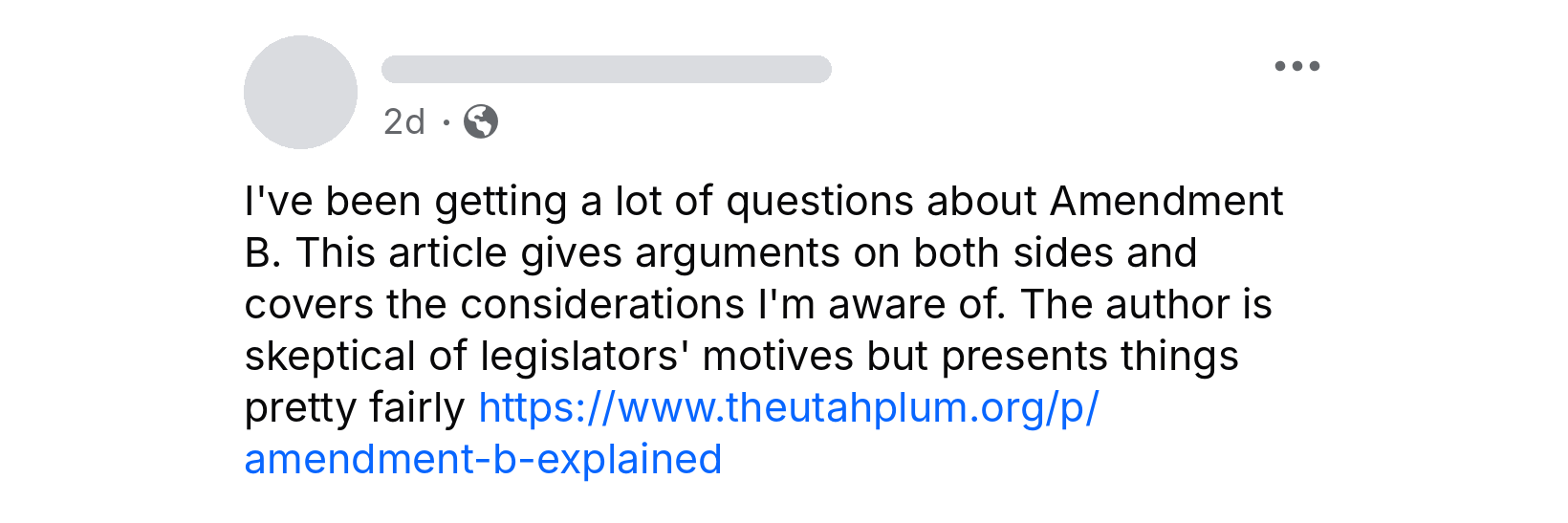

On the whole, the shares were civil and helpful, exactly the kind of discussion that I hope The Utah Plum invites.
The comments under the article itself were just as thought-provoking, from both “yes” and “no” voters.
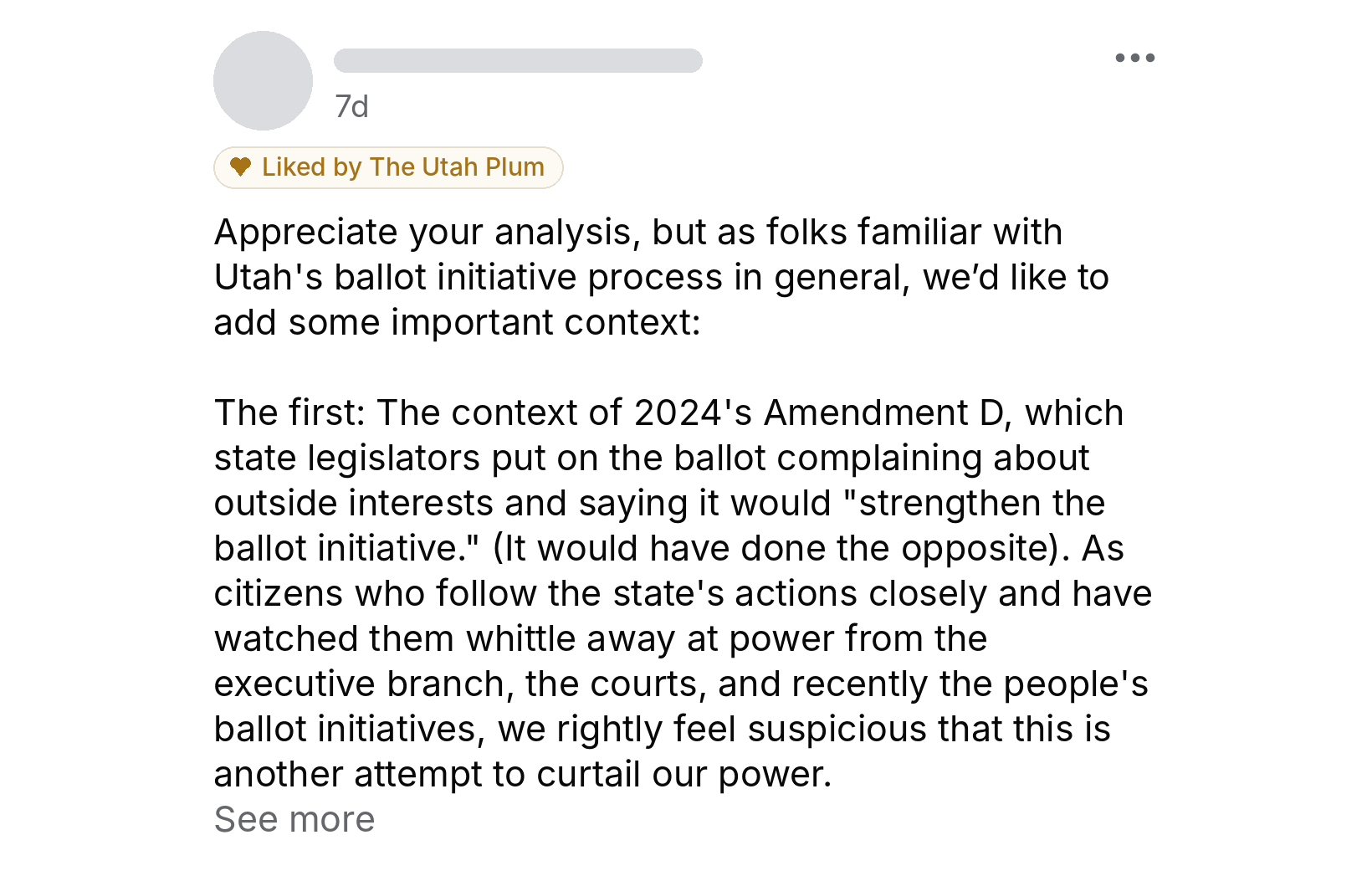
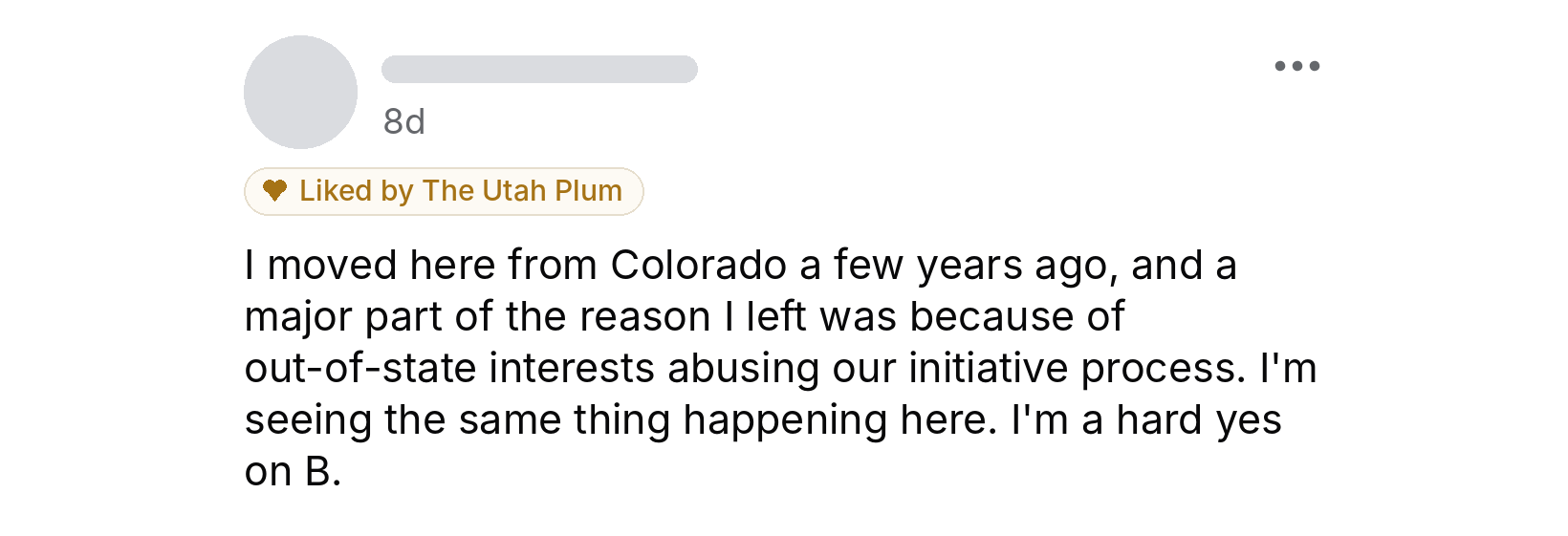
A big ol’ “thank you” to all you thoughtful sharers, commenters, and readers.
Okay. On to Kalshi.
Today’s Read
Research and writing: about 18 human hours
Reading time: about 17 minutes
Background
On Tuesday, Oct. 20, Utah Attorney General Derek Brown filed a 63-page lawsuit against Kalshi in 3rd District Court in Salt Lake City. The suit names the prediction platform, three of its affiliates, and Susquehanna International Group, a Wall Street trading firm that acts as a market maker on Kalshi, meaning it stands ready to take the other side of users’ trades.
The state is asking a judge to do three things:
Order Kalshi to stop offering “sports, elections, politics, culture and mention bets” in Utah, with a court-approved geolocation provider checking that the platform complies.
Make Kalshi give up the money it has made from Utahns.
Declare the whole operation a public nuisance.
The complaint says more than 32,000 Utahns had verified Kalshi accounts as of February, that Utah accounts have placed more than $3 billion in wagers over Kalshi’s lifetime, and that Kalshi’s fee of one to two cents per contract works out to somewhere between $30.6 million and $61.2 million in fees from Utah. The state also estimates Utahns have lost at least $5.5 million on the platform. Those are estimates built on Utah’s share of Kalshi’s national volume, but the complaint says the actual figures are “likely much greater.” Brown told reporters he expects to get a clearer picture as the case moves forward and more evidence comes to light.
Why civil and not criminal? Brown said his office is focusing on the civil case for now and “we don’t comment on existing criminal investigations or potential criminal investigations.” Why Kalshi and not Polymarket or Robinhood, which offer similar contracts? He said the office is “focusing on Kalshi” for now and that other companies operating here should read the complaint.
What is Kalshi?
Kalshi is a New York company that lets people bet on whether something will happen in the future, from election results to sporting events. Here’s how it works: You buy a contract predicting a yes-or-no outcome for anywhere from 1 cent to 99 cents. If you’re right, you get a dollar. If you’re wrong, you get nothing. The price changes as people buy and sell, much like a stock. You’re trading against other customers or large financial firms (like Susquehanna), not Kalshi itself. The company makes its money by charging a small fee on trades, whether you win or lose.
Kalshi is regulated by the federal Commodity Futures Trading Commission (CFTC), the same agency that oversees trading in commodities like oil and wheat. That gives Kalshi a different legal status from a traditional sportsbook. It spent years securing federal approval and won a court battle with the CFTC in 2024 that allowed it to offer contracts on election outcomes.
Last year, Kalshi started offering contracts on sports, and the company took off. CEO Tarek Mansour told RotoWire in September that Kalshi is “edging close to 30 million customers.” Of the $179.4 billion traded on Kalshi this year through early September, $128.3 billion was on sports or sports “combos,” which is Kalshi’s word for parlays.
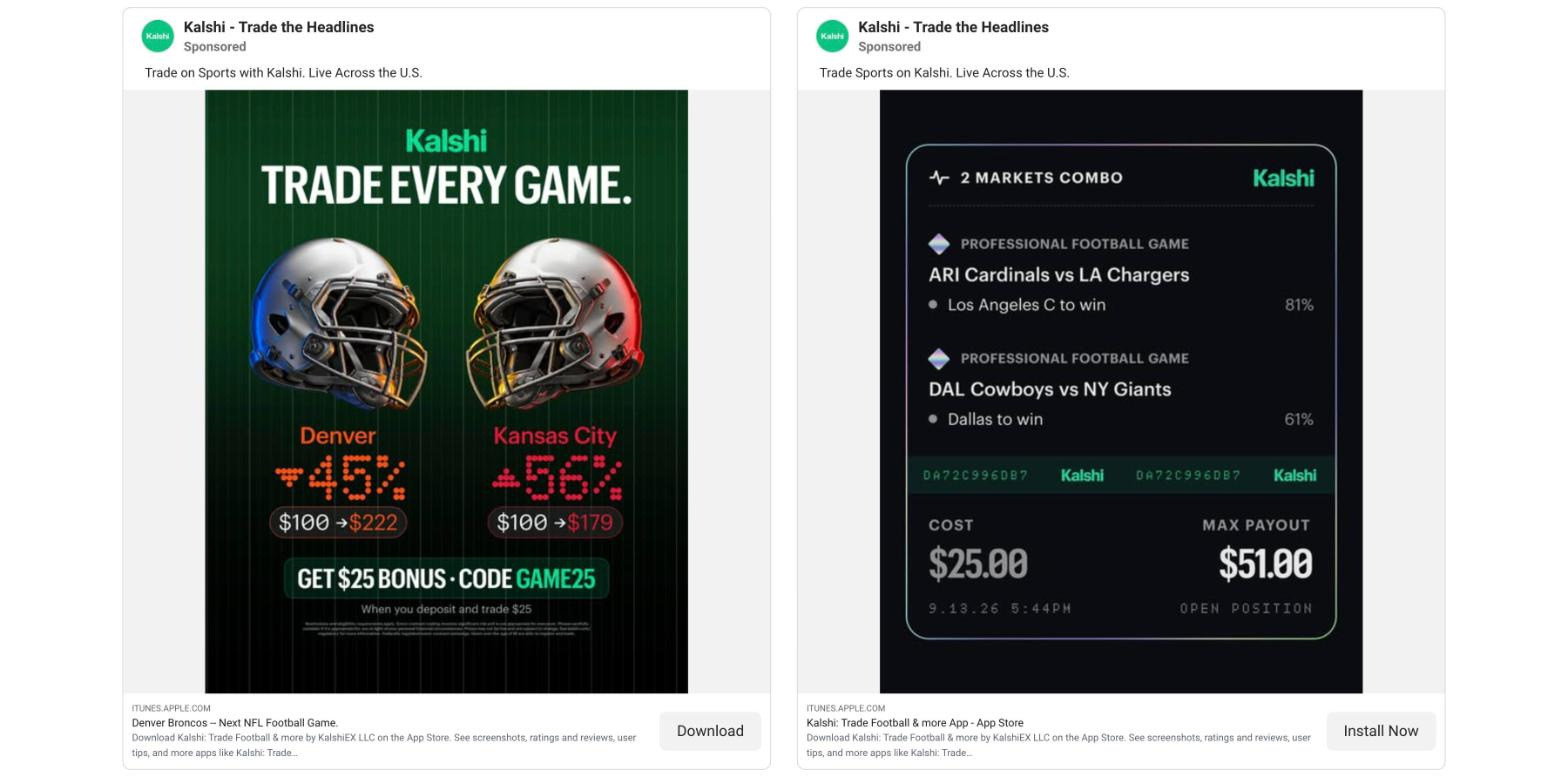
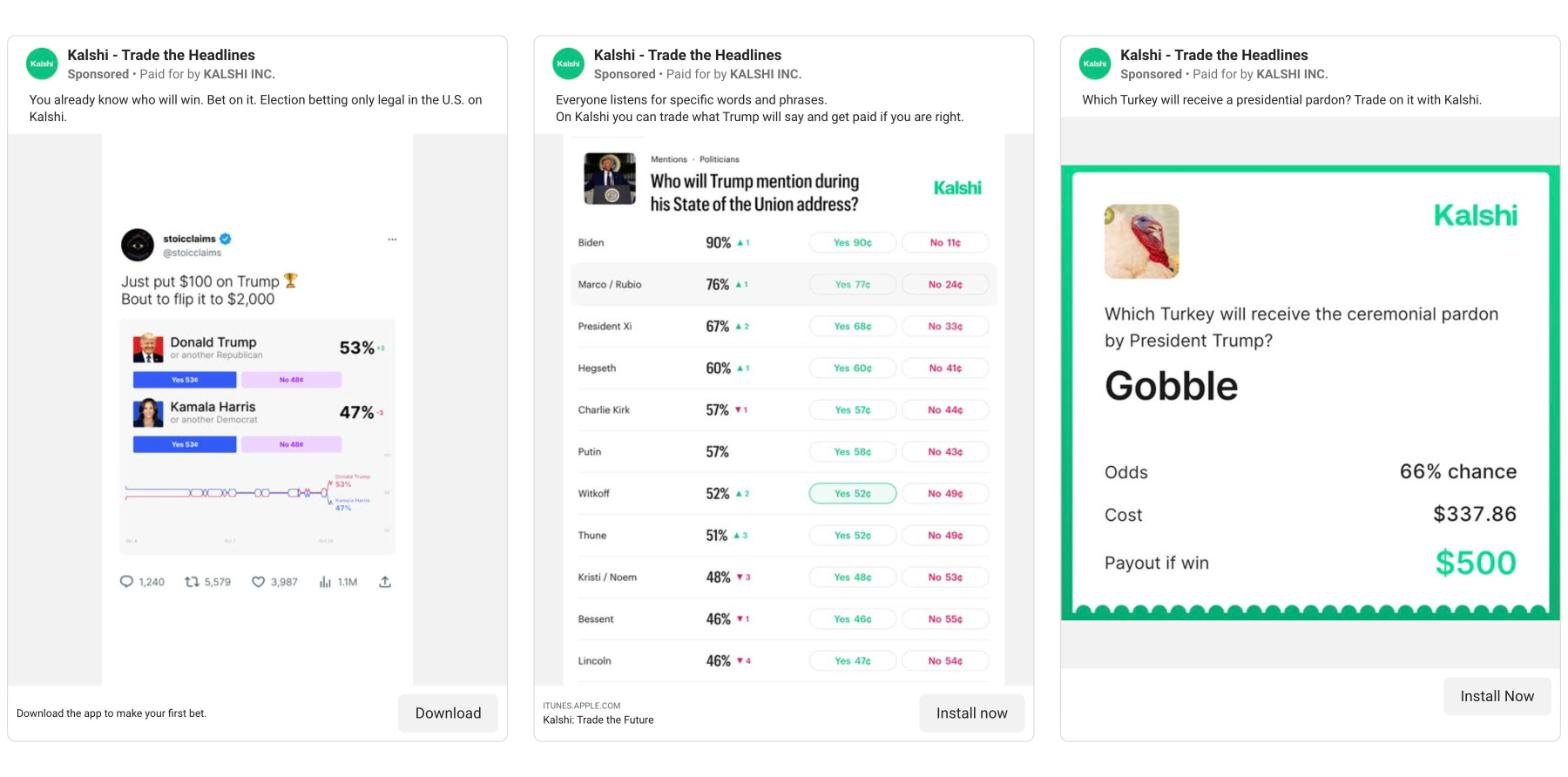
Utah’s complaint lists contracts on game outcomes, point spreads, player props, and parlays, plus elections (“Blue wave this year?”), politics (“Trump’s approval rating Friday”), culture (who headlines Coachella in 2027), and “mentions,” which are contracts on whether someone will say a particular word at an event.
Back up. Isn’t gambling illegal in Utah?
Yes. Utah and Hawaii are the only two states with no legal gambling of any kind. Utah’s ban is in the state constitution, which has said since 1896 that “the Legislature shall not authorize any game of chance, lottery or gift enterprise under any pretense or for any purpose.”
So how is Kalshi operating in our state?
Kalshi says Utah’s law doesn’t apply to it.
The argument goes like this. The federal Commodity Exchange Act gives the CFTC “exclusive jurisdiction” over swaps traded on registered exchanges. Kalshi says its event contracts are swaps, so a state can no more ban Kalshi’s sports contracts than it can ban wheat futures in Chicago. And since the contracts are legal under federal law, Kalshi argues they’re a “lawful business transaction,” which is exempt under Utah’s own definition of gambling.
Utah’s complaint says Kalshi has been offering contracts to Utahns since at least September 2024 and alleges that a Kalshi representative filmed an ad on BYU’s campus.
How’d we get to a lawsuit?
Kalshi sued Utah first. In February, Gov. Spencer Cox told Bloomberg that companies like Kalshi are “illegal in Utah and will continue to be so,” and Brown wrote a Deseret News op-ed naming the company. Within days, Kalshi sued Cox and Brown in federal court to block any enforcement before it started.
On Aug. 4, U.S. District Judge Robert Shelby ruled for Utah and closed the case. He held that Utah’s gambling laws apply to Kalshi’s sports contracts and that federal law does not preempt them. Kalshi appealed. On Sept. 8 the 10th Circuit denied Kalshi’s emergency request to block Utah from enforcing its laws while the appeal is heard. The appeal itself is still pending.
But Kalshi kept taking Utah trades.
States versus the federal government
Utah is one of at least nine states that have taken legal action against prediction markets. The legal battle has three unusual features.
First, the federal government is on Kalshi’s side.
The CFTC has sued six states to stop them from enforcing gambling laws against registered exchanges. In June, it proposed a rule that would define which prediction-market contracts count as gambling. Under the proposal, betting on the outcomes of sporting events would generally be allowed. Forty-four state attorneys general oppose the rule.
Second, the federal appeals courts disagree with each other.
In August, the 9th Circuit Court of Appeals sided with Nevada, 3 to 0, holding that Kalshi’s sports event contracts are not swaps. In April, the 3rd Circuit sided with Kalshi against New Jersey, 2 to 1, holding that sports event contracts are swaps and that the CFTC’s jurisdiction is exclusive. New Jersey has asked the Supreme Court to take the case.
If it does, the answer will apply in Utah too.
Third, gambling states and tribes with casinos are on Utah’s side.
States where gambling is legal, like Nevada and New Jersey, are also taking on Kalshi, but for different reasons. They argue the CFTC is overstepping its authority.
There’s also a lot of money at stake. Kalshi competes with casinos and sportsbooks, which are a substantial source of these states’ tax revenue. Nevada collects about $1.1 billion a year in gaming taxes. State regulators have warned that revenue could shrink as more betting moves to prediction markets that aren’t taxed like sportsbooks. The tribes that joined the Supreme Court case have raised similar concerns.
What do Utahns think?
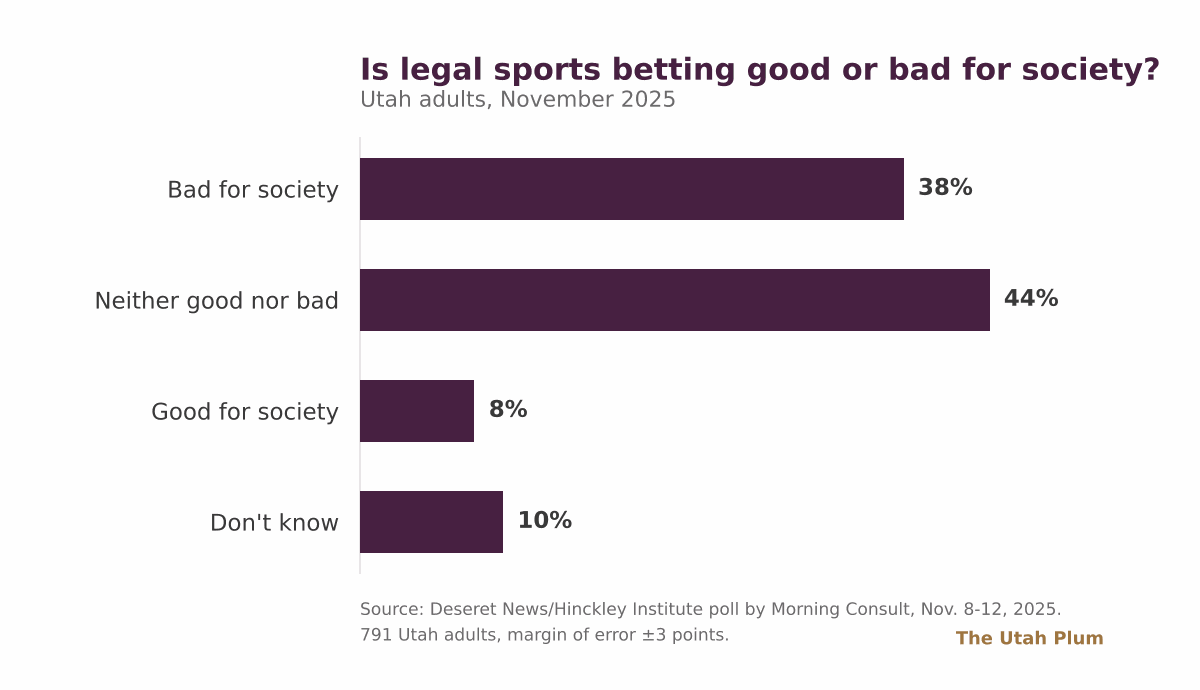
A Deseret News/Hinckley Institute poll last November found that 38% of Utah adults thought legal sports betting was bad for society, compared with just 8% who thought it was good. Another 44% said it was neither.
Today, we’ll share views from both sides of the debate. Then, Editor-in-Chief Nick Huey shares his take.
What Utah and its allies are saying
Utah has banned gambling since 1896. Calling a bet a “contract” doesn’t change what it is.
Congress did not authorize the CFTC to take a wrecking ball to all sports gambling regulation.
Betting is bad for society, whether you call it betting or not.
Utah Attorney General Derek Brown, announcing the lawsuit:
“Utah has said no to gambling since statehood in 1896, and that didn’t change when betting moved onto cellphones. Effectively, Kalshi bet today that Utah would not enforce its gambling laws. Well, we are enforcing it. So on that point, Kalshi has now lost their bet. …
“Ultimately, this is part of a larger investigation. But the reality is, Utah law is very specific. And under our system of government, every state can choose how they treat this issue.”
Judge Ryan Nelson, writing for a unanimous 9th Circuit panel in Kalshi’s case against Nevada:
“We have recognized that a ‘swap’ allows two parties ‘to exchange (“swap”)’ cash flows on obligations such as ‘interest rates, currency rates and security or commodity prices,’ to hedge risk on those obligations. As Nevada points out, Kalshi’s sports event contracts do not help institutions or investors hedge against risk; they create risk, largely for ordinary consumers, where none previously existed. …
“Congress did not take a wrecking ball to all sports gambling regulations built up over decades by federal, state, and tribal governments when it amended the CEA to add the definition of swap we are considering today.”
President D. Todd Christofferson, second counselor in the First Presidency of The Church of Jesus Christ of Latter-day Saints:
“The smartphone has transformed gambling from an occasional activity requiring a trip to a casino, racetrack, or lottery kiosk into an activity available continuously, privately, and almost anywhere. This has led to an explosion in gambling. Worldwide surveys spanning multiple years indicate that 46 percent of adults gambled in the last 12 months — that is about 2.3 billion people. The global gambling industry generated estimated revenues of $758 billion in 2025. Of course, the industry’s revenue is the gambler’s loss. Simply put, the industry’s entire business model is built on its customers losing money.
“The growth in worldwide gambling is primarily driven by three new online markets. First is online sports betting, which involves wagers on sports scores, statistics, or events. Second is online casino-type games, sometimes referred to as internet or iGaming: slot games, roulette, blackjack, poker, and so on. A third, relatively new platform is what are called ‘prediction markets’ that allow participants to bet on whether something will or will not happen and when. It could be tied to anything: interest rates, elections, sports, wildfires, or even, if you can imagine, the timing of the Second Coming. (Where would you go to collect on that bet?)”
What Kalshi and its defenders are saying
Kalshi is an exchange, not a bookie. You can actually gain wealth consistently on Kalshi.
One federal regulator protects market participants from inconsistent and contrary rules.
Ban sports contracts and the useful prediction markets may go with them.
Kalshi CEO Tarek Mansour, asked by RotoWire to describe the difference between Kalshi and a sportsbook:
“People come up to us [and] say: ‘It quacks like a duck, and it looks like a duck …’ I would say two things to the duck arguments. The law is not ducks. Because if it was, then gambling in grain would still be regulated at the state level. The number two thing, which is very important, is that the people actually using Kalshi, they know the difference. What is that difference? There are very concrete differences in the product experience. If you’re a winner on Kalshi over the last 10 to 12 months, you’re still trading on Kalshi. You’re probably bigger than ever, and you’re winning more than ever. That is impossible on traditional sportsbooks. You get limited, and you would get banned in ways that you basically would not on prediction markets because of that structural difference between the two exchanges.”
Judge David Porter, writing for the 3rd Circuit majority in Kalshi’s case against New Jersey:
“The outcome of a sports event certainly can be associated with a potential financial, economic, or commercial consequence. …
“Kalshi’s sports-related event contracts are swaps traded on a CFTC-licensed DCM, so the CFTC has exclusive jurisdiction. …
“This state regulation is exactly the patchwork that Congress replaced wholecloth by creating the CFTC.”
CFTC Chairman Michael S. Selig, announcing the agency’s lawsuits against Arizona, Connecticut, and Illinois:
“The CFTC will continue to safeguard its exclusive regulatory authority over these markets and defend market participants against overzealous state regulators. This is not the first time states have tried to impose inconsistent and contrary obligations on market participants, but Congress specifically rejected such a fragmented patchwork of state regulations because it resulted in poorer consumer protection and increased risk of fraud and manipulation.”
Eric Zitzewitz, an economist at Dartmouth College who studies prediction markets, asked by The Plum what reporters miss about this fight:
“The non-sports prediction markets can be really valuable, and the sports prediction markets help bring people to these markets and/or give prediction markets’ operators a reason to help them succeed.
“We are now seeing, for the first time, liquid prediction markets on thousands of elections a year, all over the world, geopolitical risks that are first-order for anyone investing in any affected country, climate change, future pandemics, FDA approvals, company earnings and key performance indicators, economic numbers, etc. There are even prediction markets on Rotten Tomatoes ratings, so you know which movie to not take your date to.
“But my suspicion, and I am working on research to test this hypothesis, is that a lot of this will go away if we ban sports prediction markets. I suspect that the sports prediction markets have a side benefit that betting at an online bookmaker or a traditional casino do not — they both cross-subsidize and draw traders to socially valuable prediction markets.”
My Take
Kalshi is fairer than any sportsbook.
Futures markets protect American industry, and the CFTC is right to guard them.
But Utah is right. A contract on the Jazz winning shouldn’t count as a swap.
Congress should update the law: Real hedging stays with the CFTC, and bets go back to the states.
This one is fascinating.
Before I started researching this article, I had no idea the CFTC was against Kalshi a couple of years ago. In 2023, the agency told Kalshi it couldn’t list contracts on which party would control Congress because betting on elections was gambling and against the public interest. Kalshi sued its own regulator, won, and the contracts went live before the 2024 election. Then the administration changed, and now the CFTC isn’t just letting Kalshi operate. It’s actively suing any states that say no thanks.
Talk about a 180.
Part of it is obviously a turf war. CFTC Chairman Selig’s own words were that states are “overzealous” and that Congress rejected a “fragmented patchwork” on purpose. If states can tell a federally registered exchange which contracts it can list, the CFTC stops being the only cop on the street.
The other part is politics. This administration is pro-crypto and pro-deregulation, and Donald Trump Jr. is a paid adviser to Kalshi who has also received company shares, raising concerns about conflicts of interest.
Still, I kept getting stuck on a simpler question: Why did Congress give so much power to the CFTC to regulate futures in the first place? Why is it so bad if Utah tells Chicago we’re not accepting wheat futures?
Why swaps matter in the first place
Futures markets were created to help businesses protect themselves from unpredictable prices.
Think of a wheat farmer who plants in the spring but won’t sell his crop until fall. If wheat prices drop in the meantime, he could lose a lot of money. A futures contract lets him lock in a price at planting. Airlines do the same thing with jet fuel; cereal companies do it with corn. Farmers and airlines walk onto the exchange carrying risk. The exchange lets them sell it to somebody else.
But this system only works if the contracts are protected across state lines. A corn contract traded in Chicago might involve buyers and sellers from anywhere in the country. If individual states could suddenly declare those contracts illegal gambling, the farmer could lose his protection right when he needed it. In fact, many states did just that in the 1800s. That’s one reason Congress put the whole thing under one federal regulator, the CFTC, in 1974, and gave it “exclusive jurisdiction” over these markets.
Kalshi argues that event contracts are simply the next step in the evolution of futures markets. They started with grain, expanded to oil and interest rates, and now include predictions about future events.
So is a Jazz game contract a swap?
“Swap” means you’re swapping away a risk your business already has. But if I buy a contract on the Jazz winning, what risk is it swapping?
As far as I can tell, none. It’s only introducing a new risk that I win or lose my money, which is exactly how a bet works.
Judge Nelson from the 9th Circuit agrees. He wrote that Kalshi’s sports contracts “do not help institutions or investors hedge against risk” and instead “create risk, largely for ordinary consumers, where none previously existed.”
Kalshi argues, and the 3rd Circuit agrees, that a Jazz game’s outcome is associated with economic consequences for teams, sponsors, and TV networks. The company is right, but by that rationale, anything counts as a swap: who headlines Coachella, a celebrity breakup, whether Trump says the word “ballroom” in a speech (that’s a real one).
If that’s the test, there’s no such thing as a bet anymore, and we might as well erase every betting law on the books.
Is Kalshi gambling?
Kalshi says it offers consumers a better deal than traditional sportsbooks. There’s some truth to that. The popular online sports betting company DraftKings sets its own odds, takes the other side of every bet, makes money when you lose, and limits your bets if you win too often. On Kalshi the price is set by other customers, the company charges a penny or two per contract either way, and it doesn’t punish consistent winners. If I were going to bet on the Jazz (don’t worry, AG Brown, I would never), I’d much rather do it on Kalshi.
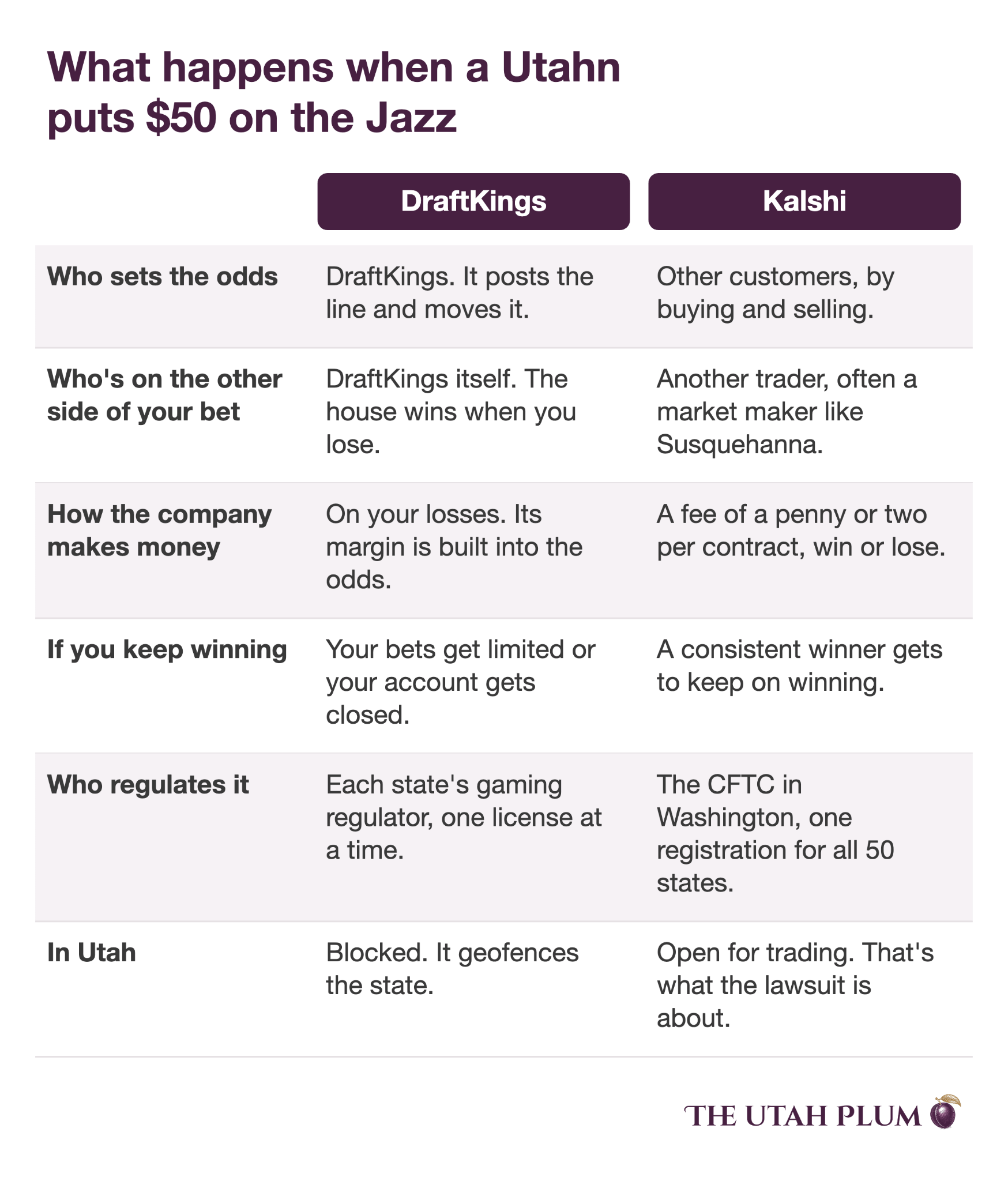
But just because Kalshi offers a better experience doesn’t mean it isn’t gambling. To the consumer, the experience of paying $1 and receiving $2 back on a swap or a bet is objectively the same.
And look at what people actually trade on Kalshi. It’s not a $40 billion market for wheat futures. Of the $179 billion traded on Kalshi this year through early September, $128 billion was sports. Parlays, point spreads, player props. Pretty much everything you’d find at a sportsbook. Until recently, Kalshi even advertised itself as “the first app for legal sports betting in all 50 states.”
If it walks like a duck, quacks like a duck, and puts up ads that say, “Hey guys, I’m a duck!” we should probably start treating it like a duck.
What I think should happen
Utah could be completely right about Kalshi and still lose in court, because the courts are interpreting a law that was written before anyone imagined a world full of pocket-sized magic mirrors that let us swap trade just about anything. The law hasn’t kept up with the technology, and it’s Congress’ job to fix that.
Three things the updated law should include:
Clarify that “swap” means “a hedge against economic risk.” A contract should only count as a swap if the thing it’s about is economic in itself: crop prices, jet fuel, interest rates. A game, an election, or a word in a speech doesn’t qualify.
Bets go back to the states. Sports contracts, election contracts, and the rest get treated as what they are, gambling. And gambling has always been the states’ call. Utah gets to say no.
A state can only say no to Kalshi if it says no to sportsbooks, too. Right now Nevada is on Utah’s side, most likely because it has casinos to protect. But a legal gambling state shouldn’t get to ban Kalshi just to protect its gambling tax revenue at the expense of its citizens. Congress should give registered exchanges like Kalshi the right to operate under the same rules as a licensed sportsbook.
Sen. Curtis’ bipartisan bill, the Prediction Markets Are Gambling Act, gets us partway there. It tells every CFTC-registered exchange that it can’t list a contract on “any sporting event or athletic competition” or any casino-style game, and it says in plain words that nothing in federal law overrides a state’s right to regulate or ban them.
Rep. Blake Moore has one that would ban gaming contracts on federal exchanges unless a state expressly permits them, and Sens. Richard Blumenthal, D-Conn., and Andy Kim, D-N.J., have another bill that would let prediction markets operate only in states that set up a program for them, with a 21-and-up rule.
None of these match my criteria perfectly, but they all preserve Utah’s right to make and enforce its own gambling laws.
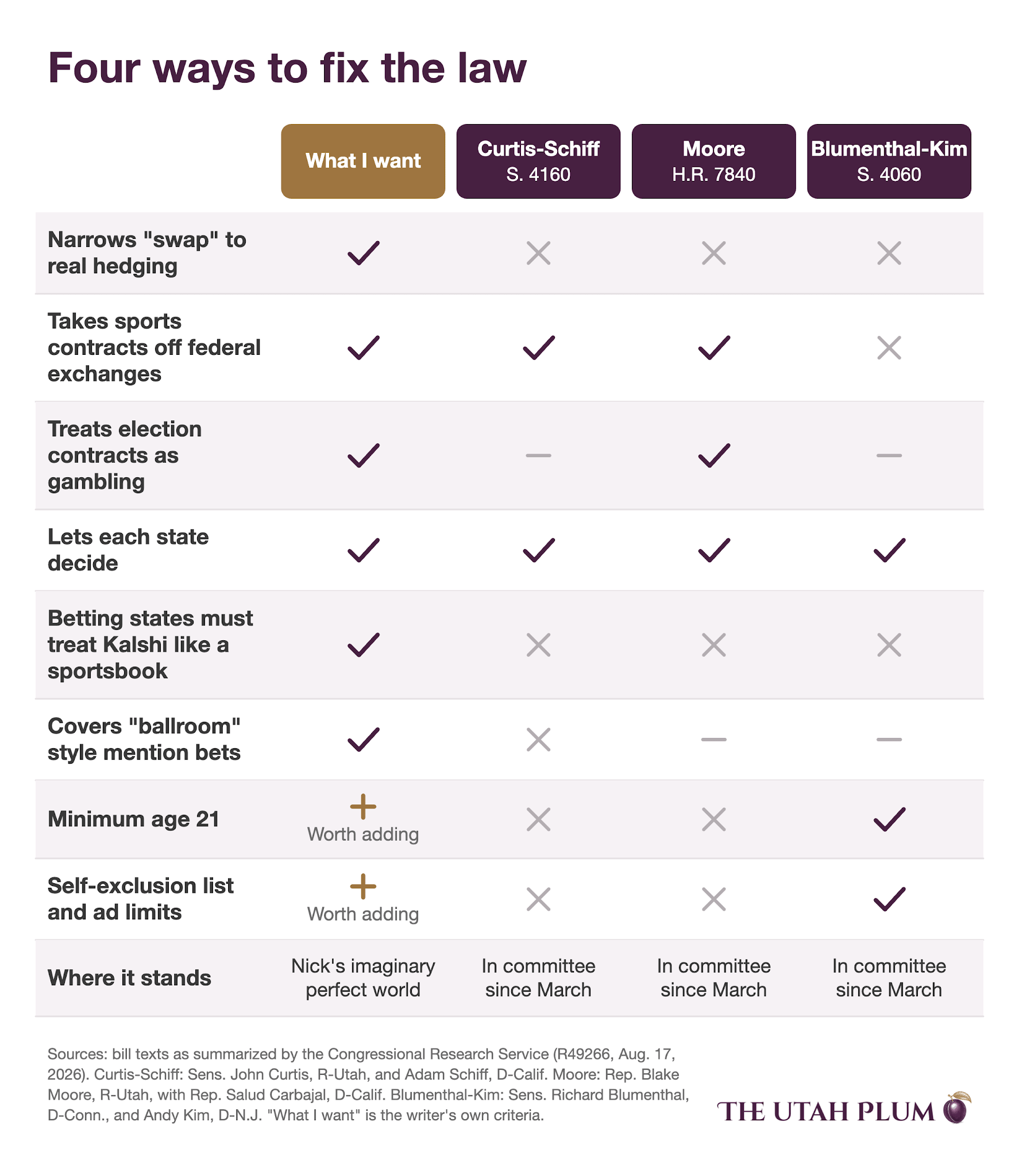
Getting the perfect bill is pretty rare in Congress, and we’ll probably have to link arms with gambling states to get something passed. I’ll take what I can get. The most important thing is that we let states decide whether they allow betting within their own borders.
If I were a betting man (or a Kalshi trader), I’d say we’ll probably get that.
What would change my mind
If the Supreme Court sides with Utah’s reading of the law. If the Court takes New Jersey’s case and agrees with the 9th Circuit that a sports contract isn’t a swap, the law as written already does job one, and “Congress has to fix it” becomes “Congress should lock it in.”
If sports are what keep the useful markets alive. Zitzewitz is researching whether the valuable prediction markets dry up without sports. If they do, then I need to reckon with whether banning some event contracts is worth the valuable data prediction markets provide around elections, geopolitical risks, climate change, and more.
Think we got this one wrong? We want to hear about it.
The sharpest reader responses may end up in a future article.