


Reporting and research by Sydney Jezik
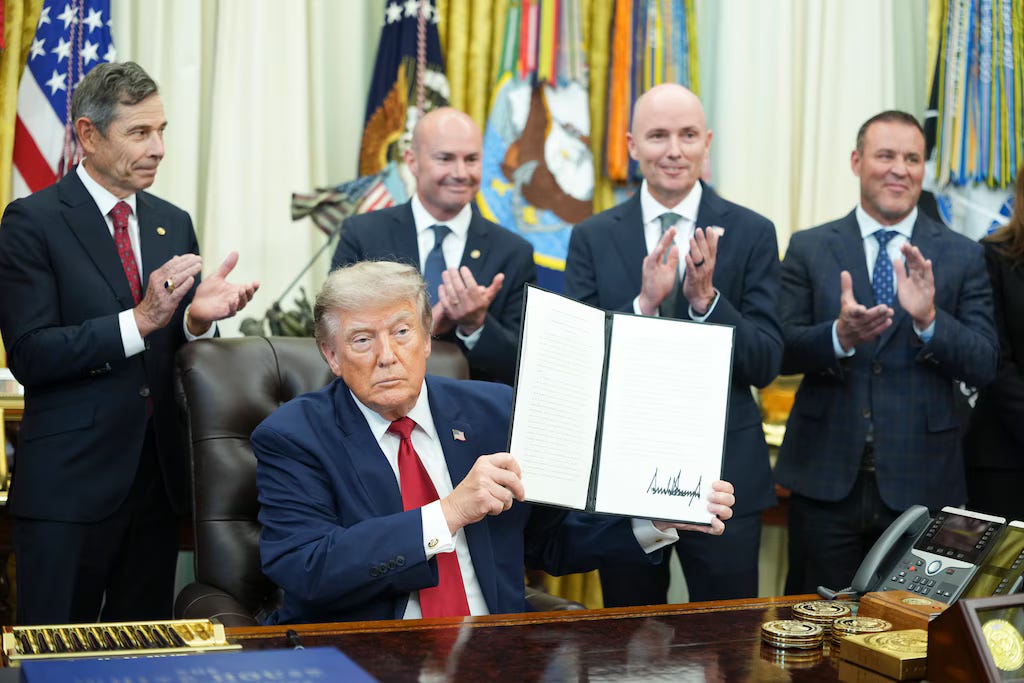
On July 13, President Trump cut Utah’s two biggest national monuments by 90%. Bears Ears National Monument went from 1.36 million acres to 121,096. Grand Staircase-Escalante went from 1.87 million acres to 181,541.
Utah’s leading Republicans were present for the signing in the Oval Office. Sen. Mike Lee had been working with local stakeholders and the Interior Department for a year and a half to get these cuts made.
The Bears Ears proclamation also revokes the co-management framework which five tribal nations (the Hopi Tribe, Navajo Nation, Ute Mountain Ute Tribe, Pueblo of Zuni, and Ute Indian Tribe) took ten years to achieve, and the Grand Staircase order ends a similar tribal co-stewardship arrangement there.
Back up. How’d we get here?
The Antiquities Act of 1906 lets presidents unilaterally protect “objects of historic or scientific interest” on federal land by proclamation, with one caveat: the reserved land must be the “smallest area compatible with the proper care and management of the objects to be protected.”
President Clinton designated the Grand Staircase-Escalante monument in 1996, and President Obama designated Bears Ears monument in 2016. Bears Ears is the first national monument ever established at the request of tribal nations, after five tribes petitioned for years to protect a landscape holding an estimated 100,000 archaeological and cultural sites, including cliff dwellings, kivas, granaries, burial grounds, and rock art.
Obama’s 2016 designation of Bears Ears National Monument kicked off 10 years of political ping pong.
In 2017, a year after Bears Ears was designated, President Trump cut the monument by roughly 85% and Grand Staircase by about half.
Tribes, conservation groups, and outdoor businesses then sued, arguing the Act lets presidents create monuments but not shrink or dismantle them.
But in 2021, President Biden restored both monuments, putting the lawsuits on pause.
Then the State of Utah sued Biden, arguing multimillion-acre monuments violate the “smallest area” clause in the Antiquities Act.
But on July 13, 2026, President Trump re-shrunk both monuments by about 90%. And on September 11th this year, the land opens up for mining claims.
Important note: On June 23, the 10th Circuit Court of Appeals ruled that Utah can sue the executive branch for illegal monument designations, but declined to rule whether President Biden’s designation was indeed illegal. The case is headed back to district court, where we will likely get a ruling on the legality of the larger monument boundaries. But that ruling cuts both ways. It makes Trump’s new reductions just as reviewable as Biden’s original designations.
What can be mined now?
The BLM has previously found the two monuments have very little oil and gas potential. Grand Staircase’s Kaiparowits Plateau holds a large coal deposit, but mining it is likely unprofitable.
Uranium is the most economically viable prospect. Uranium has quadrupled in price since 2017, and the original Bears Ears boundary took in hundreds of uranium and vanadium claims. Trump’s new proclamation cites other resources in the Bears Ears region, including copper, silver, lead, and zinc, although there is little evidence of large deposits of these materials.
Can the land be sold?
No. Removing monument status does not make it easier to sell this land. All of it remains public land under BLM management.
One point of clarification
During the signing, Trump claimed people can't hunt or fish in the monuments, and Deputy Interior Secretary Kate MacGregor affirmed him. This is inaccurate. Both monuments' rules explicitly allow hunting and fishing.
What supporters of the cuts are saying
These monuments were originally created despite Utah’s strong objections.
The original boundaries were much larger than the “smallest area compatible” that the Antiquities Act requires.
Smaller means better protected. A few rangers can’t monitor 3 million acres.
Utahns should be able to access and profit from their own lands.
Sen. Mike Lee (R-UT) is the main proponent of the reductions. He has focused his arguments on the legal element of the case as it has faced challenge after challenge in court.
“For too long, presidents have weaponized monument designations to lock up millions of acres, close roads, restrict grazing, and cut rural communities off from lands their families have lived on and worked for generations,” he said. “I thank the President for correcting this abuse and keeping his promise to the people of Utah.”
Cox, who has pushed this position for years, framed Monday as targeted protection rather than abandonment.
“It’s very clear that these monument designations are supposed to be the smallest area possible to protect the antiquities and these multimillion-acre monuments that are bigger than the state of Delaware certainly do not fit that designation,” Cox said. “We definitely care about protecting these antiquities, and will continue to do so. The problem is with these giant monument designations. There are no resources that come with those.”
Ben Burr, the executive director of BlueRibbon Coalition, an advocacy group for motorized recreation, has positioned the reduction as a great thing for hobbyists.
“The previous plans… restricted huge areas… to motorized recreation and other forms of recreation that still require motorized access of some kind. We think this will result in a much better position for the Utah recreation economy to be able to let the recreation users go in and access these lands.”
“Right-sizing these monuments to what the statute actually allows isn’t an attack on public lands; it’s how we keep them open for all Americans to enjoy. We plan to continue fighting in the courts and in the Congress to ensure that abuse of the Antiquities Act becomes a thing of the past.”
What critics of the cuts are saying
The Antiquities Act authorizes presidents creating monuments, not revoking them.
The Trump administration broke their written commitment to consult the inter-tribal coalition.
If the goal was better management, why dismantle the free co-stewardship support?
Heidi McIntosh, the managing attorney for Earthjustice, pointed to the legality of the monument reduction.
“President Trump’s attack on Bears Ears and Grand Staircase-Escalante National Monuments is just as illegal today as it was in 2017. The Antiquities Act authorizes presidents to designate national monuments, not to destroy them. Today’s proclamations are a slap to the face of public lands visitors across the country, as well as the local communities and Tribes that have worked for years to protect these special places. Earthjustice and our partners are prepared to vigorously defend the monuments once again.”
Autumn Gillard, coordinator of the Grand Staircase-Escalante Inter-Tribal Coalition and a Southern Paiute woman, went straight at the process.
“Our Tribes were not informed of or asked about this decision, and that’s unacceptable. The federal government must honor its Trust and Treaty obligations to our Tribes — it is not optional. Today’s action is a direct strike against the federal government’s duty to consult with Tribes. It also profoundly disrespects our intergenerational Traditional Knowledge by destroying a framework for Tribal co-stewardship over our ancestral lands in which we invested years of effort. Today’s action cannot stand.”
Erik Stanfield, an anthropologist with the Navajo Nation Historic Preservation Department, made the practical case against the whiplash.
“Every time the Monument is cut apart and put back together, proper land management gets delayed, public resources are wasted, and Tribes are asked to start over after years of consultation. We need stewardship and consistency, not reactionary politics.”
My take
The inter-tribal coalition deserved a heads up, at a minimum. A seat at the table would have been even better.
Utah’s management argument makes practical sense, but the proclamation’s own energy language undercuts the claim that this is only about stewardship.
If we’re going to preserve the beauty and history of Southern Utah, it needs to be through hard-fought compromise. Not running to the Oval Office.
I feel for the five rival tribes.
They received a written promise from the Department of the Interior that they’d be consulted about any reductions to Bears Ears, and then found out the President had not only cut the monument, but also unilaterally disbanded their hard-fought co-management agreement.
Yeesh.
Interior’s justification is that the Antiquities Act doesn’t require them to consult with the tribes. Legally, they’re right. But “you can’t sue us for this” is a pretty galling response to someone asking about the promise you just broke.
The Department of Interior could have made the reduction with their honor intact. They just needed to have a tough conversation with the tribes first. And they apparently didn’t.
Which brings us to the bigger question. Were these reductions justified?
I tend to agree with Utah officials that the monument sizes were not “compatible with the proper care and management...” Asking a few rangers to manage over 3 million acres of land is like asking the security guards at the Louvre to manage the entire city of Paris.
But critics also have a point that the Antiquities Act does not explicitly give presidents the power to reduce national monuments. That’s a legitimate argument that could win in court.
Both of these arguments are valid legal arguments. But I think what’s really going on here is much simpler.
Tribes want permanent federal protection of their ancestral lands.
And Utah’s leaders want control over as much of Utah’s land as possible.
This is a tale as old as the Antiquities Act itself. States don’t happily cede control of their lands to the federal government.
Grand Teton National Park was a 40 year battle between the feds and Wyoming.
Alaskans burned effigies of Carter and organized mass trespasses over Carter’s 1978 monument proclamations.
Olympic monument went through several size cuts before it was made a national park in 1938, despite protests from the timber industry.
Utah’s leaders are doing their fiduciary duty in pushing back against federal control of local land, just like those states were. And the federal government is doing their fiduciary duty by trying to protect lands of national value that are in danger of irreversible damage or exploitation. That tension is good and necessary.
The problem is that both critics and supporters are resorting to temporary unilateral wins, and then acting outraged when those wins turn into losses in four years.
Unilateral moves are designed to fail in America. And this move by Trump and Utah’s leaders is no different. Even if the courts rule that the monuments are too large, the next administration will likely find a way to tip the scales back in their favor through the privileges of the executive branch.
On balance, I want a significant portion of these lands protected. The heritage is real. The beauty is real. And the loss is real when these natural or manmade structures are defaced or looted.
But the real answer is not to go running to daddy’s Resolute Desk as soon as your favorite parent gets elected. It has to be solved through Congressional legislation that’s filled with hard bargains and compromises that neither side wants to make.
Then we’ll have a beautiful National Park or Preserve. One that’s smaller than the tribes want, and bigger than Utah’s leaders want. But one that lasts a lot longer than the next presidential cycle.
What would change my mind
For this article, I’m trying out a new section aimed at accountability for my take. If you like it and think we should include it across all articles, let me know.
On the ‘dishonor’ of the Department of Interior: If it turns out Interior did contact the Bears Ears Commission before July 13, the honor critique at the top of this take collapses, and I’ll say so. Same if Interior negotiates a new co-management agreement for the remaining 121,000 acres in the next year.
On Congress being the real solution: My take assumes the courts can’t end this fight. Only compromise through Congressional action can fix this long-term. If the Supreme Court hands down a ruling so decisive that the ping-pong actually stops, and the next administration doesn’t find a workaround, then the courts will have solved what I claimed only Congress could.
Think we got this one wrong? Tell us!
The sharpest reader responses may end up in a future article.
You really nailed it. You noted the broken promises, the legal challenges, and the unstable victories that unilateral political decisions create. A legislative compromise born out of the tension that you described so eloquently would likely create a permanent boundary that both sides may dislike, but would probably be the best outcome for everyone. Thanks for the even handed analysis! Appreciate your work!
This was never Utah's land. It was federal land before the monument designation, before Utah became a state. Utah has no claim to it, so those arguments fail. While possibly not the smallest possible area to protect the antiquities, I challenge you to name one part of either of these monuments that aren't worthy of protection. I've been to both; both are sacred landscapes, unique and irreplaceable.