


By Nick Huey, Editor-in-Chief
Ballots are hitting mailboxes this week! I want to pre-empt your reading today to tell you three things:
My personal take is at the end (I say how I’m voting, so skip it if you’d rather not know).
We gave Billy Hesterman, president of the Utah Taxpayers Association, exclusive access to this article and invited him to write a rebuttal. You can find his take right below mine.
If you want civic bonus points, I wrote this article on Amendment A, which will also be on your ballot. Amendment A is less controversial, but still has its detractors.
Reading time: about 15 minutes
Research & writing: about 18 human hours
What is Amendment B?
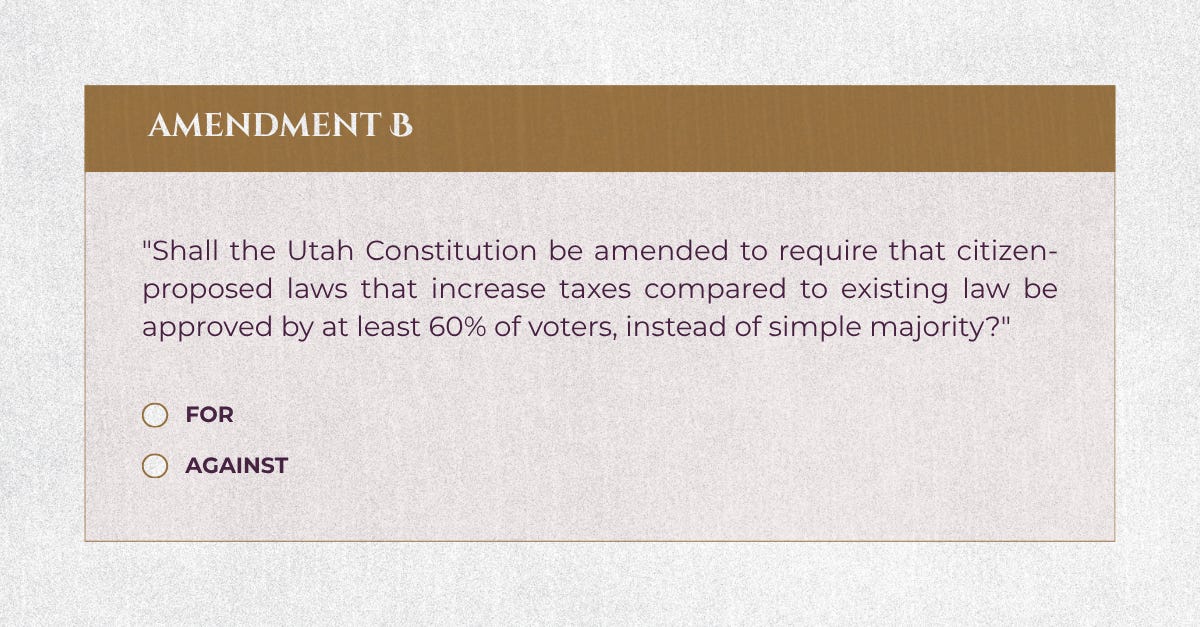
Amendment B asks one question: Should a citizen initiative that raises taxes need 60% of the vote to pass instead of a simple majority?
If Amendment B passes, any initiative voted on after Nov. 1, 2026, would need at least 60% if it does any of the following:
creates a new tax,
expands an existing tax to cover more items,
raises a tax rate, or
changes a property tax rate so that it “decrease[s] less than it would under current law.”
That last clause needs some explaining. Under Utah’s Truth in Taxation system, property taxes automatically fall as property values rise, keeping local governments from collecting more money simply because properties are worth more. Under the amendment, even an initiative that froze property tax rates, allowing the government to collect more as values rise, would count as a tax increase and require 60% voter approval.
It’s important to note that Amendment B covers taxes, not spending. An initiative that costs money but doesn’t raise a tax would still pass at 51%.
Who wrote Amendment B?
Lawmakers put this on your ballot with SJR2, sponsored by Sen. Lincoln Fillmore, R-South Jordan, and Rep. Jason Kyle, R-Huntsville. In the 2025 session, the Senate passed it 21-8. All 21 yes votes were Republicans. Six Democrats and two Republicans voted no. The House passed it 55-17, again with only Republicans in favor and 13 Democrats plus four Republicans against. Lawmakers had tried once before: A near-identical proposal stalled in 2024 after then-Senate Majority Leader Evan Vickers said too many amendments “really muddies the field when a voter goes to the polls.”
What do Utahns think?
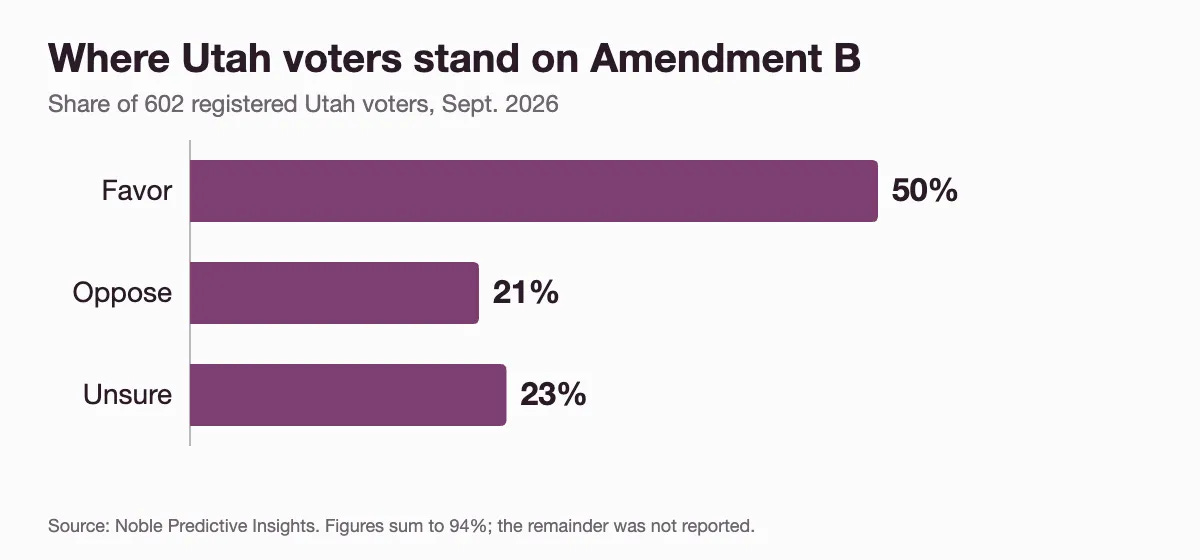
Noble Predictive Insights surveyed 602 registered Utah voters in September and found 50% in favor, 21% opposed, and 23% unsure. Support climbs with age, from 29% among voters 18 to 29 up to 64% among those 65 and older. Independents are the least settled group, with 35% unsure.
Today, we’ll share views from supporters and critics of Amendment B. Then I’ll give my take.
What supporters of Amendment B are saying
A tax increase takes money from the half that voted no. Laws like that should require broader consensus.
Lawmakers can be held accountable. Your neighbor who voted to raise your taxes cannot.
Ballot initiatives lack the debates and flexibility of legislation, making mistakes harder to correct.
Sen. Lincoln Fillmore, R-South Jordan, the amendment’s sponsor, presenting it to the Senate Revenue and Taxation Committee in January 2025:
“The question here is very simple. Do the people of Utah want 50.1% of the people in the state to be able to raise taxes on the other 49.9%? Or, when it comes to this type of a question, should there be a broader consensus? I don’t know what the people will decide. … But I’m certainly not afraid to ask.”
At the same hearing, Fillmore explained why a tax passed by lawmakers should face a lower bar than one passed by voters:
“If your representative votes to raise your taxes, there is a maximum of 18 months before you will get a chance to vote for or against that representative. There’s a maximum of three-and-a-half years, 42 months, before you’ll have a chance to vote for or against the senator who voted to raise your taxes. You will never get a chance to vote for or against your neighbor who voted to raise your taxes.” (KUER)
“I think there really is a difference with the ability for you to hold electorally accountable the people who vote to raise your taxes, and the people that you will never be able to hold electorally accountable for raising your taxes.” (Utah News Dispatch)
Senate President Stuart Adams, R-Layton, speaking to reporters in 2024 when the first version of the amendment was moving through the Legislature:
“You get something on the ballot and you just have to vote it up or down. You can’t amend it, you can’t substitute it, you can’t discuss it. And sometimes there are mistakes made, things that need to be tweaked.”
What opponents of Amendment B are saying
The Legislature can already rewrite a tax initiative it doesn’t like, and has. The 60% rule solves a problem that doesn’t exist.
This is one more piece of legislation designed to make citizen initiatives harder to pass.
If 60% is the right threshold for a tax increase, it should be applied to lawmakers too.
Katharine Biele, president of the League of Women Voters of Utah, in an exclusive interview with The Plum:
“The Legislature already has the power of the purse and can revise any citizen initiative (unless it is one to change the form of the government). In other words, Amendment B is unnecessary.
“Requiring a 60% threshold for initiatives gives a minority of voters the power to block popular policies and those that could fund needed public services.”
Helen Moser, director of voter services for the League of Women Voters of Utah, testified on her own behalf at the January 2025 Senate committee hearing:
“It would make it significantly higher for citizens to enact any kind of meaningful change through the ballot initiative process. In addition, it allows a minority of voters to overrule a majority of voters, which really undermines the fundamental principles of our country.”
When the House took up the amendment alongside SB73, Moser warned:
“Together with SJR2, (SB73) really makes it nearly impossible for grassroots efforts to succeed while large, well-funded interests can still navigate the system. … these extra barriers only silence the people.”
Rep. Jennifer Dailey-Provost, D-Salt Lake City, the House minority whip, in committee in 2024, on the first version of the amendment:
“I would be less opposed to this if we first imposed on ourselves a requirement to get to 60%, but to sit here and say ‘I think we should do this as legislators’ and not actually follow up with anything substantive … does nothing more than continue to erode the confidence the public has in us.”
My Take
Tax laws are complicated, and mistakes in ballot initiatives can’t be fixed until after voters decide.
We should expect our lawmakers to amend citizen initiatives to make them better. That’s their job.
Raising the bar to 60% serves legislators more than voters, and weakens one of our most powerful tools as citizens.
I’ll start with where I believe supporters are right. Writing good legislation is extraordinarily difficult, even when it’s your full-time job. A bill at the Capitol can be amended right up to the final vote. In contrast, a citizen initiative gets a fiscal estimate, seven public hearings and one chance to revise, and then it’s locked in for a yes-or-no vote. Whatever flaws are still in it on Election Day are in it the day it becomes law. That makes it hard to get a tax law right, especially one that’s going to raise taxes for every Utahn who didn’t vote for it.
In that context, this amendment seems perfectly reasonable. If you’re going to raise taxes in this way, you need a supermajority to do so.
But there was one thing that I didn’t quite understand. Why was the Legislature making this a priority now?
That’s when I started looking at the most recent tax-related citizen initiatives to see what could have inspired this amendment.
Which recent initiatives would Amendment B have affected?
A lot of Utahns assume that this amendment is a response to Prop. 4, the 2018 initiative that created an independent redistricting commission, but Prop. 4 didn’t raise a tax, so Amendment B wouldn’t have actually affected it.
However, there are two other recent citizen initiatives from 2018 that Amendment B would have likely stopped from passing:
The Our Schools Now initiative would have raised roughly $700 million a year for schools by raising both the income and sales tax rates by 0.45 percentage points. But the petition was dropped after the Legislature cut a deal with the architects to keep it off the ballot.
The Prop. 3 Medicaid Expansion initiative sought to give more Utahns access to Medicaid, paid for by raising the state sales tax from 4.7% to 4.85%. The state’s share of the cost was estimated at about $77 million a year, and the tax was expected to bring in about $90 million.
After it passed with 53% of the vote (short of the 60% Amendment B would require), the Legislature passed SB96 to repeal it and replace it with a smaller expansion. It covered adults up to the poverty line instead of 138% of it, added work requirements, and let the state cap enrollment if costs ran high. Its sponsor, Sen. Allen Christensen, R-North Ogden, argued that full expansion was not financially sustainable.
The backlash was not fun for lawmakers.
On the day of the House vote, faith leaders knelt in front of the chamber doors with their elbows locked, praying. One of them, the Rev. Curtis Price of First Baptist Church of Salt Lake City, called the bill “a war on the poor.” Inside, then-Speaker Brad Wilson, R-Kaysville, warned he’d clear the gallery after an outburst, and protesters unfurled a “Respect our vote” banner anyway. Utah Decides Healthcare, the group behind Prop. 3, had already spent more than $100,000 on TV ads, and its spokesman accused politicians of “striking backroom deals designed to overturn the clear will of the voters.” Prop. 3’s backers called SB96 “a dark day for democracy in Utah,” and The Salt Lake Tribune’s editorial board called the repeal “a cruel lie to the people of Utah.”
These two initiatives are the clearest motives I can find for writing and passing Amendment B now. In fact, when the Legislature struck its deal with Our Schools Now, Senator Fillmore said the compromise bill “ends the threat of the largest tax increase in the state’s history.” It’s not hard to draw a line from this deal to Amendment B, which would make anything like it much harder to pass again.
Fillmore rejects this reading. Amendment B “is not designed to stop any particular initiative,” he told The Plum. “It is designed to require broad public support and consensus before a bare majority of voters can impose higher taxes on everyone else.” He may well see it as a general rule, but the timing is hard to ignore. Since 1952, Utah voters have approved seven citizen initiatives, and Prop. 3 is the only one that raised a tax.
I can’t know what’s in his head. But I think 2018 is why this is on your ballot.
If I’m right, I don’t actually blame Senator Fillmore. Citizen initiatives like these must be a massive headache for legislators. In the case of Our Schools Now, the initiative handed enormous bargaining power to the sponsors, forcing the Legislature to give up more than they wanted in order to fend off a larger tax increase at the ballot box. And in the case of Prop. 3, legislators had to weather months of bad press and attacks on their motives for what they saw as protecting Utahns from fiscally unsound legislation.
With Amendment B, most of that headache goes away. Legislators don’t have to try to convince half of Utah that they are changing this tax-raising legislation for their good. Because now, that legislation will probably never make it to their desks.
That sounds like a really good deal for the Legislature. Is it as good of a deal for Utahns?
Legislators would say yes because it’s an extra barrier against runaway taxation. And they’re right. This does make it harder for Utahns to pass tax increases.
But that barrier is already pretty high.
Barrier #1: Publicly disclosed funding mechanics (SB73)
SB73 requires sponsors to spell out how they’ll pay for the initiative, including any new tax and its rate or the existing programs that would lose money. If the lieutenant governor finds the math doesn’t add up, the initiative is rejected before sponsors can collect a single signature.
Barrier #2: Collecting signatures
Sponsors need signatures from 8% of active voters statewide and in 26 of 29 Senate districts. That's about 140,750 valid signatures, roughly the population of West Valley City.
Barrier #3: Paying to publish the initiative
Starting in 2027, sponsors have to publish their entire initiative application the same way the state publishes a proposed constitutional amendment. The Salt Lake Tribune estimated that it could add about $1.4 million to the cost of an initiative.
NOTE: If Amendment A, the other amendment on your ballot, passes, these notices could go online instead of into newspapers and most of that cost would disappear.
Barrier #4: Winning at the ballot box
After all of that, 51% of voters would have to approve the initiative.
Barrier #5: Surviving the Legislature
And if the initiative survives, the Legislature could still repeal or amend it how they see fit, which is exactly what happened to Prop. 3.
We can add a sixth, 60% threshold barrier on top of all this if we want to. Before we do that, we should understand what we would be giving up to add it.
We would be giving up one of our most powerful tools as citizens: the ability to force the Legislature to talk about issues we care about between elections.
Voting someone into (or out of) office is powerful, but voting about a specific policy is a different kind of leverage. It’s our one way to say to whoever is in office, “We care about this issue. Here’s our best guess for how to fix it. Now keep this law, or explain why you changed it.”
To me, that changes the calculus of this debate and makes me hesitant to accept the 60% threshold the Legislature wants. I think it serves the Legislature more than the people because it allows them to avoid a conversation that a lot of voters apparently want them to have.
A 60% bar is a blunt instrument. It makes no distinction between good initiatives and flawed ones. It just makes them all harder to pass. If we keep the current majority threshold, lawmakers could still address problems by refining the initiatives that pass into more thoughtful, effective laws.
Lawmakers may not like the political cost of stepping in and changing these initiatives, but I think that’s an important feature. When lawmakers rewrite something voters passed, they do it in a recorded vote, and they answer for it at the next election, where voters can judge whether the rewrite kept faith with what they passed.
Yes, that’s a headache for lawmakers. But if Utahns are willing to go through the effort to pass a ballot initiative, I think it’s a headache that’s owed them.
If 51% of Utahns want the Legislature to consider expanding Medicaid, then I think the Legislature should go ahead and have the hard conversation about Medicaid. And if lawmakers decide against the changes voters passed, then they should clearly explain why.
By the same token, citizens shouldn’t automatically get mad when the Legislature changes an initiative. In fact, I would argue that as citizens we should expect them to change the initiative.
The first draft of a law is rarely the last, even at the Capitol. So I wouldn’t judge lawmakers for amending an initiative. I would judge them on whether the amended version is true to the goals of the version that voters approved.
Citizen initiatives are one of the few levers we have outside of elections to pressure our lawmakers into addressing the issues we want them to address.
Amendment B would weaken that lever.
What would change my mind:
If SB73’s money check turns out to be toothless. SB73 is new. If the lieutenant governor’s office were to start approving funding plans that clearly don’t add up, one of the barriers I’m counting on wouldn’t really be a barrier.
If lawmakers lost the ability to fix a flawed initiative. My whole argument depends on the Legislature being able to amend a tax initiative that passes. In 2024, the Utah Supreme Court limited how much lawmakers can change initiatives that reform government, like Prop. 4. That ruling wasn’t about tax laws. If courts ever extend it to tax-raising initiatives, a higher bar at the ballot box starts to make a lot more sense.
If fear of voters kept lawmakers from fixing a bad tax law. If lawmakers start leaving seriously flawed tax initiatives alone because they’re afraid of public backlash, I would reconsider whether citizen initiatives are a good thing altogether.
A rebuttal: The case for Amendment B
By Billy Hesterman, president of the Utah Taxpayers Association
From my perspective, Amendment B isn’t solely about increasing taxes. It is also about protecting Utah from being overrun by outside interest groups.
While it sounds nice in theory to imagine a scrappy group of Utahns coming together and doing the grassroots work necessary to put a proposed change to state law on the ballot, that just isn’t how things typically happen. Initiative campaigns cost hundreds of thousands, if not millions, of dollars to pass. As we’ve seen with ballot initiative campaigns over the last 10 years, these efforts have not been funded primarily by local families and businesses. Instead, they’ve been supported largely by out-of-state organizations that stand to benefit from the proposals being approved.
According to the state’s financial disclosure website, for Proposition 3, the initiative to expand Medicaid in Utah, the largest donor was a Washington, D.C.-based group known as the Fairness Project, which poured about $3.5 million into passing the initiative. United Way of Salt Lake was the largest Utah-based donor, contributing $75,000 to the effort.
For Proposition 2, the initiative to allow medical marijuana to be dispensed in Utah, the Washington, D.C.-based Marijuana Policy Project was the largest donor at about $318,000, while the local libertarian think tank Libertas Institute was the largest Utah-based organizational donor at $135,000.
For Proposition 4, perhaps the most well-known ballot initiative because it created Utah’s Independent Redistricting Commission, many of the largest donors were also from out of state. Action Now Initiative, a Texas-based philanthropic organization associated with billionaires John and Laura Arnold, donated more than $1 million to pass the initiative. The California-based Campaign for Democracy gave $100,000, as did SEIU-United Healthcare Workers, which is also based in California.
I believe in free speech, so I don’t mind if out-of-state organizations choose to spend their money on issues in Utah. But that’s also precisely why I believe Utah needs a higher standard when someone wants to raise taxes.
Raising taxes means less money in Utah families’ bank accounts. It means less money for a business to pay its employees, and it means less money for Utahns to spend at their favorite local restaurants or retail stores.
Simply put, raising taxes should not come down to who spends the most money during an election cycle. When even a single dollar is going to leave a Utahn’s pocket, I want to be certain that a substantial majority of Utahns support that decision, rather than having it decided by a simple majority persuaded by catchy advertising campaigns and political parties’ get-out-the-vote efforts.
Is this a belt-and-suspenders approach to raising taxes? You bet it is. But I don’t apologize for that. Raising taxes should be difficult.
For local elected officials to raise property taxes, they must hold a public hearing to inform residents of the proposed increase. A notice of that hearing is sent to every property owner in the jurisdiction. These hearings are often painful experiences for elected officials, who must listen to residents and answer difficult questions about why they believe additional tax revenue is necessary.
For the Legislature to raise taxes, lawmakers must consider the proposal in a public committee meeting, where members of the public have an opportunity to comment on and question the proposed increase before it can move forward.
Then, both local and state elected officials must answer to their constituents for those tax increases when election time comes around.
It isn’t easy for them, and I believe that if an outside group wants to come into Utah and campaign to raise taxes on Utahns, it shouldn’t be easy for that group, either.
As with nearly everything in public policy, this approach isn’t perfect. But I believe it is pro-taxpayer, pro-Utah families and businesses, and in the best interest of our state to ensure that all voices are heard and considered before more money can be taken from Utahns.
Did Billy change my mind?
Partly. Billy is right that citizen initiatives are usually funded by outside money. I’m surprised I missed that.
But Amendment B wouldn’t change how these citizen initiatives are funded. The difference is they’ll be much harder to pass.
And that’s the whole point. If you feel, as Billy does, that raising taxes deserves a different threshold than other legislation, then Amendment B makes perfect sense.
I’ll be voting “no” for the reasons I stated above, but I understand and respect Billy’s rationale, and I’ll sleep just fine if Utahns decide “yes.”
Can’t wait to see what Utah decides.
Think I got this one wrong? Write a response.
The sharpest reader responses may end up in a future article.
It seems to me that the way to protect outside interests from influencing Utah ballot initatives would be to ban outside money from funding citizens initatives. In the same bill we could ban corporations and corporate PACS from donating to political races.
This feels like just another power grab by the state legislators. They have already made citizen initatives so much harder by changing the signatures needed and from where. And by raising the Senate Districts threshhold to 26.
Appreciate your analysis, but as folks familiar with Utah's ballot initiative process in general, we’d like to add some important context:
The first: The context of 2024's Amendment D, which state legislators put on the ballot complaining about outside interests and saying it would "strengthen the ballot initiative." (It would have done the opposite). As citizens who follow the state's actions closely and have watched them whittle away at power from the executive branch, the courts, and recently the people's ballot initiatives, we rightly feel suspicious that this is another attempt to curtail our power.
Second: One sponsor mentioned voting incumbents out. What they left out is that current lawmakers have a huge advantage. Voting out incumbents is really hard. As mentioned, votes could be up to 2 or 4 years away, which most elected officials realize is an eternity (most voters don't remember votes or positions from years ago). If voters are upset enough by their representative, they then have to defeat an incumbent who likely has the head start of name recognition, party support, and plenty of fundraising. Voting people out is not simple, easy, or cheap even when that politician is unpopular. In our opinion, this "just vote them out" argument is oversimplified and flawed, ignoring the realities of elections in Utah (and elsewhere).
Third: We've seen a lot of claims that ballot initiatives prioritize outside special interests. It is interesting that state leaders claim that
a) building a grassroots movement to collect signatures, the highest threshold of any state, just to get on the ballot, then
b) persuading over 700,000 Utah voters to vote for something (and that's just the simple majority scenario; over 1.4 million Utahns voted in the 2024 election)
Is more prone to the adverse affects of "special interests" than just a simple majority of state legislators (that's 53 total people) getting pressure from donors, lobbyists, and party leaders. Knowing how much pressure lawmakers face even from their own party, delegates, and outside organizations like the Eagle Forum / Utah Parents United / many other organizations to pass certain bills, we find this argument frankly baffling. We believe in our neighbors, Utah voters, and find them much less susceptible to such pressure.
Fourth: It is extremely hard to pass a ballot initiative. It takes over 140,000 signatures from Utah voters, significant fundraising (from within and without the state—most of the initiatives that legislature leaders grumble about receive donations from thousands of individual Utahns), and requires widespread voter support to pass. A simple majority keeps hundreds of thousands of citizens' votes co-equal with a simple majority of elected representatives; a check and a balance. Lawmakers know that 60% is virtually impossible (see Florida, which passed this two decades ago and hasn't passed a law since—13 have failed), which makes the threat of ballot initiatives less potent. (We believe that’s the goal)
Lastly: Utah leaders actually do have the ability to make changes to citizen-led ballot initiatives afterwards if there is a compelling state interest. That's in the Supreme Court decision! Lawmakers just can't meaningfully change it away from the intent of the law citizens passed, as leaders arguably did with all 3 ballot initiatives passed in 2018. That hasn't seemed to make them happy.
We’ll be voting no to protect Utah citizens’ power and hope many more join us.