


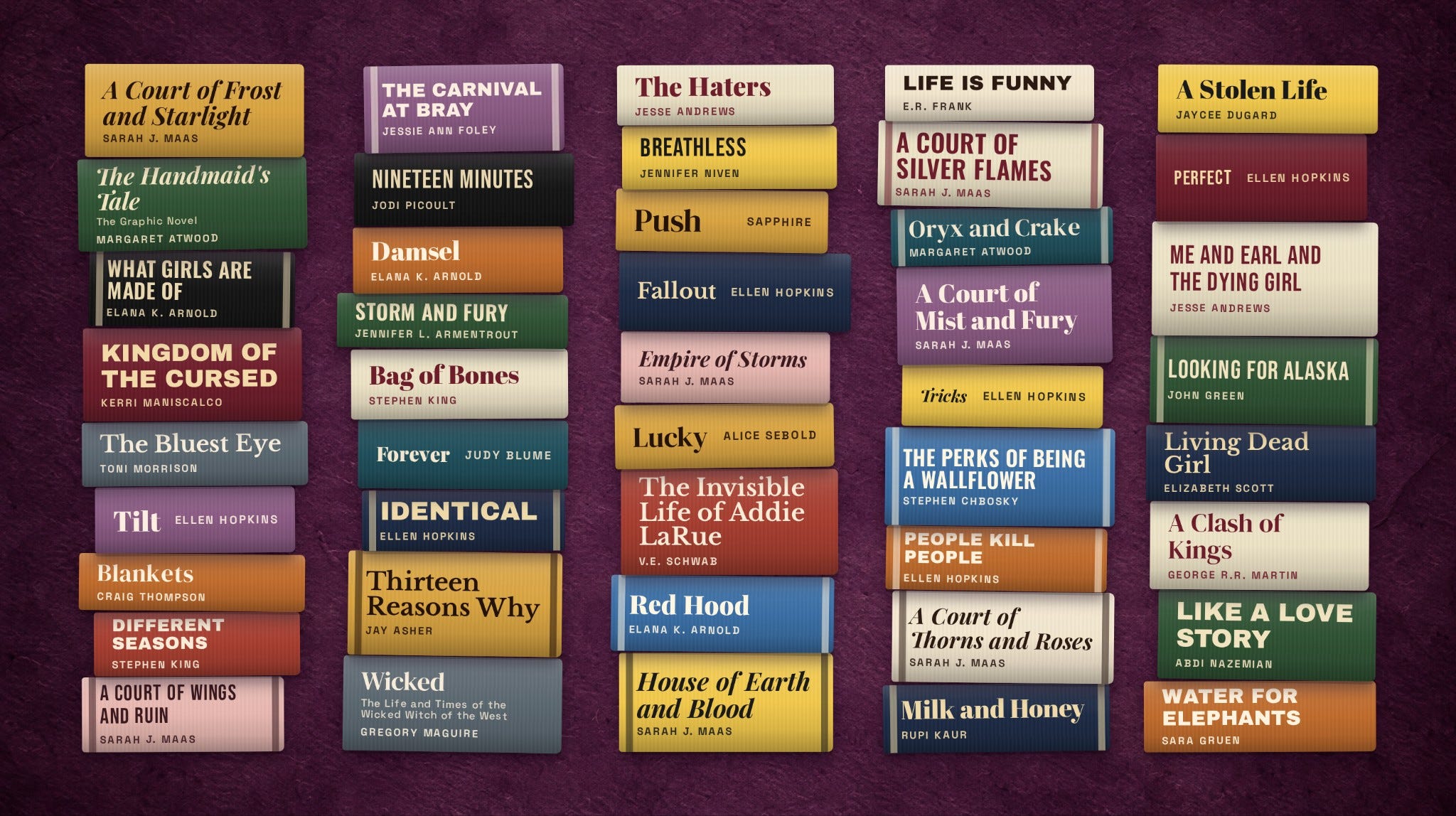
Utah’s statewide list of books pulled from public school libraries now stands at 44. Is the law protecting kids, or pulling books that deserve to stay? Today we’ll share views from supporters and critics of Utah’s sensitive materials laws. Then, contributing writer Erica Royer’s take.
Today’s Read
Research and writing: about 20 human hours
Reading time: about 16 minutes
A note on terminology: At The Plum, we try to introduce issues without taking sides. But even the words used to describe this issue can suggest a position. “Book bans” can sound like opposition, while “sensitive materials laws” can suggest support. Both terms are common in news coverage, so we’ll use them, but try to balance one with the other. Otherwise, we’ll stick with “book removals,” which we hope is more neutral.
Utah passed its sensitive materials law, HB 374, in 2022, then expanded it with HB 29 in 2024. Today 44 books are banned from public school libraries statewide, while individual districts have banned additional titles. Both the statewide and district-level lists continue to grow. In Davis School District alone, more than 130 books have been removed.
What began as disputes over individual books in local school libraries has become a statewide system in which decisions by three districts can determine what books are available to every public school student in Utah.
How it started
The conflict gained momentum in 2021, amid a national surge in school book challenges fueled by debates over parental rights, sexuality, race, and education.
That November, Canyons School District temporarily pulled nine books from its high school libraries following a parent’s complaint about their content. The district failed to follow its established review procedures, which drew criticism from library and civil liberties organizations.
Meanwhile, parent activists in several districts argued that schools were giving children access to sexually explicit books and that existing review procedures weren’t adequately addressing their concerns.
Utah Parents United, emerged as an influential voice, with then-curriculum director Brooke Stephens helping organize challenges to books she considered inappropriate. Rep. Ken Ivory, R-West Jordan, took up the issue in the Legislature, joined by Sen. Todd Weiler, R-Woods Cross.
During the 2022 legislative session, Rep. Ivory introduced HB 374, which prohibited pornographic or indecent materials in Utah’s public schools. The original proposal broadly restricted sexual descriptions and vulgar language in instructional materials. It also allowed parents to sue districts that failed to remove prohibited materials within 30 days of written notice, with $10,000 in damages per violation plus attorney fees.
Lawmakers substantially narrowed the bill before passing it. They removed the lawsuit provision and tied prohibited materials to existing state pornography and indecency statutes. The final law relied on school districts to review challenged materials. It required that districts include parents in those reviews and directed the State Board of Education to provide guidance and training. Districts were to report how they handled complaints, including their reasons for retaining challenged books.
The sensitive materials law’s rollout
The law had a bit of a bumpy start.
School districts struggled with growing numbers of challenges and different interpretations of the statutory requirements. Some books were removed in one district but retained in another.
A 2023 KSL investigation found that Davis School District had received 129 book challenges, resulting in 38 districtwide removals. Across 17 large districts, The Salt Lake Tribune identified 262 book removals. Many of the books addressed subjects ranging from sexuality and gender identity to racism, abuse, and trauma.
In December 2022, a parent challenged the King James Bible over its descriptions of sex and violence. A Davis review committee removed the Bible from elementary and junior high school libraries, although it concluded the text did not violate the sensitive materials law. The decision was based on age appropriateness. The school board unanimously reversed the removal that June.
“Frankly, this is embarrassing,” said Rep. Brady Brammer, R-Pleasant Grove. “It’s embarrassing for the state. And it’s embarrassing for the Davis School District.”
The 2024 expansion
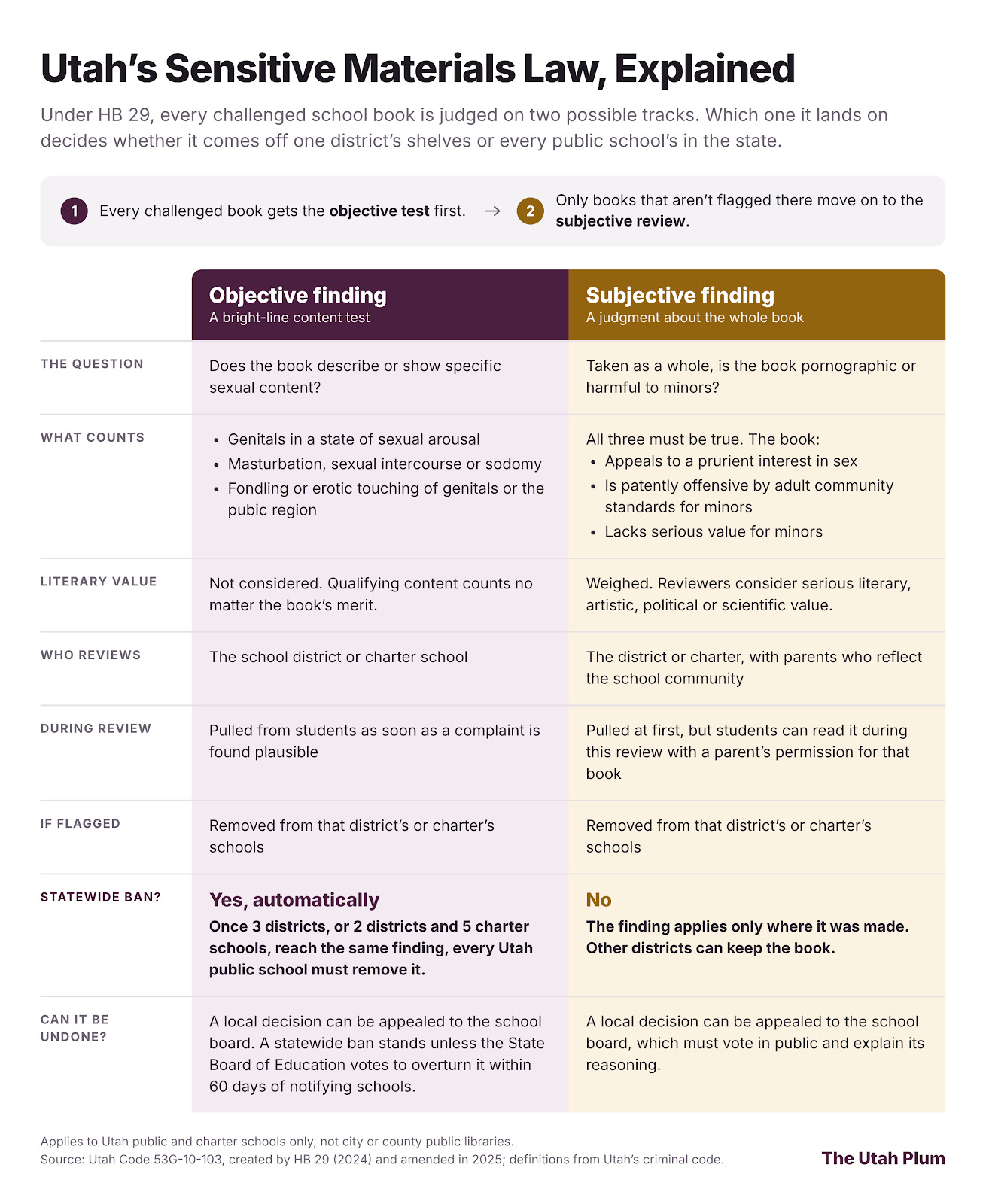
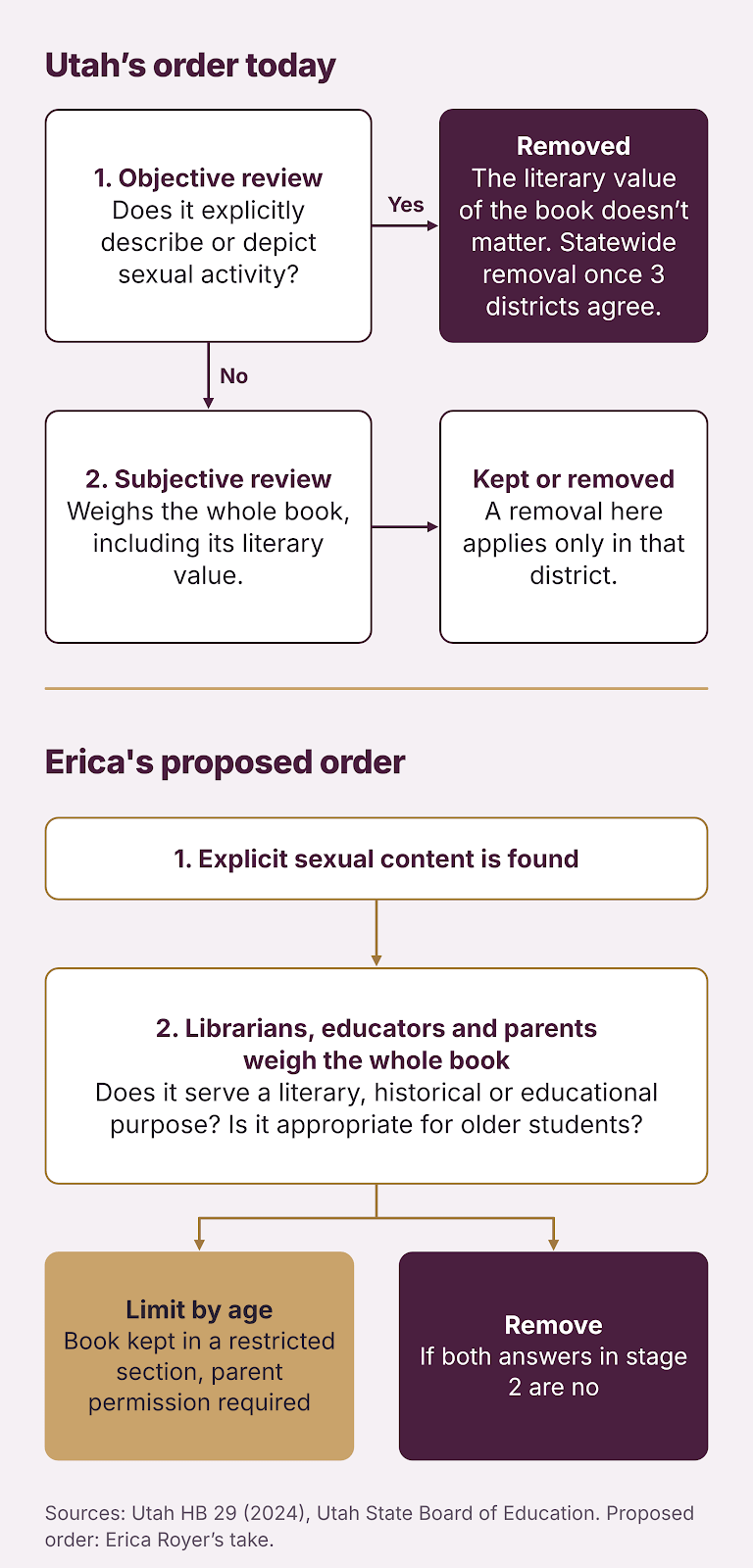
Ivory and Weiler returned to the Legislature in 2024 with HB 29. The legislation clarified two separate standards for reviewing books: objective and subjective.
Under the objective standard, certain descriptions or depictions of sexual activity can justify removing an entire book, regardless of its broader literary value. Judy Blume’s Forever, for example, was removed under this standard because of its explicit descriptions of teenage sexual activity.
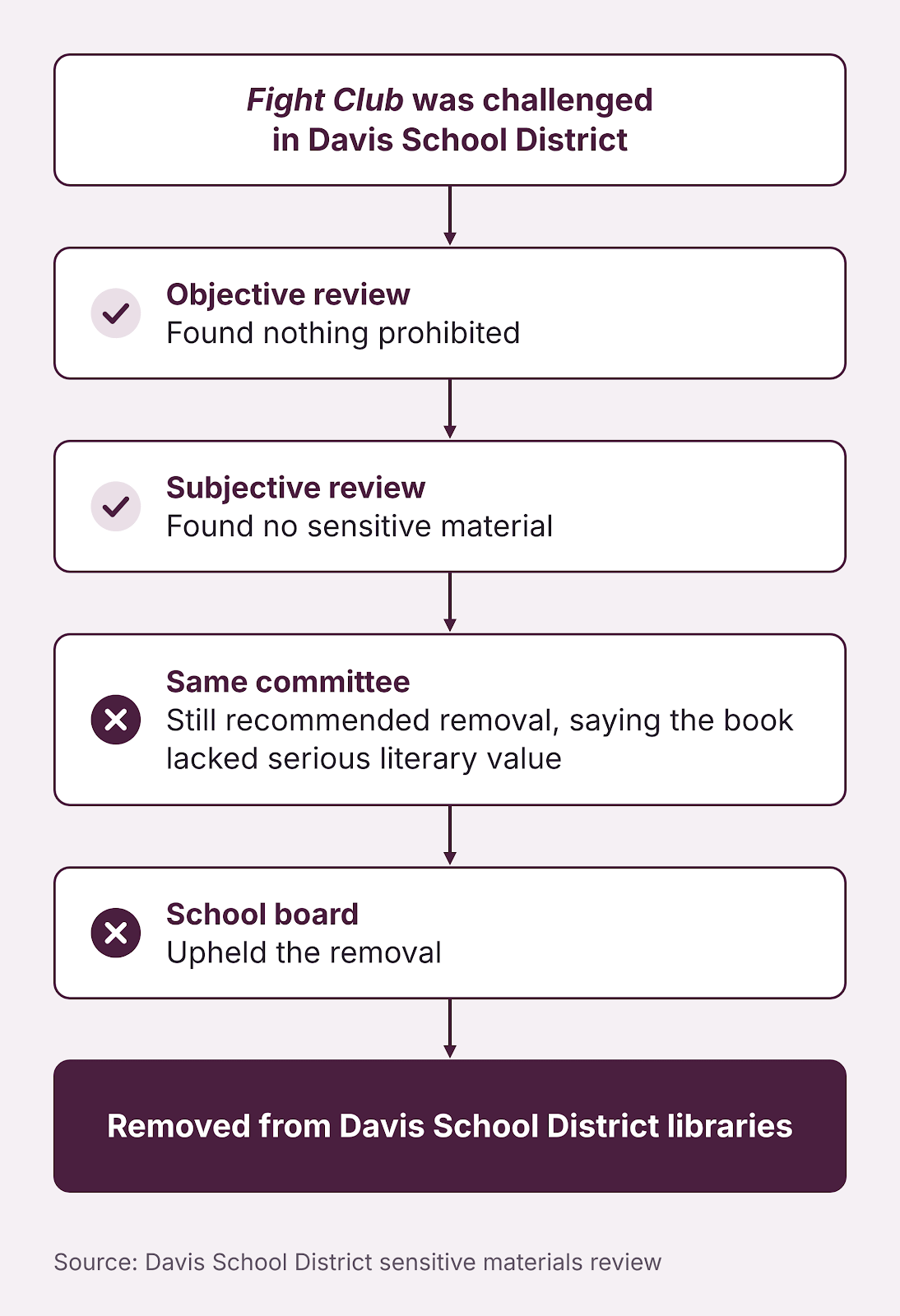
If a book doesn’t meet the criteria for removal under the objective standard, it moves on to a subjective review, which considers the work as a whole, including whether it has serious literary, artistic, political, or scientific value. In Davis School District, reviewers determined that Chuck Palahniuk’s Fight Club contained no material prohibited under Utah’s objective standard. Although the subjective committee also found no sensitive material, it recommended removing the novel based on its opinion that the book lacked serious literary value. The school board ultimately upheld its removal.
Books deemed subjectively sensitive can be removed by individual districts, while objective findings can trigger an automatic statewide ban once three districts reach the same conclusion.
In August 2024, Utah released its first statewide removal list. The 13 titles included Judy Blume’s Forever, Margaret Atwood’s Oryx and Crake, Elana K. Arnold’s What Girls Are Made Of, and six novels by Sarah J. Maas.
A growing list and a legal challenge
On Sept. 28, 2026, the statewide list grew to 44 titles, including Toni Morrison’s The Bluest Eye, Stephen King’s Different Seasons, and John Green’s Looking for Alaska.
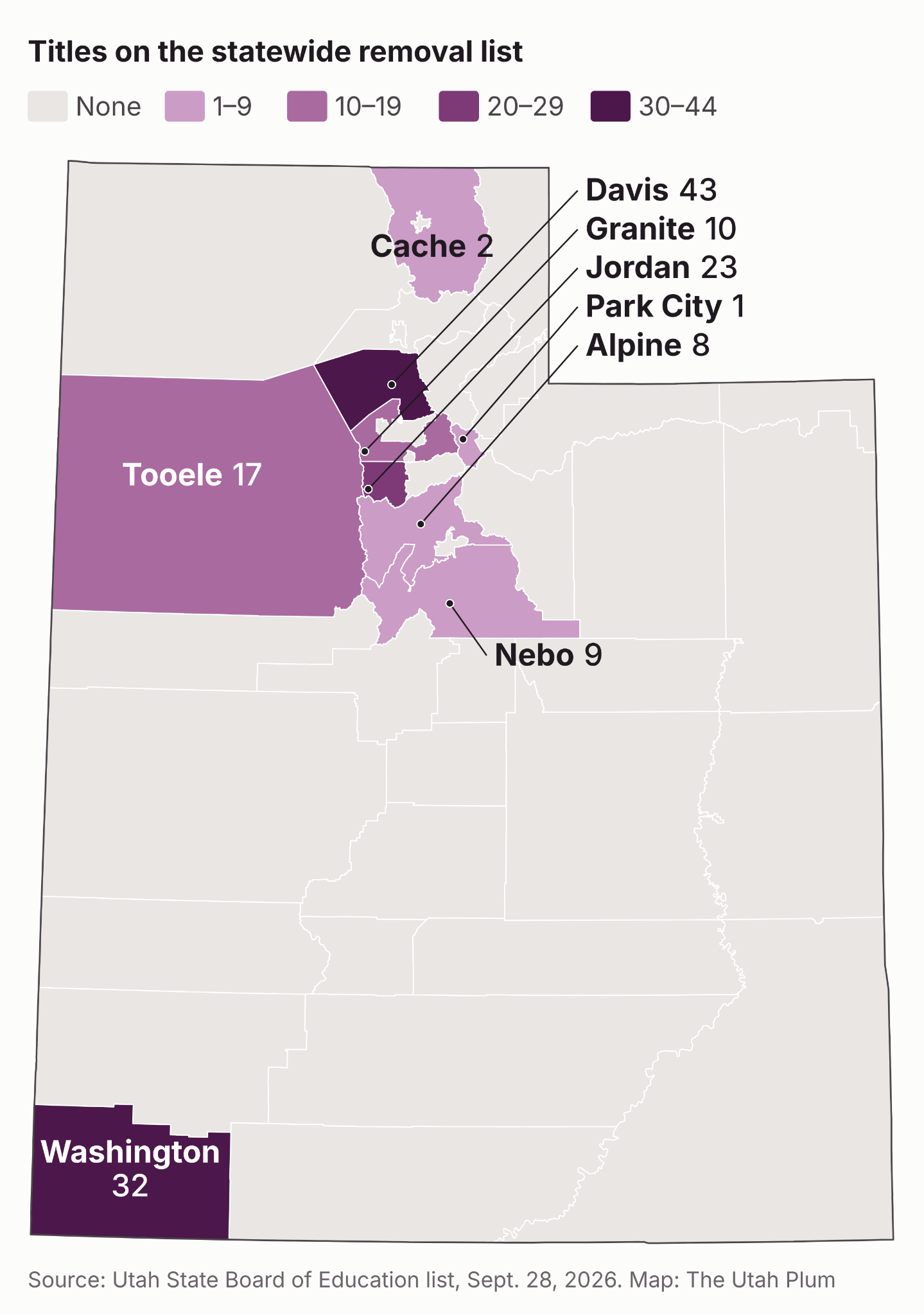
The removal decisions are concentrated in a handful of districts. According to the State Board of Education’s list, only nine of Utah’s 41 districts appear among the qualifying determinations. Davis appears in 43 of the 44 entries, Washington in 32, Jordan in 23, and Tooele in 17.
In January 2026, the ACLU of Utah filed a federal lawsuit arguing that the law unconstitutionally restricts access to protected expression. A federal judge has since ruled that significant portions of the lawsuit can proceed, without deciding whether the law violates the Constitution.
What supporters say about Utah’s book removals
Removing books from schools isn’t banning them; families can still get them elsewhere.
Some books contain material too explicit to legally share in legislative hearings.
The First Amendment doesn’t protect minors’ access to legally prohibited sexual content, and schools should respect parental rights.
In a conversation with The Plum, state Rep. Ken Ivory, R-West Jordan, who sponsored HB 374 and HB 29, maintained that calling the removal of these books a ban is misleading.
“People throw around the word ban very inappropriately. Nothing is banned. These are just reasonable limits on what is provided and not provided to children at taxpayer expense in a compulsory education system in public school. Parents could go to the public library or to brick-and-mortar bookstores or order things online. … None of that has been banned, as people would say. Just simply have reasonable protections. It goes both ways, right? Should a parent have the right to determine that their child should be protected from such things in public school? That choice was being completely taken away from parents.”
Rep. Neil Walter, R-Santa Clara, chair of House Education Committee, told The Plum sharing the material in the Legislature would have violated Utah’s obscenity laws.
“We found that there were books that had been shipped to school libraries and shelved without anybody looking at them, and when people started looking at them, there was a lot of concern about the material. For example, some of the material that was brought to the Legislature could not be shown because putting it on the public record would violate Utah’s obscenity statutes. And so, some of that material was brought to the committee, and they asked the chair … if that could be distributed to the members of the committee, and the answer is no, because now you’ve essentially publicly distributed material that violates Utah’s obscenity laws. So when we started this process, we found that we had material that was inappropriate for schools — was inappropriate for children. It wasn’t in every school. It wasn’t widespread, but we felt like we needed to get ahead of that.”
In an open letter to parents published in the Deseret News, Brooke Stephens and Gloria Vindas argued that the First Amendment does not protect minors’ access to vulgar content.
“The First Amendment protects lawful speech, not vulgar content declared to have no value to minors. Our society already rates media, such as movies, music, video games and TV. There is no public outcry that movie ratings destroy freedom of speech, because parental guidance is publicly accepted. In a parents’ rights state such as Utah, taxpayer funded schools have no legal right to override parental discretion with criminally indecent and pornographic books.”
What critics say about Utah’s book removals
Book bans limit students’ autonomy and critical thinking, and disproportionately affect books about marginalized communities.
Parents should decide what’s appropriate for their own children, not everyone else’s.
Books about difficult subjects, including sexual abuse, can help young people understand real-world experiences and develop empathy.
Dr. Sarah M. Coyne, professor of family life at Brigham Young University, told The Plum in a statement that banning books can hinder adolescents’ development of critical thinking skills.
“I would love more depictions of sexual health messages in novels, and context of sex definitely matters. There is very little research on the effects of this content though, particularly in an increasingly digital world.
“I am completely against book bans, and would encourage the Utah Legislature not to support them. I trust librarians far more than the government to choose what is appropriate in their libraries. Banning certain books based on a specific value system places limits on adolescent and school autonomy and the development of critical thinking. Also, banned books tend to primarily involve BIPOC and/or LGBTQ+ authors or topics. This is discriminatory and sends a strong message to the community of intolerance. It is also a very slippery slope, reminiscent of the book banning in the late 1930s and 1940s in Germany. I would love for books to have content ratings on the back, similar to television programs, video games, and movies to provide information as opposed to complete bans.”
Dr. Mandy Luszeck, assistant professor of English education at Utah Valley University, told The Plum that these decisions belong in individual homes, not schools.
“Individual families and parents should have the ability to monitor and help to guide their children’s access to certain materials. They know their kids, and they know what material might be appropriate for them or what might be too mature or not OK, and those conversations are OK, but that means that the parents are having conversations with their kids, that they’re willing to say, ‘Let’s look at this book, and let’s see what’s in it, and let’s talk about it, and talk about if you’re ready for this content or you’re not.’ That should be happening at home.
“I do think that if there is content that parents are concerned about, that they should have the right to ask for a different option. What I don’t think they should be allowed to do is make the decision for every student in the school or every student in the district. They have the right to make the decision for their child, but not for every other child who may have very different life experiences and backgrounds, and might need to hear some stories that maybe another family’s child does not need to hear yet or is not ready for yet.”
Shannon Hale, Utah’s Ambassador for Young People’s Literature and author of 50 children’s and young adult books, said Utah’s laws remove books that can help young people navigate difficult real-world experiences.
“Labeling books about abuse and rape as ‘pornography’ is not only misleading, but it prevents teens from engaging with these important stories. … A friend of mine is a high school teacher, and she has her freshmen classes read ‘Speak’ by Laurie Halse Anderson, a frequently banned book. Speak shows, in a non-graphic, compassionate way, a freshman girl’s experience after an upperclassman rapes her at a high school party. For many of the boys in my friend’s class, it was the first time they’d been asked to truly empathize with a female character, let alone a girl in this situation. One freshman boy wrote in his reaction paper: ‘I’m stuck. In “Speak,” the girl gets raped. But she was drunk. Before I read this book I would have said that if a girl is drinking and gets raped, it’s all her fault. But now I am not sure. I mean, she was stupid for drinking. But he shouldn’t have done that, no matter what.’
“How did the experience of reading the book change that boy? Is he more likely now to speak up if he saw a guy hurt a girl? Is he less likely to hurt anyone himself? Books like ‘Speak’ and ‘Damsel’ have impacted millions of teenagers in the United States. Millions of teen boys may now see girls with more empathy than they did before.”
My take
Even the Supreme Court hasn’t fully settled how the First Amendment applies to school libraries.
A fair review process should protect both parental rights and First Amendment freedoms.
Utah’s system emphasizes removing books without enough safeguards for keeping those that deserve to stay.
Public schools are government institutions, and the First Amendment limits what the government can restrict. But schools also get a lot of leeway to decide what’s appropriate for kids.
So where do we draw the line between protecting children and protecting freedom of expression?
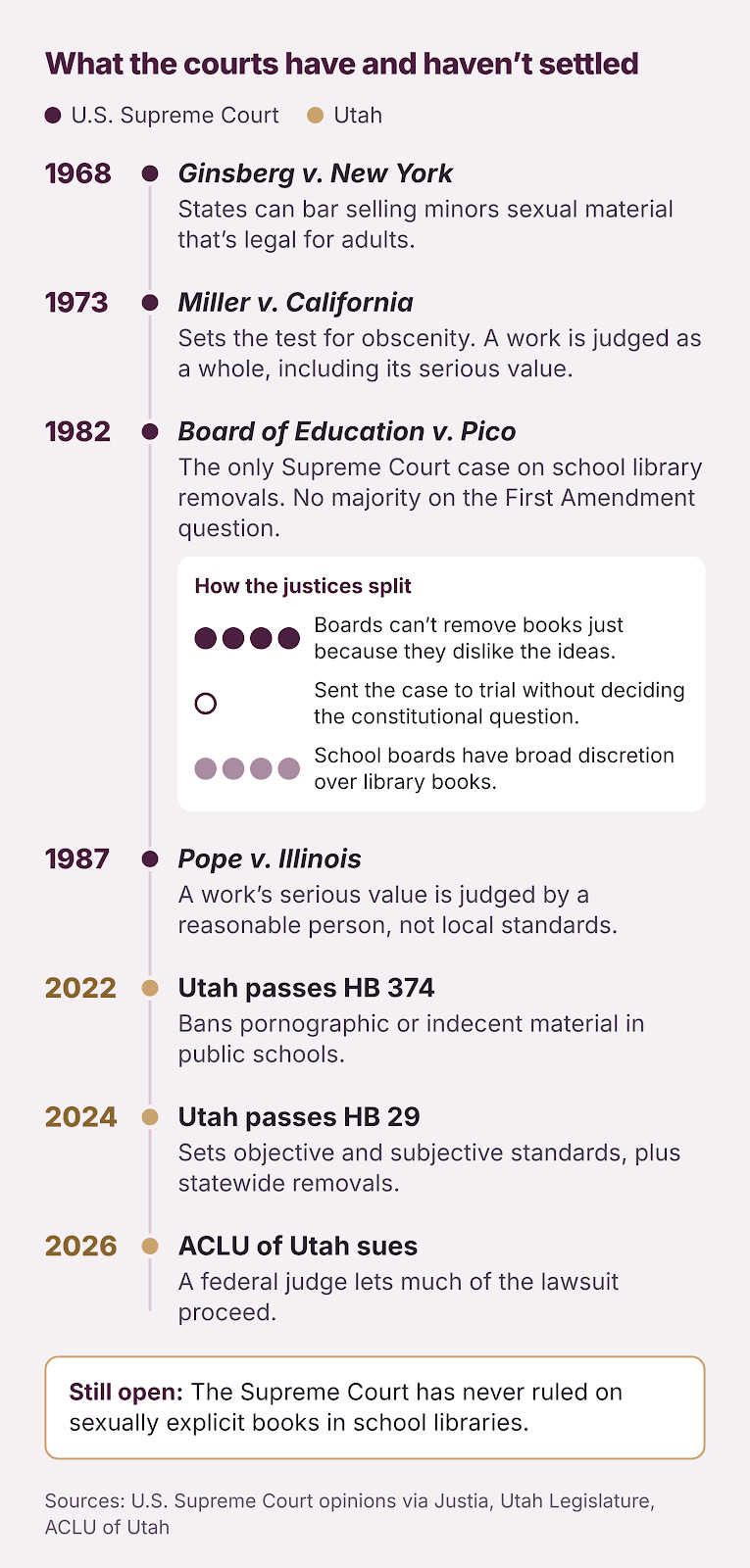
Even the Supreme Court hasn’t fully settled this question. In Board of Education v. Pico, the only school library book-removal case the Court has ever decided, the justices split 5-4 in deciding students could pursue a lawsuit challenging book removals. However, the justices were deeply divided over whether removing books from school libraries violated the First Amendment. The case produced seven separate opinions. Without a clear majority, the constitutional boundaries remain unsettled more than 40 years later.
Importantly, Pico wasn’t about legally obscene books. It dealt with whether schools could remove books because they objected to their ideas. The Supreme Court has never directly addressed how far schools can go in removing sexually explicit books from their libraries, or to what extent the First Amendment protects those materials in school settings.
All this legal ambiguity makes an already emotional debate even harder. Parents who support removing these books believe they’re protecting their children from harm. Those who oppose the removals believe they’re defending a fundamental freedom — the right to read, explore and exchange ideas, especially uncomfortable ones.
Both sides believe they’re protecting something sacred. In that respect, they’re both right.
For Utahns desperately trying to protect your children from inappropriate content, I’m with you. None of the books on the statewide removal list will be showing up in my children’s Christmas stockings this year. I’ve tried reading two of them and found them more explicit than even my adult sensibilities could handle.
But that doesn’t automatically make them pornographic or legally obscene. The Supreme Court has established specific legal standards for determining when sexually explicit material falls outside First Amendment protections, just not how those standards apply to school libraries.
For Utahns equally concerned about protecting freedom of expression, I’m with you, too. The First Amendment protects some of our most fundamental freedoms, including the right to express views that challenge the prevailing beliefs in our communities. And history gives us plenty of reasons to be cautious about government control over what children can read and learn. Look at Russia, where the government has rewritten school textbooks to justify its invasion of Ukraine. Students are now required to attend lessons promoting the government’s version of events, while teachers have been instructed to monitor students for signs of dissent.
I’m not suggesting Utah’s book restrictions are comparable to Russia’s political indoctrination. But Russia offers a stark reminder of why government authority over education needs constitutional limits.
A fair process can build trust on both sides
I think there’s more common ground between these opposing sides than this debate might suggest.
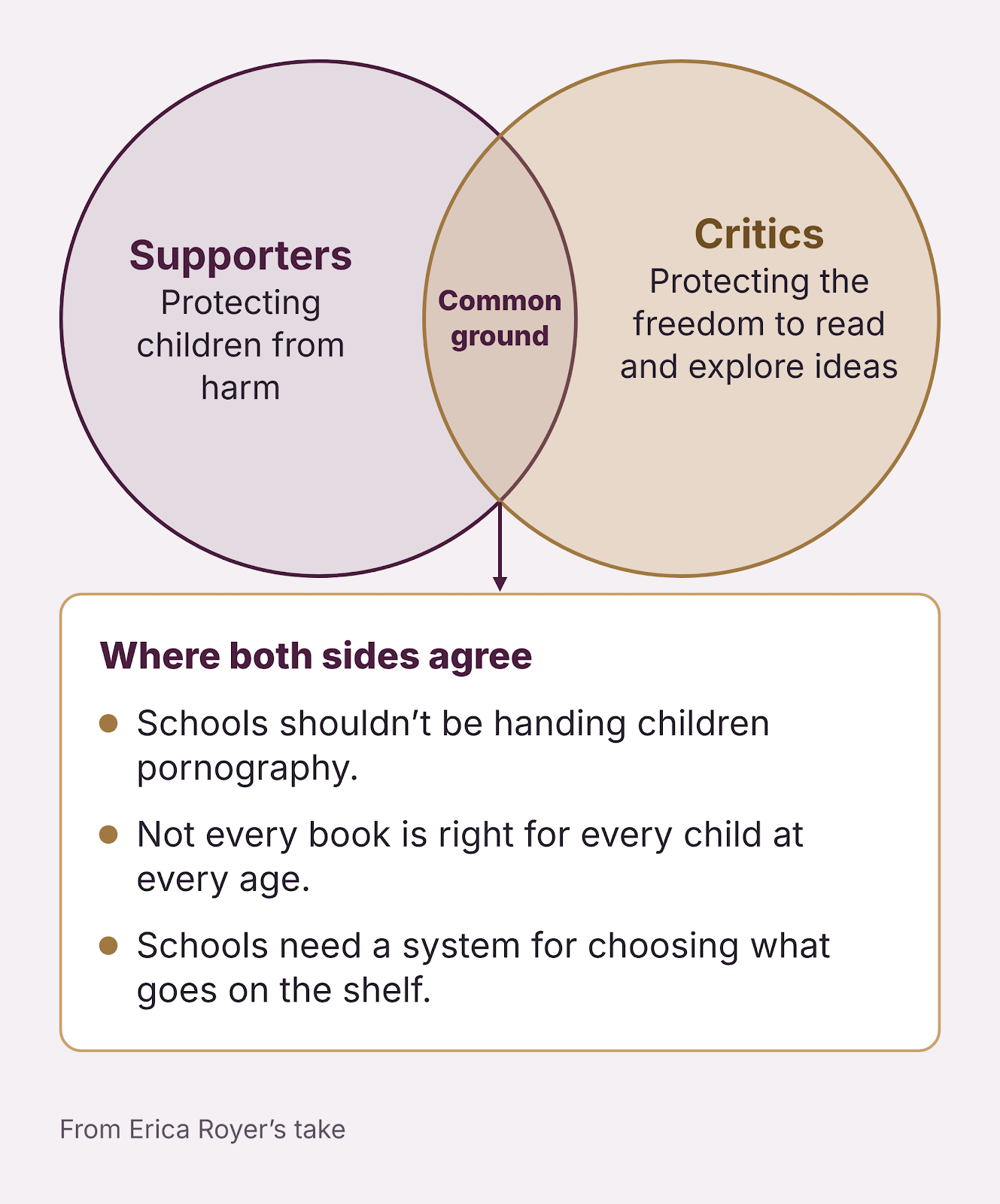
For starters, I don’t think anyone is arguing that schools should be handing children pornography. And most of us would probably agree that not every book is appropriate for every child, especially at every age.
We can also agree that schools need a system for deciding what belongs in their libraries. After all, no school library has room for every book. Schools have always had to make choices about which books to include and which to leave out.
But without a clear process for raising and reviewing concerns, those decisions can go wrong in either direction. Schools might dismiss legitimate complaints. Rep. Ivory told The Plum some parents came to him for help after their schools did just that. Or schools might be too quick to remove books, as when Canyons School District pulled nine titles without following its review policy in 2021, or when Washington County reportedly bypassed formal review procedures even after Utah established statewide requirements.
A good review process should give parents a meaningful way to challenge inappropriate books while placing clear constitutional limits on what schools can remove.
Such a policy would do four things:
Give parents a meaningful way to challenge books and ensure every challenge receives a fair review.
Establish clear constitutional limits on book removals, drawing on existing First Amendment precedents while recognizing that the Supreme Court has yet to fully define those protections in school libraries.
Require reviewers to consider every book as a whole, with committees that include librarians and qualified educators who can assess its literary, historical, and educational value.
Use age-appropriate restrictions for sexually explicit books that don’t meet the legal definition of obscenity. Such books would be excluded from elementary school libraries but could remain available to middle and high school students in restricted sections requiring parental permission.
How Utah’s restrictions stack up
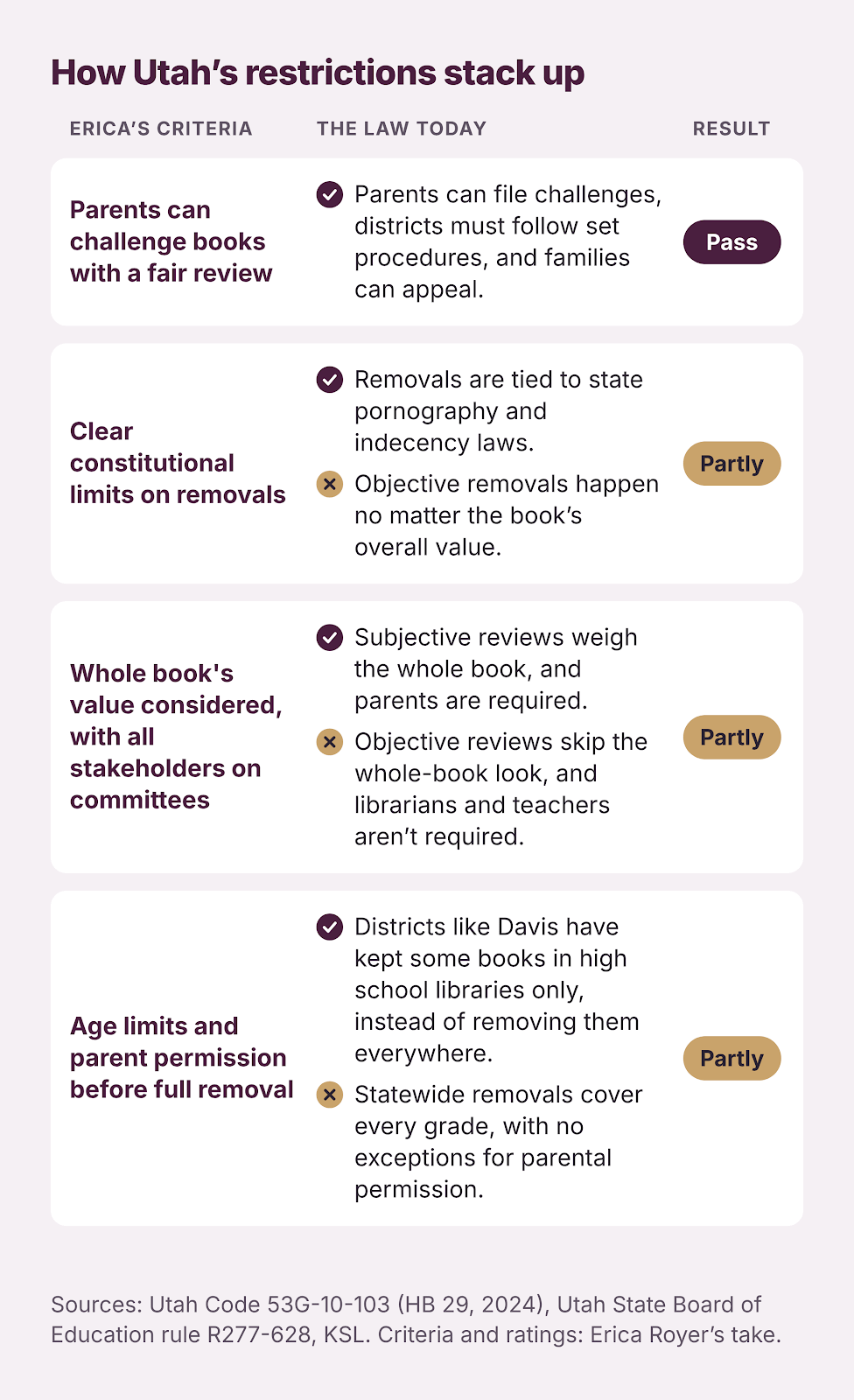
Utah’s laws already accomplish some of what I’d want from a fair review system. Parents have a formal way to challenge books, districts are required to follow established procedures, and families can appeal decisions they disagree with. Those are meaningful safeguards, even if they don’t always work as intended.
But I have concerns about how the state decides which books must go.
For starters, I think Utah has its review process backward. Under the objective standard, reviewers can remove a book based on specific sexual passages without considering its broader literary or educational value. Only if a book doesn’t qualify for removal under that standard does it move to a subjective review, where the entire work is considered. In effect, that second review becomes another opportunity to remove the book, rather than a safeguard against removing something worth keeping.
I’d reverse that approach. If reviewers find sexually explicit content, that should trigger a closer examination of the entire book that answers two questions:
Does the material serve a legitimate literary, historical, or educational purpose?
Is the book appropriate for older students, even if it isn’t suitable for younger ones?
There’s good reason to include ‘literary value’ as part of the review process. In its landmark 1973 decision, Miller v. California, the Supreme Court established that determining whether sexually explicit material is legally obscene requires considering the work as a whole, including whether it has serious literary, artistic, political, or scientific value. The Court hasn’t established that schools must apply the same test when removing books from their libraries. But I think the underlying principle matters: A book’s most explicit passages don’t necessarily tell us its full value.
I’d also like to see more emphasis on professional judgment. Utah requires parents to participate in reviews, which makes sense, but it doesn’t require every committee to include librarians or educators trained to evaluate literature. They deserve to be part of the solution, too. In Pope v. Illinois, the Supreme Court ruled that a work’s serious literary value, for purposes of the constitutional obscenity test, must be judged from a broader perspective, not according to the personal beliefs or preferences of a particular community. Again, that ruling wasn’t about school libraries, but the principle seems relevant.
Consider what happened to Fight Club in Davis School District. The objective and initial subjective review committees found no prohibited sensitive material, yet the latter recommended removal because it judged the novel to lack serious literary value. Let me repeat, the novel passed both the objective and subjective review stages, and still was removed because Davis School District deemed it of no value. Literary scholars have written extensively about the novel’s value as a critique of consumerism, masculinity, and the appeal of extremism. Whether it belongs in a school library is a separate question, but its literary merit shouldn’t be dismissed simply because local reviewers don’t recognize it.
None of this means every challenged book should stay on the shelves. I believe schools have a responsibility to protect children from inappropriate material, and sometimes removal is justified.
But they also have a responsibility to respect constitutional limits on government authority.
A fair review process should do more than make it possible to remove books. It should also make sure we’re removing them for the right reasons. What are we teaching students if we make removing books the normal response to objectionable content? Yes, we’d be protecting them from sexually explicit material. But would we also be teaching them to see government censorship as normal? And if they grow up believing it’s acceptable for government authorities to decide which ideas people can encounter, what’s to stop them from taking those restrictions even further as adults?
I don’t want schools handing children pornography. I also don’t want them teaching students that when something makes us uncomfortable, the answer is to make it disappear.
Protecting children and protecting freedom shouldn’t be competing goals. Our responsibility is to find a way to do both.
One more question before you go.
Think we got this one wrong? We want to hear how!
The sharpest reader responses may end up in a future article.