



The blue wave crashed into Utah and completely transformed the political landscape in ways that most Utahns are only just starting to comprehend.
Below are four significant impacts that I haven’t seen any other outlets cover. But first, a snapshot of where things stood as of 5:30 a.m. Thursday.
A snapshot of the current results
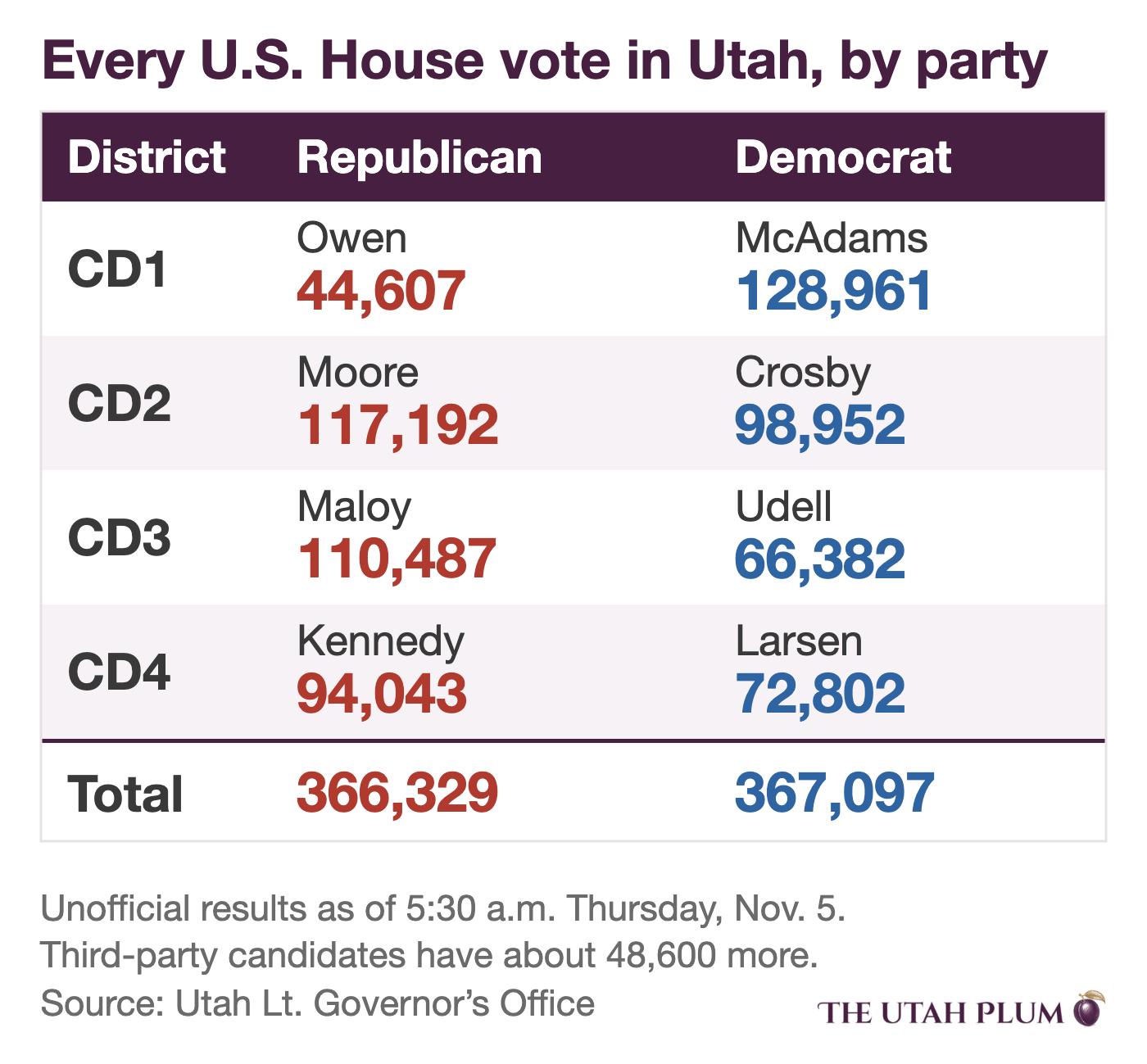
Ben McAdams (D) won Utah’s new 1st Congressional District, 128,961 votes to 44,607.
Republicans held the other three: Blake Moore by about 8 points, Mike Kennedy by about 12, and Celeste Maloy by more than 20.
Amendment B failed, 62% to 38%, after polling 50% to 21% in favor in early September (Turns out The Plum’s poll results were much closer than I thought).
Amendment A passed, 61% to 39%.
Utah House: Republicans lead in 46 of 75 seats, Democrats in 27, and unaffiliated candidates in 2. If these leads hold, it’s the first time they’ve fallen short of a House supermajority since 1992.
Utah Senate: Republicans hold or lead in 21 of 29 seats, one more than they need for a two-thirds supermajority. Democrats lead in two Republican-held seats, including Majority Leader Kirk Cullimore’s. A Republican now narrowly leads Forward Party Sen. Emily Buss.
These numbers are as of 5:30 a.m. Thursday, Nov. 5. Salt Lake County’s next update is expected Thursday evening, and all of it is unofficial until the state canvass on Nov. 23.
Now, onto the impacts.
Today’s Read
Research and writing: about 10 human hours
Reading time: about 7 minutes
Impact #1: Gov. Cox just got a lot more powerful
If you think Democrats were the biggest winners Tuesday night, you’re wrong. The biggest winner was Governor Cox.
Since his tenure began, a Cox veto has been more of a polite suggestion. In 2022 he vetoed a transgender sports bill, got praised and scorned in equal measure, and then the House and Senate immediately sent it back with a veto-proof majority. Since then, Cox has been more careful about using his veto power.
But that veto isn’t so frail anymore.
Next year, if Cox vetoes, House Republicans can only overcome it with help from their new Democratic colleagues. So legislation either needs to be bipartisan or have the governor’s buy-in to get passed.
And let’s not forget, Governor Cox has announced that he is not running for reelection. He’s in a self-imposed lame-duck term, which tends to breed much more brazen politicking. I’m very interested to see what he does now that he can push his own agenda during the legislative session, without worrying about a reelection bid or getting steamrolled by the supermajority.
Impact #2: The court’s map probably saved Republicans
Remember the court-ordered congressional maps that Republicans have fought tooth and nail to overturn, while Democrats have fought tooth and nail to protect them?
It turns out that if Republicans had gotten their maps, they probably would have lost two House seats to Democrats.
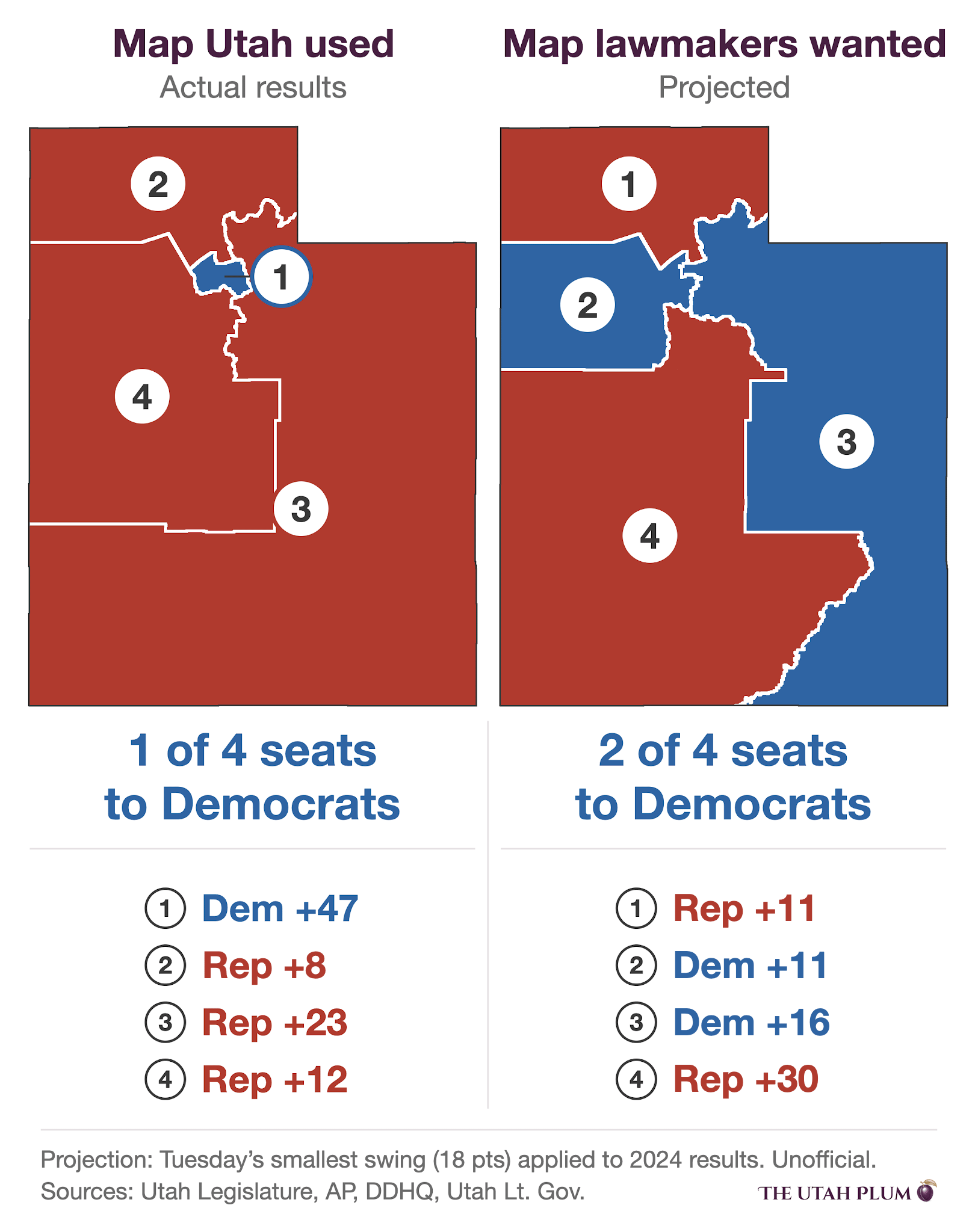
Compared with the 2024 presidential race, all four of Utah’s congressional districts swung toward Democrats on Tuesday, by about 18 to 23 points. The Legislature’s map had two districts Trump won narrowly: one by about 2 points and one by just under 7. Apply even the smallest swing we saw Tuesday, and Democrats win both, by roughly 16 and 11 points.
In hindsight, the best thing Democrats could have done would have been to roll over and accept the Republicans’ maps with a wink and a smile. Not that anyone could have predicted today’s outcome at the time.
Impact #3: Democrats could have won a statewide election had there been one
Looking at current numbers (which will change), Democrats’ U.S. House candidates edged out Republicans’ statewide, by about 800 votes. No Democrat has won a statewide race in Utah since Attorney General Jan Graham in 1996. If Senators Mike Lee, John Curtis, or Governor Cox had been up for reelection this year, they very well could have lost, and Utah would have a Democratic U.S. senator or governor (or both!) for the next 4 to 6 years.
This raises the question: Would Ben McAdams consider a bid for Senate or governor in 2028? The maps he just won under could still change if Republicans win their fight to overturn them, and Utah is guaranteed to redraw its maps again after the 2030 census. McAdams is no stranger to having his district redrawn against him. If the new maps are all red and sentiment toward Republicans is still poor, McAdams’ best move might be to abandon the House to take a shot at something with a little more political longevity.
Impact #4: The blue wave decimated Utah’s most bipartisan Republicans
BYU political scientist Adam Brown tracks how often each legislator sides with their party when most Republicans and most Democrats vote opposite ways. Among House Republicans on the ballot this year, the quarter who sided with Democrats most often in 2025 are trailing in 6 of 11 races. The most Republican-loyal quarter? Just 2 of 12.
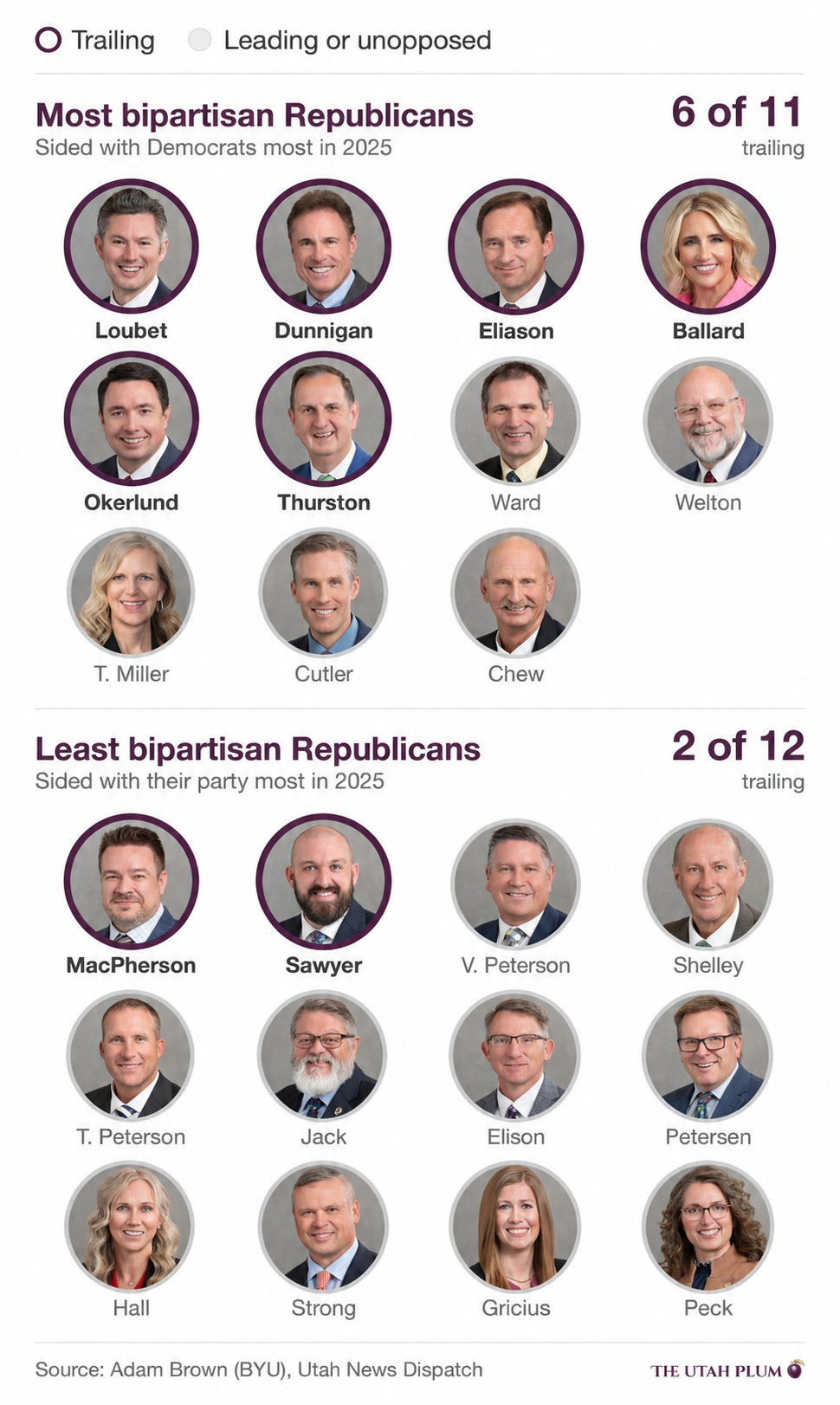
Rep. Anthony Loubet, one of the Legislature’s more moderate Republicans on social issues, trails Democrat Liz Oates 64% to 36%. Rep. Steve Eliason, most of whose bills have passed unanimously, including suicide-prevention laws he built with the state’s top gun-rights lobbyist, trails Democrat Ofa Matagi 56% to 44%. And Speaker Pro Tempore Jim Dunnigan, who voted against his party on the 2025 ban on public-union bargaining, on Amendment B and on the Legislature’s congressional map, trails Democrat Blake Townsend 55% to 45%.
These were some of the most collaborative and moderate Republican representatives in the Legislature. Waves like these hit the most competitive districts hardest, and the Republicans or Democrats who hold those seats have the most reason to work across the aisle. Depending on the political posture of the newly elected Democrats, the Legislature could be much more polarized next session.
Disclaimer: The count isn’t over. The supermajority could make a comeback.
Conventional wisdom in Utah has been that the first ballot drops containing mail-in votes typically lean more blue, while later ballot drops lean more red. And there are tens of thousands of ballots left to count in Utah and Davis counties, with Salt Lake County’s next update expected Thursday evening.
That matters because a lot of these races are razor thin. Democrats lead four House races by fewer than 600 votes. If Republicans swept all four, they’d be back at 50 seats and a supermajority. Going the other way, Democrats trail by fewer than 500 votes in eight more Republican-held seats. And in the Senate, Forward Party Sen. Emily Buss now trails Republican Brooks Benson by fewer than 200 votes. If she comes back, she’d be the first Forward Party member elected to a state legislature anywhere in the country.
The late count has been moving toward Republicans, though. Wednesday’s updates put two House seats back in Republican hands, and Democrats’ statewide lead in House votes is down to about 800.
Other impacts we’ll see
Citizen referendums are back on the table. With no two-thirds in the House, laws passed next session can be put to voters.
No more special sessions called by the Legislature, at least from the House side, once the new members are sworn in.
No more constitutional amendments without Democratic support.
My takeaway
Voters across the country have sent a very clear message that they are unhappy with the Republican Party, and it’s up to Republicans to figure out where to go from here.
Overall, I believe getting beat is good for both parties. Democrats had their moment of reckoning in 2024, and moved away from the messaging and policies that were losing at the ballot box. I think that it resulted in them focusing on more commonsense policies, and better candidates.
In Utah, our Republican-led Legislature has had quite a few humbling moments in the past few years. In 2018, Utahns passed three initiatives the Legislature didn’t like: medical cannabis, Medicaid expansion and independent redistricting. Lawmakers rewrote all three, and they’re still fighting over redistricting. In 2024, they lost court battle after court battle and even had two of their constitutional amendments voided from the ballot. In 2025 they were forced to repeal their own union bill because of a citizen referendum. Then they had their congressional maps thrown out, and their Senate president lost his primary over backlash to the Stratos data center.
And now, more than 60% of voters have rejected Amendment B, and House Republicans are on pace to lose their supermajority in the biggest swing the Utah House has seen in decades.
I don’t believe this week’s political drubbing was simply voters expressing displeasure with Donald Trump (although that was certainly a large part of it). Whether justified or not, voters have lost a lot of trust in Utah’s Republican-led Legislature and voted accordingly.
It’s up to what’s left of our elected Republicans to earn that trust back.
What to watch next
Friday’s leadership elections. Majority Leader Kirk Cullimore was running for Senate president against Sen. Evan Vickers. If his loss holds (and it looks like it will), Vickers is the clear favorite.
Sen. Kathleen Riebe. Senate Democrats have called on Riebe, one of their own, to resign over harassment and discrimination allegations. On Wednesday, she refused.
The canvass on Nov. 23. That’s when results become official, and when we’ll know for sure whether the House supermajority is gone.
The independents. Patrick Belmont, a Utah State University scientist running unaffiliated, leads Republican Rep. Jason Thompson in Cache County. He hasn’t said whether he’ll join either party’s caucus and has floated an “Integrity Caucus”. Sergio Sotelo, a union electrician, leads as an unaffiliated candidate in HD38.
The lame-duck window. The outgoing Legislature keeps its supermajority until Jan. 1. It can only call itself into a special session for an emergency. I’ll be interested to see whether they do.
Think I got this one wrong? I want to hear about it.
The sharpest reader responses may end up in a future article.
