


Quick question before you start. We’ll share the results in our next article.
Today’s Read – est. 20-minute reading time
Utah expects to need a lot more electricity. The harder question is where it will come from.
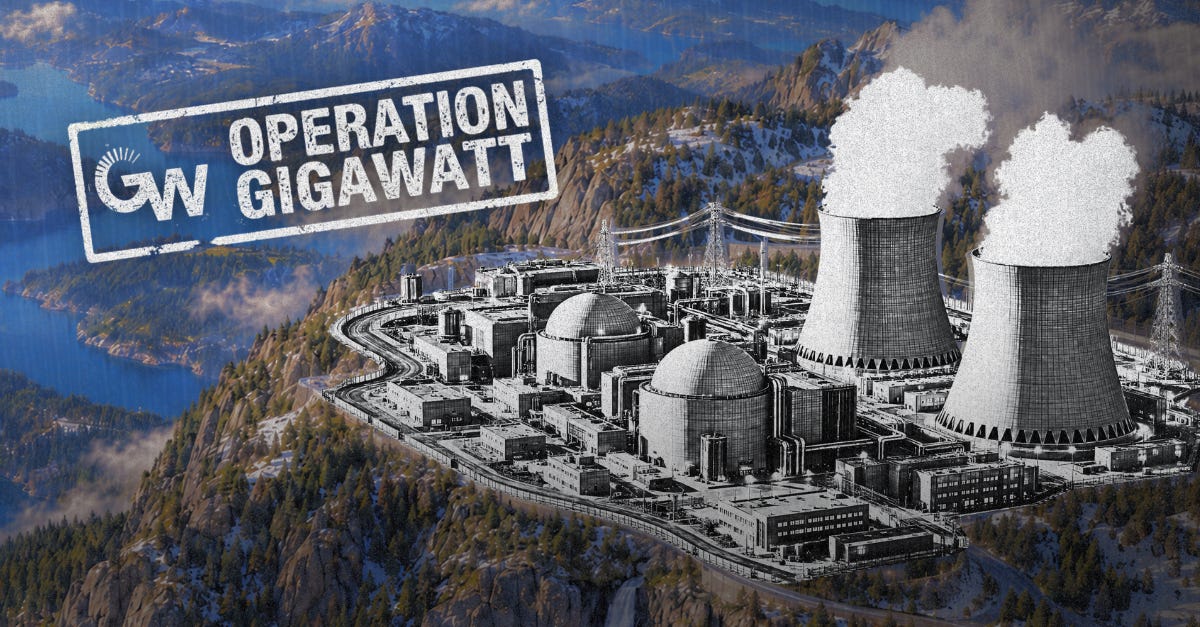
Gov. Spencer Cox’s answer is Operation Gigawatt, a plan announced in 2024 to double Utah’s power-generation capacity within 10 years by expanding nearly every available resource — natural gas, geothermal, storage, transmission and, increasingly, nuclear.
The nuclear piece is more than just one power plant. State leaders want to make Utah a nationwide hub for every part of the nuclear lifecycle, from mining and fuel production to energy generation, recycling, and waste management.
Cox has called the work of the past two years “only the beginning as we seek to become a central hub in the nuclear renaissance.”
Jeremy Pearson, director of the Utah Advanced Nuclear and Energy Institute, put the vision even more plainly: “A state that makes a bet on nuclear energy is a state that is making a bet on being an energy leader for the indefinite future.”
The demand behind Operation Gigawatt
Utah is planning for a power-hungry future. Population and business growth are pushing demand higher, electrification is adding new loads, and data centers can consume enormous amounts of electricity almost overnight.
A recent Utah legislative briefing estimated that planned data-center development could add roughly 2,600 megawatts of demand, a striking number in a state where average electricity demand was about 4,000 megawatts in 2025. At the same time, parts of the grid and generating fleet are aging, increasing the pressure to invest in new infrastructure even where existing plants may continue operating for years.
Gov. Cox sees the coming surge in electricity demand as both a problem to solve and an opportunity to seize.
National power use is climbing after more than a decade of relative stagnation, driven increasingly by data centers, AI, and new manufacturing. The U.S. Energy Information Administration expects electricity sales to set records in both 2026 and 2027 and continue growing for decades.
Utah is bracing for the same pressures, while state leaders argue that getting ahead of them could do more than prevent shortages. Cox has framed abundant energy as a way to attract industry, support national security and AI development, and make Utah a bigger player in the next wave of U.S. energy growth.
Utah’s nuclear strategy
Nuclear appeals to state leaders because it promises large amounts of around-the-clock, carbon-free power.
But there’s more.
Much of the advanced nuclear industry barely exists at commercial scale yet. Utah leaders see an opportunity to get in early and build the jobs, manufacturing, and investment around an industry they believe is poised to grow exponentially.
For now, though, Utah is still in the research and exploration phase, inviting proposals from across the industry — from small modular reactors (SMRs) and microreactors while leaving the door open to the large conventional reactors most people picture when they think of nuclear power.
In Green River, developers are trying to revive the long-stalled Blue Castle nuclear project using Holtec’s smaller SMR-300 reactors instead of the large reactors originally proposed there. TerraPower, a nuclear company founded by Bill Gates, has an agreement with the state to look for possible Utah sites for its Natrium reactor, an advanced design that uses liquid sodium and energy storage. Near Delta, EnergySolutions and the Intermountain Power Agency are studying whether advanced nuclear could eventually replace or supplement generation at the existing Intermountain Power Project.
Then there is San Rafael Energy Lab in Emery County, which is becoming Utah’s nuclear testing ground. Valar Atomics has already built Ward250 there, a tiny experimental gas-cooled reactor that reached criticality (a self-sustaining chain reaction) in June. It is not producing commercial electricity, instead it’s being used to test reactor physics, fuels, and equipment.
Several other companies are also working with the Utah Office of Energy Development and the San Rafael Energy Lab on nuclear research and development.
At the same time, the state is considering proposals to build the expertise and manufacturing capacity needed to support those reactors. In Brigham City, Holtec and Utah-based Hi Tech Solutions are pursuing a manufacturing and training hub for Holtec’s SMR-300 technology. The idea is not necessarily to build reactors in Brigham City, but to manufacture components and train workers who could help build and maintain future nuclear plants across Utah and the Mountain West. Utah universities and Idaho National Laboratory are also part of the state’s broader research and workforce push.
State government is expanding to match. Lawmakers have created a Nuclear Energy Consortium to bring industry, government, and researchers together, along with a Nuclear Energy Regulatory Office to build state expertise. Utah has also added financing tools, signed federal permitting agreements, and launched a $1.8 million marketing and outreach campaign around nuclear energy.
Officials are also exploring parts of the nuclear fuel cycle — the steps that happen before and after a reactor uses its fuel. Curio Solutions is looking at Millard County’s salt dome as a site for storing and recycling spent nuclear fuel. And Tooele County is on a shortlist to become the home for a federal Nuclear Lifecycle Innovation Campus that could potentially bring several pieces together in one place, including uranium enrichment, fuel fabrication, advanced reactors, recycling or reprocessing, manufacturing, and long-term management of nuclear waste.
While this is an audacious push into nuclear energy, almost all of this is still exploratory.
For now, much of Utah’s nuclear push is still taking shape. Most agreements are nonbinding memorandums of understanding, site studies, or early development plans, and the state is keeping its options open as it evaluates different technologies, locations, and business models. No commercial reactor is under construction yet, and officials have not settled on a preferred design, a target share of future electricity from nuclear, or a single master plan tying the various efforts together.
Utah’s broad approach could leave the state well positioned if advanced nuclear takes off. Keeping multiple technologies and projects in play gives decision-makers room to learn, adapt, and back the options that prove most viable. Making that strategy work, though, will require disciplined choices about financing, permitting, infrastructure, workforce, and which projects are worth carrying forward.
What opponents are saying
Utah is doing too much persuading and not enough listening.
Nuclear may pay off if electricity demand surges; if it doesn’t, the economics get shaky.
Utah could be managing high level nuclear waste — and its health consequences — for generations.
Dr. Danielle Endres, director of the Environmental Humanities Program at the University of Utah, says the state needs a clearer process for involving the public in its nuclear push.
“Initiating a PR campaign seems to have bypassed a public participation process about whether nuclear energy is what the people want in favor of a campaign to persuade them that it is right for the state. Although there is no one agreed upon definition, a key element of energy democracy is ensuring that citizens and energy users have a say in decision-making about energy extraction, production, use and waste management choices that affect them. As a representative democracy, the role of the government is not to spend tax dollars on a PR campaign, but to represent the views of its citizens. Furthermore, science communication research tells us that a deficit model of communication — one in which publics are viewed as empty vessels who merely need to be educated about the values of nuclear energy — rarely works.
“Instead, the state should create a robust process for Utahns to engage in a research-informed dialogue about our state’s energy future. A decision as significant as whether to move forward with nuclear energy deserves public input.”
Ted Goodell, the nuclear reactor facility director at the University of Utah is still on the fence about the viability of Utah’s all-out-push:
“Companies want to be the first ones with their foot in the Intermountain West,” he said. “They are ready to support a burgeoning nuclear industry out here. But if this AI bubble pops and a bunch of these big tech companies start to walk back from their massive data center ambitions, I think that could really be a nail in the coffin for a new nuclear industry in Utah.
“If the projected electricity demands really pan out, though, and we really do need several gigawatts more of extra base load capacity then it could be a really big deal for the state and the region in general. But are you familiar with the other nuclear projects that have been attempted in our region?”
After Utah was named one of five states under consideration for a federal Nuclear Lifecycle Innovation Campus, Lexi Tuddenham, executive director of HEAL Utah (Healthy Environment Alliance of Utah), raised concerns about potential long-term health effects.
“I can’t in good conscience say that we won this bid because it really feels like losing,” Tuddenham said. “The Utah office that led this said that they wanted and were willing to take both temporary and permanent high-level waste storage. So that means that it will be shipped from around the country. It will be shipped and buried here in our land forever. . . . And those issues have not been dealt with, nor have they been truly rolled out in a way that involves people who will be dealing with those health effects potentially for generations.”
What proponents are saying
The state will only move forward with projects that make sense for Utah.
Utah’s nuclear buildout could bring long-term economic growth.
Nuclear is a proven technology worth weighing seriously alongside other energy sources.
In an interview with The Utah Plum, Emy Lesofski, director of the Utah Office of Energy Development, said the state will only move forward with projects that make sense for Utah:
“If it’s not safe, we won’t do it, and if it’s not good for Utah, we won’t do it. Full stop. The nuclear industry has operated safely in the United States for decades. It has a really great security history, and if you look around the world, nuclear power is a safe, sustainable baseload power resource that has zero carbon emissions and is a fantastic energy resource. . .
“The reality of it is these things take time. They’re capital intensive. They’re permitting intensive, and they have a lot of things that have to happen in order to make them successful. So we’re really just at the beginning of the conversation, and it’s a really robust conversation. We’re excited about it because we think nuclear energy presents a ton of opportunities for Utah, for Utah families, for generational economic opportunity, for carbon-free power for the United States that’s baseload and sustainable. There’s a ton of opportunity, but this all takes a long time.”
Scott Cuthbertson founder and CEO of Alpen Associates and the former CEO of the Economic Development Corporation of Utah (EDCUtah), says the economic impact of Utah’s plan will transform the state.
“The economic impact is even more transformative. Building a small nuclear reactor industry in Utah would do far more than generate power — it would also drive lasting prosperity. A single reactor could bring billions in capital investment alone. Hi Tech Solutions’ broader plan to establish a full industry that includes workforce training and reactor manufacturing would create tens of thousands of high-paying, long-term jobs and attract tens of billions more in investment. In the process, it would strengthen the energy security that underpins Utah’s — and the Intermountain West’s — industrial and economic growth for generations to come.
“The nuclear conversation should no longer be defined by old fears or outdated narratives. Thanks to the governor’s leadership and bipartisan action, Utah is already laying the foundation for what comes next. With the right mix of innovation, experience and community partnership, we are transforming nuclear power from a point of debate into a defining driver of energy independence, industrial growth and shared prosperity for Utahns.”
Christopher Koopman, CEO of the Abundance Institute, respects Gov. Cox’s “clear respect for trade-offs rather than slogans.”
“Nuclear energy is not a speculative enterprise. It may have been 60 years ago, but it is now among the most established industrial technologies of the modern era. It has powered cities, industries and hospitals for decades, with a safety record that — measured over time and output — compares favorably to nearly every alternative. The countries that rely on it most heavily are not taking chances. They are making deliberate choices. . . Utah Gov. Spencer Cox has approached Utah’s energy future with an instinct that is increasingly uncommon: curiosity without alarm, ambition without theatrics and a clear respect for trade-offs rather than slogans. He has not treated nuclear energy as either a cure-all or a menace, but as one option among many that a serious state has an obligation to examine in a holistic energy conversation.”
My take
Nuclear could replace coal with reliable, clean power while preserving energy jobs in rural communities.
Nuclear financing often requires public risk-sharing, and Utah has tools that could expose taxpayers and ratepayers if projects run into trouble.
Utah should define those limits now — including how much consumers can absorb and what happens if multiple projects go over budget.
There is a lot about Utah’s nuclear push that I genuinely like.
We will eventually have to replace coal, and when we do, we need to think about more than megawatts. Communities in Carbon and Emery counties have built their economies around energy production for generations. Replacing those plants without replacing the jobs and economic base they support would be a failure. Nuclear offers the possibility of doing both: producing enormous amounts of reliable, clean electricity while keeping energy investment and high-paying jobs in communities that already know this industry.
And nuclear itself is exciting. It is one of the most reliable sources of electricity we have, capable of producing power around the clock without the air pollution and carbon emissions that come with fossil fuels.
I have also been struck by how consistently Utah energy officials talk about safety. Every official I have interviewed, heard speak, or received feedback from has emphasized that safety is nonnegotiable. That emphasis is beginning to show up in the state’s agreements and proposals, some of which call for upfront financial assurances to cover the consequences of accidents or other major failures. And despite some questionable choices in the state’s public-relations campaign — I still think comparing nuclear risk to bananas does the public a disservice — the Office of Energy Development appears genuinely interested in engaging with communities. Its town halls, in particular, are an encouraging start.
I want Utah to get this right. And that is precisely why the breadth of what the state is attempting makes me nervous.
Nuclear projects are notorious for long construction timelines and major cost overruns. Managing one is difficult enough. Utah has at least 13 nonbinding, nuclear-related memorandums of understanding (MOUs) in place, according to OED’s public partnership listings and separate announcements.
Those options span an extraordinary amount of the nuclear industry: power generation, fuel, manufacturing, research, workforce development, recycling, and waste infrastructure. If even a few of those efforts mature into major projects at the same time, each will bring its own financing, contracts, regulators, suppliers, and political pressure to keep going once money has been committed.
Recent history offers plenty of reasons to take that risk seriously.
In Georgia, the effort to build two new reactors at Plant Vogtle took roughly 15 years from the beginning of construction to the second reactor entering commercial operation and ended up costing $21 billion more than originally projected, with a substantial share of the costs ultimately borne by ratepayers.
South Carolina’s V.C. Summer expansion project never made it that far. Utilities abandoned two partially built reactors after spending billions, leaving customers paying costs associated with plants that never produced electricity. The collapse later led to criminal charges and prison sentences for executives accused of misleading regulators and investors about the project’s progress.
Patty Durand, founder of Georgians for Affordable Energy, argues that consumers in other states should take note.
“What does that have to do with the national push for nuclear energy underway now?” she writes in an op-ed for Utility Dive. “There is a strong belief among proponents that the next time will be different, that a learning curve exists from Georgia’s experience. Claims that Unit 4 (Vogtle’s second reactor) was cheaper to build, or that there was any meaningful learning curve, are not backed up by facts or documentation.”
Georgia Power, for its part, has said Unit 4 benefited from lessons learned during Unit 3, including faster completion of some testing. The larger point is that even after building two nearly identical reactors back to back, the project remained enormously expensive.
Utah does not have to look far for another cautionary example. Utah-based Associated Municipal Power Systems, or UAMPS, spent years pursuing NuScale’s proposed small modular reactor project in Idaho, only to see it canceled in 2023 after projected costs climbed dramatically and too few utilities committed to buy the power.
Federal taxpayers absorbed part of that failed experiment. The Department of Energy had committed substantial support, and its inspector general later concluded that critical risks were not adequately identified and managed before and throughout the project, contributing to escalating costs and putting federal money at greater risk.
This is not just a collection of unusually bad projects. The Nuclear Energy Agency (NEA), an international organization that studies nuclear energy policy and economics, identifies the underlying financing problem as one of the central challenges facing new nuclear construction.
Nuclear plants require enormous amounts of capital years before they begin generating revenue. Shifting some construction risk to governments or ratepayers can lower borrowing costs and make projects more affordable. In fact, the NEA argues that some nuclear construction risks are now too large for private investors to carry alone and that public-sector risk sharing will often be necessary.
But that creates another problem. The more developers and contractors are protected from losses, the weaker the pressure can become to control costs. Nuclear projects are further complicated by layers of companies and contractors making decisions with other people’s money.
A utility may hire a developer, which hires major contractors, which rely on dozens or hundreds of suppliers. If companies throughout that chain believe a project is too important to fail — and that government, utilities, or ratepayers will ultimately cover the difference when costs rise — overruns can become easier to tolerate. Economists call this a “soft budget constraint”: the expectation that a struggling project will be rescued rather than allowed to fail.
The NEA argues that cost control therefore has to be designed into the project from the beginning: clear milestones, carefully structured contracts, independent oversight, and meaningful consequences for poor performance. Without them, budget discipline can erode throughout the chain.
The frustrating part is that there is still no widely demonstrated modern formula for getting that balance right.
The NEA points to successful nuclear construction in the United Arab Emirates and earlier projects in Japan. But those examples come from very different models. Japan’s successful builds date back decades, while the UAE’s Barakah project began construction in 2012 under a highly centralized, state-backed system — far removed from the mix of private developers, utilities, and public support Utah is likely to rely on.
When it comes to more recent new construction in NEA member countries, the report is blunt. Investors are still waiting for an example of a new nuclear project completed both on time and on budget.
That context matters when considering Utah’s plans.
Utah says private developers should carry most of the financial risk for its nuclear buildout. That is a good principle. But private-sector risk only goes as deep as a company’s balance sheet, and not even the NEA believes it to be the most viable path.
Again, Vogtle and V.C. Summer are relevant case studies. Assigning risk to a private company is not the same as guaranteeing the public will never feel the consequences if the project fails.
Westinghouse, the reactor designer and lead contractor, had accepted substantial construction risk on both projects, including fixed-price commitments intended to protect utilities from rising costs. Then the losses overwhelmed the company. Westinghouse filed for bankruptcy in 2017, and the risk it was supposed to carry did not disappear. South Carolina abandoned V.C. Summer, and customers are still paying for it. Georgia kept Vogtle alive, but had to find ways to finance billions more.
Governments are already deeply involved in making nuclear projects financeable. At Vogtle, the federal government provided billions in loan guarantees, helping the owners borrow more cheaply. Washington is now pushing further, using federal loans, guarantees, and other support to reduce the cost of financing new reactors and absorb some of the risks private lenders are reluctant to take on.
Despite its stated preference for private-sector risk, Utah is also assembling its own toolbox for sharing some of it.
The state appears to be keeping multiple financing pathways open: one that leaves construction risk with private developers, and another that allows regulated utilities to recover qualifying nuclear investments via customer rates.
In 2024, lawmakers passed H.B. 241, folding nuclear power into a “clean energy” framework originally built for renewable resources. The change did more than reclassify nuclear. It opened a path for regulated utilities to recover qualifying nuclear development and construction costs from customers — including, with regulatory approval, some costs for projects that never make it into operation.
H.B. 241 also extended to nuclear an existing exemption for qualifying clean-energy projects of 300 megawatts or less. Those projects can bypass the standard advance-review process Utah uses for major utility investments. And if costs surge after construction is underway, projects below the threshold are exempt from the ordinary process that gives regulators a formal chance to reconsider whether the project still makes economic sense.
That is not a trivial distinction. Three hundred megawatts measures generating capacity, not financial exposure. A reactor below that threshold can still carry a multibillion-dollar price tag, especially if it is a first-of-a-kind design.
None of this guarantees that taxpayers or ratepayers will end up absorbing overruns.
However, the timing of H.B. 241 suggests lawmakers wanted customer-backed financing to be available as part of Utah’s nuclear toolkit. And it is worth noting that several of the private nuclear companies now pursuing projects in Utah are pitching reactors that fall within this 300-megawatt threshold.
To Utah’s credit, the state has already identified many of the economic safeguards the NEA recommends for managing risk in nuclear projects. So far, though, they appear largely as guiding principles rather than binding commitments.
In its proposal for a federal Nuclear Lifecycle Innovation Campus, Utah says private capital should provide most of the money and construction risk should remain with project companies and their contractors. It proposes milestone-based incentives, clawbacks when companies fail to deliver promised outcomes, caps and sunsets on public support, insurance and financial-assurance requirements, and audit rights. At the same time, the proposal calls federal grants, cost-sharing, and debt support a “critical catalyst” for reducing private-sector risk.
Clearly, Utah policymakers are preparing for a balancing act.
The public sector may need to absorb enough risk to make nuclear projects financeable without absorbing so much that the companies actually building them lose the incentive to control costs. One multibillion-dollar nuclear project is difficult enough to structure that way. Utah could find itself managing several versions of the same financing challenge at once.
The question then becomes not simply whether Utah is willing to stop a troubled project, but what it is willing to trade to keep one going.
Vogtle shows why those tradeoffs are easier to define before construction begins than after billions have already been spent.
Georgia regulators eventually capped the construction costs recoverable from customers at roughly $7.6 billion, leaving Georgia Power to absorb $2.6 billion of its expected project costs. But that limit came near the end of construction, after ratepayers had already spent years helping finance the project and billions were already committed.
That is the kind of situation Utah should be planning for now.
If costs balloon after billions have already been spent, continuing may mean higher electricity rates, greater taxpayer exposure, or additional government-backed financing. Money and political attention committed to keeping one project alive may then be unavailable for other energy projects or public priorities. And if several nuclear projects run into trouble at once, those tradeoffs could compound.
Some of those choices may ultimately be worth making. An overrun is not automatically proof that finishing a project is the wrong decision. A project that costs more than expected could still provide decades of reliable power and jobs that support families and communities.
But Utahns should know what bargain they are being asked to make — preferably before the state reaches the point where every available choice is outrageously expensive.
How much additional cost is acceptable to preserve a project already underway? How much should ratepayers absorb to keep financing affordable? How much public money should be committed before the state asks whether another technology could provide the same power more cheaply? And if several projects need help at once, which ones get protected?
Those are not questions Utah wants to answer for the first time when a reactor is halfway built.
They need to be addressed now.
BONUS: A closing argument from Tracy Rees, deputy director at the Utah Office of Energy Development
In an effort to be more transparent and fair with our articles, we’re trying something new. Letting the side that the author critiqued respond with a defense of their position.
Tracy Rees, Deputy Director at the Utah Office of Energy Development, was kind enough to write this response. We gave her full, unredacted access to Erica’s article before publication, so that she could push back or correct if Erica had misunderstood the issue.
Tracy’s unedited response is below. We asked her to keep it to under 500 words. We invite readers to consider her arguments, and let us know if you would like this to become a standard part of The Plum’s information format.
Deputy Director Tracy Rees’ response
Powering Utah’s future requires a modernized grid capable of delivering electricity whenever and wherever it is needed. Through Operation Gigawatt, we’re building that future today because we know major energy projects require long lead times and must navigate complex regulatory and permitting hurdles.
As we plan for an energy future that is as sustainable and clean as it is energy-abundant, we remain committed to our any-of-the-above energy mix. Energy diversity is one of Utah’s greatest strengths. Integrating civil nuclear power will deliver reliable carbon-free baseload energy while creating high-paying stable jobs in our local communities.
Adding nuclear power to our portfolio is guided by social and environmental responsibility and fiscal sense. Our bottom line is that if it isn’t safe for Utah, we won’t do it. If it doesn’t make sense for Utah, we won’t do it. We have a duty to provide resources and information to our communities so they can make informed decisions about whether or not nuclear makes sense for them.
Our nuclear education and community outreach campaign is grassroots: We start by working with local leaders and nonprofits to develop outreach events that bring information and subject matter expertise to address questions, and we deliver the event in a way that makes sense for that individual community. We’re going to every county in the state and all our tribal nations to provide resources and access because informed decision-making is good decision-making.
We recognize that not every community would want, or even be eligible for, a nuclear project, but all our citizens deserve good information and the chance to ask questions.
We are equally committed to protecting taxpayers and ratepayers from financial risk. Our state is widely known for post-performance incentives, meaning financial benefits are awarded only after a project delivers on its promise. Nuclear is no exception. We’re protecting residents through clear measures:
Expecting private capital to absorb significant financial risk.
Passing legislation to ensure financial flexibility while safeguarding state resources and establishing necessary oversight mechanisms such as cost recovery.
Enacting law to allow energy-intensive users to connect behind the meter with power generators, shielding ratepayers from increased costs.
Making it clear that Utah will ensure there are clawback provisions, spending caps, and financial assurance frameworks for the Nuclear Lifecycle Innovation Campus.
Taking the extra measure of requiring a financial assurance for Utah’s test reactor.
The steps outlined above clearly indicate that the state is continually making progress on placing financial responsibility where it belongs. Balancing risks and innovation is not new to Utah; we have a history of fiscal responsibility while also boasting one of the nation’s strongest economies. Nuclear technologies have become smaller, safer, and more water-friendly, and it’s those technologies Utah is specifically interested in adding to our energy mix.
The United States has safely harnessed civil nuclear power for decades. Utah is exploring next-generation nuclear technologies, which offer better cost controls through modular, scalable manufacturing and absolutely offer a zero-emission, water-wise, energy-dense foundation for Utah’s economic future.
Think we got this one wrong? We want to hear about it.
The sharpest reader responses may end up in a future article.
