


The DOJ is sending election monitors to Utah. Should that worry you? Or reassure you? Today we’ll tell you what state election officials, supporters, and critics are saying. Then, writer and editor Erica Royer’s take.
But first…
We’re looking for writers. And the best place to look is our readers. That’s you 🫵.
If you’d like to write for The Plum, email nick@theplum.org with a sample of something you’ve written. Any political orientation is welcome. We’re looking for logic, fairness, and careful research.
If we like your work, we’ll pay you a small fee to write a full test article. If that goes well, we’ll add you to our freelance bench to write Plum articles at fair rates with a byline. You’ll also get an inside look at how every Plum article is produced. Fair warning: each article takes about 15 to 20 hours of research and writing. So if you’re working a demanding full-time job, this might not be the gig for you.
Okay. On to the monitors.
Today’s Read
Research and writing: about 16 human hours
Reading time: about 12 minutes
Last week, Lt. Gov. Deidre Henderson posted on Threads that the Department of Justice is sending election monitors to Utah. At the time, she didn’t know where or how many. Later that day, DOJ Civil Rights Division Chief Harmeet Dhillon confirmed the news in an interview with KUTV. She didn’t identify which counties they would visit.
Henderson said the monitors must follow Utah’s poll-watching laws. They won’t carry weapons, approach voters, or interfere with voting. They’ll identify themselves to election workers but won’t wear badges identifying them to voters.
Utah isn’t alone. NPR reported Wednesday that counties in at least five other states had received notices. The DOJ says it’s prioritizing competitive elections and places required to provide voting materials in languages other than English.
What is an election monitor?
Election monitoring is a routine part of American elections. Political parties, candidates, advocacy groups, and ordinary citizens can all serve as poll watchers to help ensure elections are fair and the rules are followed. Some are there to protect voters’ rights, while others watch for procedural mistakes, document problems, or gather evidence that could be used in court.
After Georgia’s 2018 election, for example, a federal judge ordered additional review of provisional ballots in a case supported partly by evidence gathered through a civil rights group’s election-protection efforts.
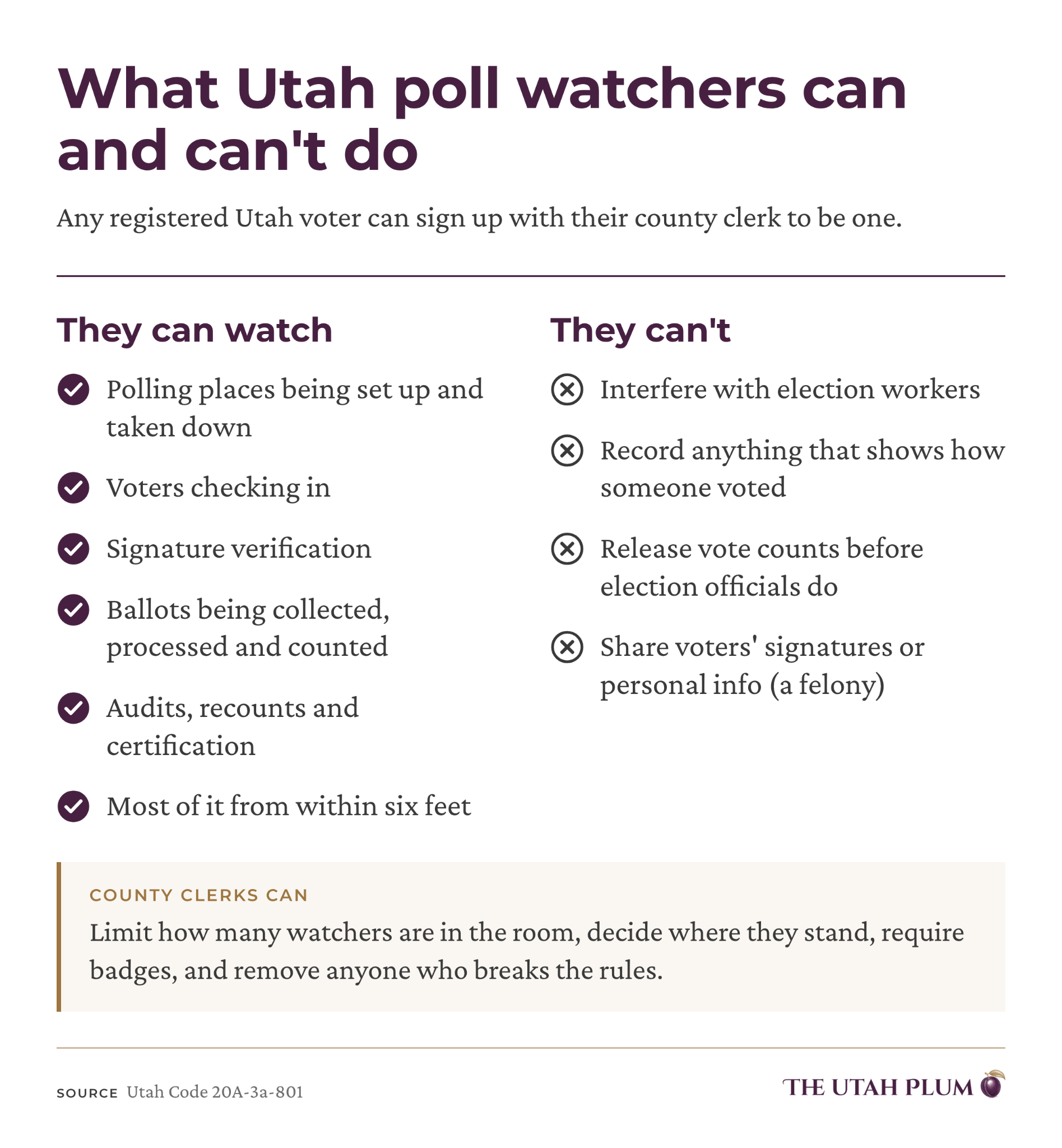
Utah law gives poll watchers a front-row seat to nearly every stage of an election. They can watch voters check in, observe how signatures are verified, and follow the ballots all the way through counting and certification. But watching is where their authority ends. They can't interfere with the process or compromise anyone's ballot secrecy, and county clerks can remove them if they break the rules.
DOJ election monitors have a more specific job: watching for violations of federal voting laws. Traditionally, they’ve been civil rights attorneys and legal support staff. This year, the department is also sending criminal prosecutors from U.S. Attorneys’ offices.
However, DOJ monitors don’t have special enforcement powers at polling places. They’re expected to follow the same rules as other poll watchers. They aren’t there to make arrests, handle ballots, or operate voting equipment.
Nevertheless, some civil rights organizations are preparing to monitor the federal monitors themselves.
Is this new?
DOJ election monitoring? No. The scale? Yes.
The DOJ has monitored elections since the 1960s, under both Republican and Democratic administrations. Utah’s San Juan County, which includes part of the Navajo Nation, had monitors in 2016, 2018, 2022, and 2024. The county has a long history of disputes over voting access for Navajo residents, including whether voters could get election information and assistance in their own language.
What’s different this year is the scale. The DOJ plans to send about 1,000 monitors across all 50 states in a nonpresidential election year. By comparison, Obama’s DOJ deployed around 780 monitors in 2012, about 250 in 2014, and roughly 500 in 2016. Biden sent at least 289 monitors in 2022.
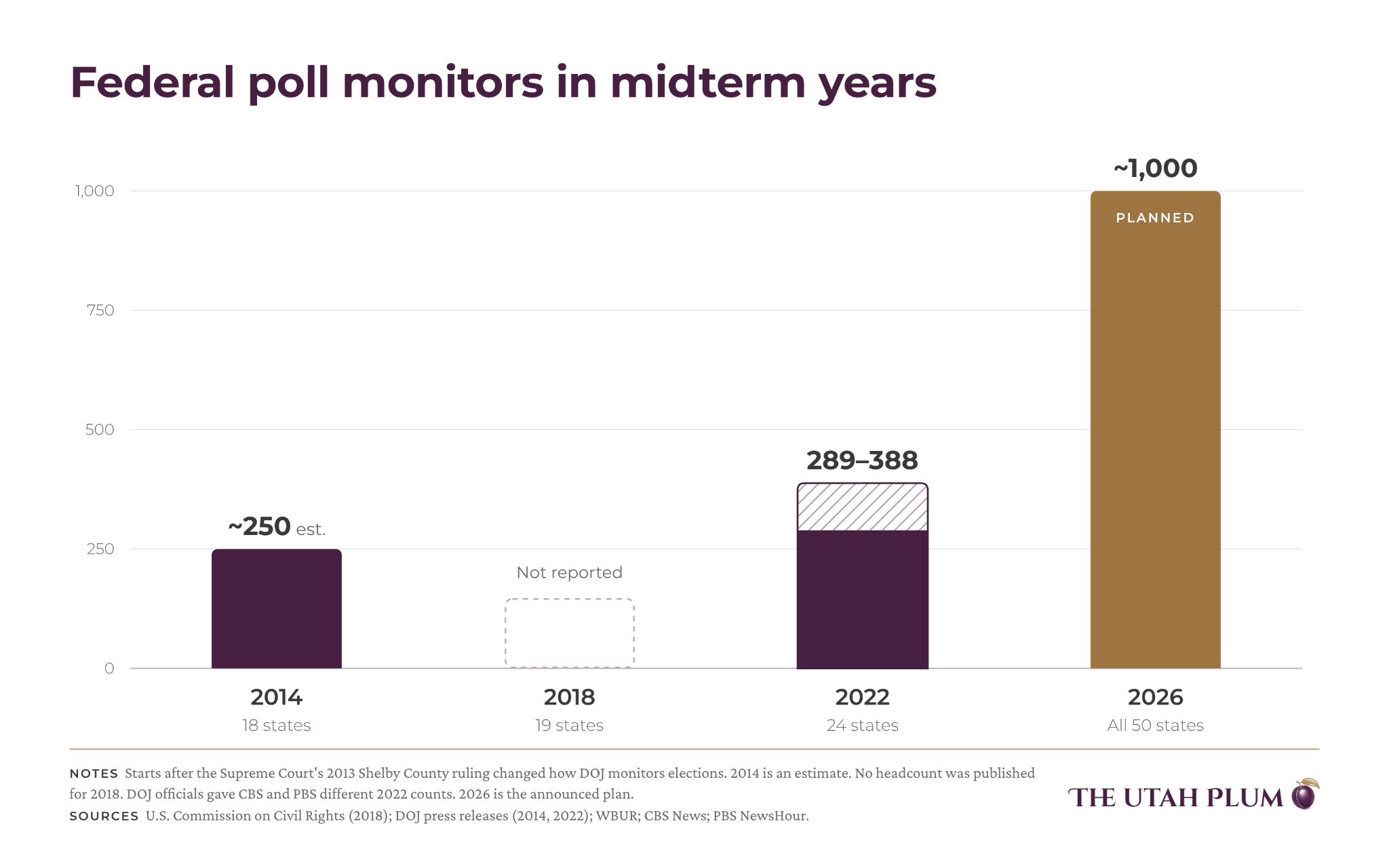
A thousand monitors is more than two and a half times Biden’s 2022 midterm total. And no previous administration has monitored elections in every state.
Meanwhile, the DOJ has spent the past year clashing with state election officials, including Henderson. In February, the department sued her after she refused to turn over Utah’s complete voter registration database.
In July, it warned Henderson that election officials who knowingly leave noncitizens on voter rolls could face criminal charges. In September, she learned she was under federal investigation, prompting Gov. Spencer Cox to condemn the investigation while Sen. Mike Lee defended the DOJ.
The tension escalated last week when Henderson told “60 Minutes” that threats to Utah’s elections now also come “from within our own [federal] government.” Four days later, she received notice that federal election monitors were coming to Utah.
What is the DOJ’s justification?
The DOJ says it’s routine election oversight, not retaliation against Henderson.
In her interview with KUTV about the monitors, Dhillon said they would watch for violations of federal election laws, including requirements that polling places be accessible to voters with disabilities.
Historically, federal monitors have focused on protecting voters from discrimination and ensuring everyone has access to the ballot. This year, the DOJ is also emphasizing election fraud, particularly voting by noncitizens.
And the monitors aren’t necessarily just watching for problems that can be fixed on Election Day. A senior DOJ official told Reuters that their reports could contribute to investigations after the election.
That raises questions given the DOJ’s investigation of Henderson and its recent legal defeat over Utah’s voter records. But there’s no public evidence that the monitors are coming to Utah because of those disputes or that the department plans to challenge Utah’s election results.
What Utah election officials are saying
Salt Lake County expects routine oversight, with DOJ monitors following the same rules as other observers.
San Juan County is accustomed to election monitors from the DOJ and other organizations.
Utah’s lieutenant governor welcomes additional scrutiny.
Salt Lake County Clerk Lannie Chapman told The Utah Plum she expects this year’s monitoring to look much like previous years.
“They’ve always monitored me because we are under Section 203, and anytime that you’re under a federal election law, they have the duty to ensure that we are complying, and that’s what they’re doing. I’m going to take them at face value and assume that that’s why they’re actually coming in person. …
“I will treat them like any other observer. They are not allowed any special access to anything other than what is allowed and required by state and federal law of what they can observe, how they can observe, what they can do, but more importantly, what they cannot do. They cannot interfere. They cannot intimidate either voters or my poll workers. So I’ll be working closely with them to ensure that they’re able to see everything they need to see to be able to check off that in fact Salt Lake County runs amazing elections, but at the same time, also making sure that all of our voters do not feel intimidated and have meaningful access to cast their vote this November.”
Lyman Duncan, San Juan County clerk, told The Plum that monitoring in this election isn’t likely to be different from any other.
“It’s a normal operation that we have here in San Juan County. We’ve always had DOJ and ACLU and other organizations oversight — Navajo Nations, Human Rights — they’ll have poll watchers. So we’re fairly used to it. Our staff and election workers are prepared for it, and generally, it runs real well.”
Lt. Gov. Deidre Henderson said DOJ monitoring is normal and any problems monitors uncover will be investigated and corrected where possible.
“We’re not really sure what to expect, except that they did give us some assurances that I think are good. They won’t be approaching voters. They won’t be wearing any sort of insignia. They have said that they will give us any feedback after the election is over on any challenges or issues that they saw. So I think things will be pretty normal. I want to make sure voters are calm and know that things are going to be OK. …
“I welcome any kind of scrutiny that the administration wants to give to the state of Utah. I am confident in our processes, and you know what? If they uncover some sort of problem, if we’re violating someone’s civil rights in some way, I absolutely want to know about it. We rely on people to tell us when there are problems. We can’t be everywhere in the state. So, if any problems are found, we absolutely will be grateful for that information and look into it and correct it if we can.”
What supporters of DOJ monitors are saying
Election monitoring is a routine safeguard that shouldn’t be controversial as long as observers don’t interfere with voting.
The monitors are not retaliation against Lt. Gov. Henderson. The DOJ is enforcing election laws consistently across red and blue states.
Federal monitors are there to report potential violations for review after Election Day.
Rob Axson, Utah Republican Party chair, told FOX 13 News that observation is an ordinary safeguard that shouldn’t be controversial as long as nobody interferes.
“I have no concerns because we have a very vibrant and history and process of transparent elections in this country.
“The DOJ being here is no different than political organization Y and concerned citizen X that is also there, as long as no one’s interfering with the process.”
Harmeet Dhillon, assistant U.S. attorney general, denied any connection between the deployment and Henderson’s dispute with the DOJ.
“We actually don’t have any ongoing tension with Lieutenant Governor. She seems to think she’s being picked on, but I’ve sued every state that didn’t give us the voter rolls. There’s nothing special about Utah or about your lieutenant governor. It’s our job to administer the election laws, and we’re doing that evenly throughout the United States. And I’ve also sued other red states, West Virginia, Georgia, some others, and as well as many Democrat jurisdictions.”
DOJ spokesperson Kiersten Pels stressed that federal election monitors will not be interfering on Election Day.
“All monitors must meet the same legal and ethical requirements, including that they not interfere with the voting process. … Every monitor has the same role: observe for potential violations of federal law and report concerns to the Department, which the Department will review after Election Day and act where appropriate.”
What critics of the DOJ monitors are saying
They raise concerns about voter intimidation and efforts to undermine confidence in elections.
The administration may have ulterior motives. Monitors could be used for election interference or political retaliation against Lt. Gov. Henderson.
Elections should remain under state rather than federal control.
In a statement on its website, the Utah Democratic Party criticized the DOJ’s decision to send election monitors to Utah as an overreach by the Trump administration.
“For years, Donald Trump and his allies have attacked election officials, spread baseless conspiracy theories about voter fraud, and tried to convince Americans that elections are rigged whenever Republicans lose. Now, the Trump administration is escalating its involvement in elections by deploying federal monitors to polling places across the country, including Utah.
“Utahns should never have to walk into a polling place wondering whether their own government is there to protect their rights or undermine them. Our elections belong to the people who participate in them, not politicians looking for new ways to cast doubt on the results.”
In a statement, Forward Party of Utah Chair Michelle Quist said she wouldn’t be surprised if the Trump administration had ulterior motives for sending election monitors to Utah.
“President Trump and the national Republican Party have given Utahns ample reason to question their intentions when it comes to elections. If this is election interference dressed up as oversight, we will oppose it,” Quist wrote to Fox 13 News.
“If it is political retaliation against a Republican official for refusing to fall in line, we will oppose that, too. Neither motive would surprise us. Our democracy is in serious trouble when protecting voters can put an election official at odds with her own party. A two-party system that rewards loyalty over principle invites exactly this kind of pressure.”
Barry Short, chair of the Utah Libertarian Party, said his party opposes “the very idea of federal election monitors.”
“Elections are the responsibility of the state, not the federal government. When it comes to election integrity, the answer is fifty different systems, not one top-down system. If someone wanted to tamper with elections, there is nothing they would want more than having one central administration over all elections. It’s LOT harder to tamper with 50 systems than it is to tamper with ONE.”
My Take
Some DOJ hiring decisions raise fair questions about impartiality.
I’m less worried after looking into it. Federal monitors have limited authority, and only 12 are expected in Utah.
I trust Henderson’s assessment. She welcomes the scrutiny and expects Election Day to proceed normally. So do I.
When I first heard the news that election monitors were coming to Utah, I pictured carbon copies of Will Smith and Tommy Lee Jones from Men in Black descending on every major polling place in Utah.
The administration has given voters plenty of reasons to wonder what’s coming next. In the past year they’ve:
Refused to fully rule out immigration enforcement at polling places, though DHS says it has no plans for it
Repeatedly asked the Supreme Court to intervene in last-minute disputes over mail-in ballot rules
Offered a $1 million reward for tips that lead to voter fraud convictions. I’m half-tempted to commit voter fraud, then tip off the authorities.
But the more I’ve read about what these monitors can actually do, the less worried I’ve become about what Election Day will look like in Utah.
Utah law is pretty explicit here. Poll monitors can’t get in the way of election workers, disrupt voting, or compromise anyone’s ballot secrecy.
The DOJ has emphasized that its monitors will follow state laws and won’t interfere with voting. They won’t approach voters or carry weapons — concealed or otherwise. In other words, most voters probably won’t even know they’re there.
My guess is that Nov. 3, 2026, will run more or less like any other Election Day in recent Utah history.
Still, a few of the DOJ’s personnel choices have given me pause.
The most troubling example is David Michael Levin, a Florida attorney who pleaded guilty after illegally accessing government election websites. Records identified him as part of the DOJ’s 2026 election monitoring operation in Arizona. If pleading guilty to improper election conduct isn’t disqualifying to be an election monitor, what is?
Other monitors have histories that aren’t exactly impartial. Joseph Voiland, who monitored Virginia’s primary in Fairfax County, was a lawyer for the Trump campaign in its bid to overturn Wisconsin’s 2020 results. At least two other monitors also worked on 2020 election challenges.
I don’t find it surprising that Trump would hire attorneys who represented him or his allies. And if he genuinely believes the 2020 election was stolen, I can understand why he’d want closer scrutiny of future elections. But I hope the other 996 election monitors are a little more neutral. I’d feel better about the DOJ’s oversight knowing its monitors were approaching the election with open minds rather than looking for evidence to confirm what they’ve been previously paid to argue in court.
Even with some less-than-ideal monitors, I find the practical details of DOJ monitors in Utah much less alarming.
Henderson says the DOJ is sending 12 election monitors to six or seven locations in Salt Lake County.
And the DOJ’s monitors won’t be the only ones on Election Day. According to the Associated Press, tens of thousands of volunteers from political parties and voting-rights organizations are preparing to observe elections nationwide, including some who plan to watch the federal monitors themselves. There’s something reassuring about knowing that no single group gets to be the only set of eyes on an election.
Lt. Gov. Henderson isn’t worried about what the monitors will find. After listening to her press conference, I felt considerably better.
“We have open processes,” she said. “The public can go watch any of these processes … I welcome that. I welcome people examining. What I don’t welcome is any kind of interference.”
I love that welcoming, collaborative attitude. The more people watching, the more reason everyone involved, from federal monitors to local election officials, has to be on their best behavior.
What I expect on Election Day
In 2024, I took my dad to vote in person. He’d recently moved to Utah, and we needed some help sorting out his registration. The polling place was packed, with voters coming and going and election workers trying to keep everything moving. We had questions, but the workers were patient and helpful, and we got everything straightened out. Between navigating the crowd and making sure my dad could cast his ballot, I barely noticed anything else going on around us.
For all I know, a federal monitor could have been standing six feet away, and I wouldn’t have noticed — at least not without the dark glasses and mysterious earpieces, à la Men in Black.
I suspect that’s how this Election Day will go for most Utahns: We’ll show up, cast our ballots, and go about our day.
Which is exactly how it should be.
One more question before you go.
Think we got this one wrong? We want to hear how!
The sharpest reader responses may end up in a future article.
